
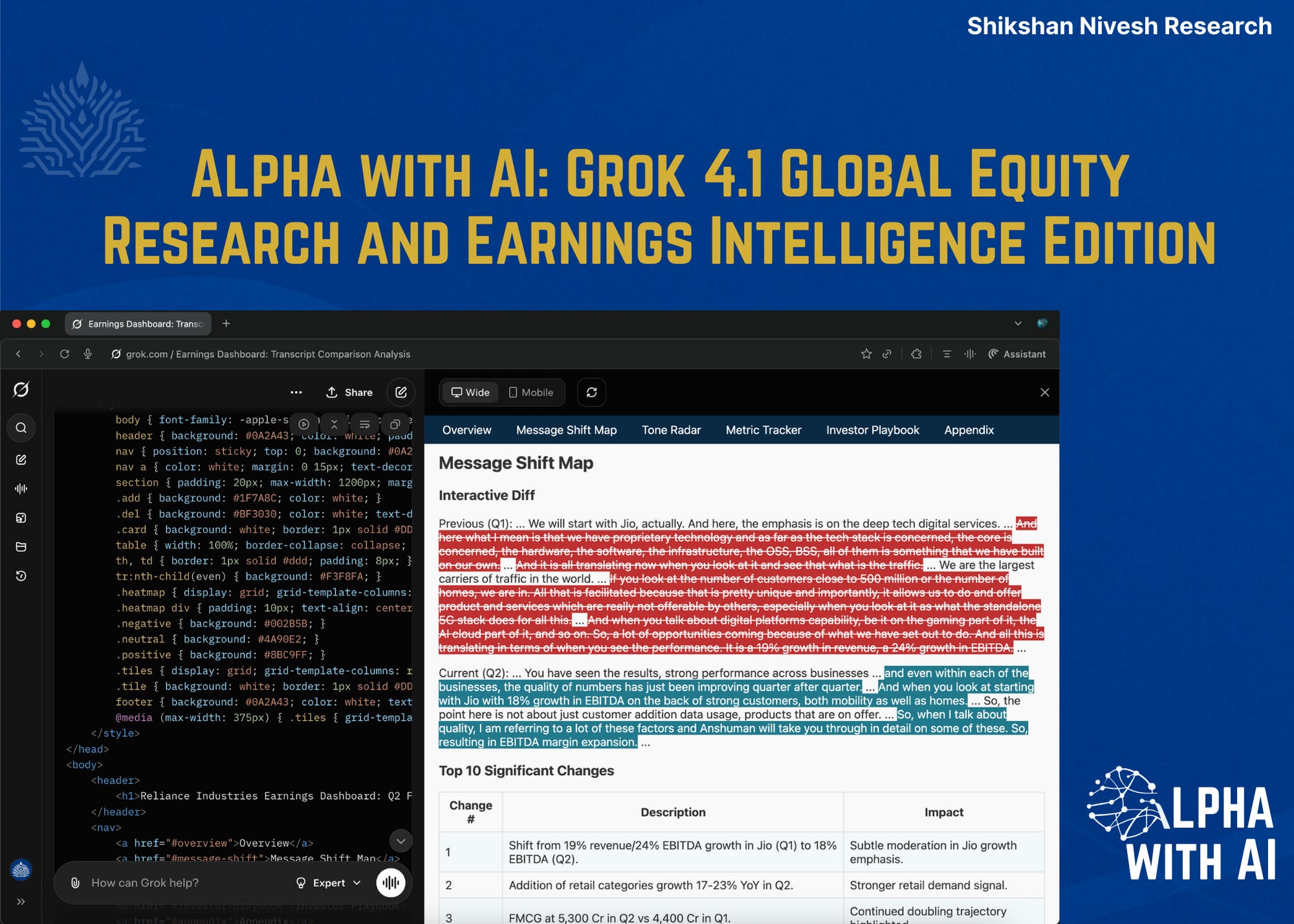
Grok 4.1 Global Equity Research and Earnings Intelligence Edition
Learn how Grok 4.1 builds global equity research reports and converts earnings calls into dashboards with two powerful prompts for analysts and investors.
Hi everyone,
This edition introduces two of the strongest global workflows we have built so far using Grok 4.1.
Both are universal.
Both work for India, US, Europe, APAC or any listed company.
Both are designed for analysts, PMs, advisors, students and anyone who relies on deep fundamental analysis.
What is inside this newsletter
You will receive:
Global Equity Research Coverage Prompt
Global Earnings Call Tone Shift Dashboard Prompt
Reference post and output from our Krsnaa Diagnostics test
Interpretation guidelines for both workflows
Market use cases
Access instructions
This edition is focused on one idea:
AI can now support end to end research workflows at a level that analysts can actually use.
1. Global Equity Research Coverage Prompt
A full scale research prompt that produces a complete, structured coverage style report for any global company.


Built for both emerging markets and developed markets.
The prompt covers:
Key data snapshot
Thesis
Drivers
Operating assumptions
Peer comparison
Valuation
Risks
Clean appendix structure
During our test with Krsnaa Diagnostics, Grok 4.1 produced a report with reasoning, sector alignment and clarity that felt far beyond typical LLM outputs.
This prompt works for any country and any market. You can specify the research house style you want, for example Goldman Sachs or Morgan Stanley or Citi. The structure adjusts automatically.
It works the same for Nvidia, Tesla, Adani Ports, Toyota, ASML, Reliance, Samsung, or any global listed company.
Required Inputs
To run this prompt, users must provide four inputs:
Company name
Ticker
Exchange
Country
Preferred research house style
(For example: Goldman Sachs or Morgan Stanley or Citi or UBS)
The prompt will reconstruct the entire report around these inputs.
This has become our base workflow for analysts who want to test coverage frameworks across markets.
2. Global Earnings Call Tone Shift Dashboard Prompt
This is the second workflow.
In many ways, it is even more powerful.
The prompt reads two earnings call transcripts and builds a fully responsive HTML dashboard that highlights:
Tone shifts
Guidance changes
Confidence vs caution
Operational commentary
Financial signals
Additions and deletions across quarters
Sentiment heatmaps
Q and A surprises
Capital allocation language
Positives and red flags that could move the stock
The dashboard is structured for institutional use:
Key components
• Message Shift Map
Interactive diff showing what management added, removed or softened between quarters.
• Six Panel Executive Summary
Macro Pulse
Demand Outlook
Margins
Guidance Tone
Q and A Surprises
Capital Allocation
• Tone and Intent Radar
Plotly based sentiment heatmap for each speaker block.
• Metric Tracker
Extracts all financial and operational metrics
Revenue, margins, volumes, AUM, NIM, PLF, backlog, capex, cash, debt
Flags metrics with five percent or more movement
Marks missing numbers as N A automatically
• Investor Playbook
A short note on what matters next for the stock.
• Full HTML export
Responsive, clean blue toned layout
Sticky navigation
Cards, highlights, and section anchors
Footer tagging as “Generated by Grok Studio”
Why this matters
Earnings calls are where management reveals intent.
But the signals are subtle.
Language, tone, omissions, guidance shifts.
This prompt gives you:
Real quarter vs quarter comparison
The exact sections where tone changed
Operational signals for near term stock impact
A dashboard you can store, compare or share
This is one of the strongest management insight tools we have built.
Reference Demo
We tested both workflows this week to understand how far Grok 4.1 can be pushed in real research scenarios.
Equity Research Demo: Krsnaa Diagnostics
Output Results: View
Earnings Call Tone Shift Demo: Reliance Industries
Output Results: View
How to Use These Workflows
Both prompts are global.
They work for:
NASDAQ
NYSE
LSE
HKEX
SGX
NSE or BSE
Tokyo
Frankfurt
Any earnings call transcript in PDF, DOC or TXT
For the equity research prompt, enter:
<Company_Name> (example: Nvidia or Reliance or Toyota)
<Exchange> (example: NASDAQ or NSE or HKEX or LSE)
Add Country
Preferred bank style
This ensures the model produces a complete, globally structured coverage report in the chosen style.
For the Global Earnings Call Tone Shift Dashboard prompt, enter:
the prompt.
Upload the two transcripts.
Add the company name inside Prompt.
Grok handles the rest.
Execution time: 2 to 5 minutes depending on transcript length.
Our 3 Tool Data Integrity Workflow for Institutional Accuracy
One reason our outputs were so strong this week is that we did not rely on one tool to do everything.
Most people use AI incorrectly. They ask a single model to read filings, fetch data, interpret numbers and build analysis. That is how inconsistencies appear.
Our workflow follows one core rule.
Data integrity first. Synthesis second.
Here is the system we used:
Step 1: NotebookLM
We uploaded the full annual report into NotebookLM to extract clean, grounded insights.
No hallucinations.
No invented trends.
Just facts distilled from the source document.
Step 2: Perplexity Finance
We downloaded the official P and L, balance sheet and cash flow statements as verified CSVs.
These came directly from filings, not scraped tables.
This gave us the clean numeric backbone needed for forecasting.
Step 3: Groq (Grok 4.1)
We fed Grok all three financial statements plus the NotebookLM summary, along with our structured prompt.
Grok handled the synthesis: the report, the layouts, the reasoning, the cross links and the valuation logic.
Because the inputs were verified, the output became significantly more accurate and aligned with institutional standards.
Why this workflow works
• Each tool does what it is best at
• Data extraction stays separate from analysis
• Grok only builds on verified inputs
• No hallucinated numbers
• No mismatched totals
• Clean, auditable outputs every time
This is now our default research stack at Shikshan Nivesh.
Why This Edition Matters
Both workflows compress days of work into minutes:
Research report drafting
Competitive mapping
Valuation layout
Tone and language analysis
Management signals
Early green shoots
Red flags
These are tasks analysts repeat every quarter.
Now they are automated, structured and exportable.
The goal is not to replace judgment.
The goal is to accelerate discovery.
Access the Prompts
Below are the exact prompts used.
Prompt 1: Global Equity Research Coverage Prompt
You are a senior global equity research analyst initiating full coverage on <COMPANY_NAME> (<TICKER>) listed on <EXCHANGE> in <COUNTRY>.
Your objective is to produce a decision ready Initiation of Coverage report written in the tone and structure of a top tier investment bank.
The user may specify the preferred house style (Goldman Sachs, Morgan Stanley, Citi, JPMorgan, UBS, HSBC, or a generic global sell side format).
====================================================================
=== CRITICAL DATA INTEGRITY RULES ===
====================================================================
You must treat the uploaded documents as the primary source of truth.
These include:
1. The full Profit and Loss statement file
2. The Balance Sheet file
3. The Cash Flow statement file
4. The NotebookLM generated analysis of the company’s annual report
Hierarchy of data usage.
• First priority: numbers and commentary extracted directly from the uploaded financial statements.
• Second priority: qualitative insights from the NotebookLM annual report summary.
• Third priority: only if a number is missing from all uploaded data, check publicly reachable filings or databases.
• If the number is still unavailable, label it clearly as “DATA NEEDED” and specify the most probable source.
Never override uploaded data with estimates from outside sources.
All calculations must be derived directly from the uploaded statements.
====================================================================
=== CORE OUTPUT REQUIREMENTS ===
====================================================================
• Length target: 5,000 to 8,000 words.
• Use bullet points wherever it increases clarity.
• Use plain English in an active voice. No em dashes.
• Every statistic must include a source and date.
Example: “FY24 Annual Report”, “2025 Q2 Results Filing”, “NotebookLM Annual Report Summary 2024”.
• Convert all global peer metrics into USD.
• Show all calculations explicitly when deriving growth rates, margins or valuation multiples.
• When charts or tables are needed, describe them clearly in text format.
• Maintain the exact eight section structure provided below.
====================================================================
=== SECTION OUTLINE TO FOLLOW ===
====================================================================
1. KEY DATA AND FORECAST SNAPSHOT
• Current price, target price, implied upside and rating.
• Summary multiples: forward P E, EV EBITDA, EV Sales, PEG or sector specific.
• Factor radar: Growth, Returns, Profitability, Multiple, Integrated Score.
• Twelve month price chart. If unavailable, write “DATA NEEDED” and suggest Bloomberg, Yahoo Finance or LSEG.
2. INVESTMENT THESIS (TEAR SHEET)
• Three bullet “Why now” summary.
• One line positioning statement.
Example: “Asia’s cost efficient logistics consolidator, initiate with Buy.”
3. INVESTMENT POSITIVES
• Rank ordered drivers with quantification.
• Use multi year CAGR, margin expansion, TAM, cycle trends, regulatory shifts.
• Cite global data sources when required, but use uploaded statements first.
4. COMPETITIVE OR PEER ANALYSIS
• Comparative table with closest domestic and global peers.
• Use industry relevant metrics.
• Convert global peers to USD and specify FX rate used.
5. ESTIMATES AND OPERATING ASSUMPTIONS
• Build a three year forward financial model.
• Revenue should be driven by operational KPIs relevant to the sector.
• Use uploaded P and L, Balance Sheet and Cash Flow statements as the base for all projections.
• Clearly outline assumptions with calculations.
• Cite historical data sources precisely.
6. VALUATION
• Use sector appropriate valuation method: EV EBITDA, P E, EV Sales, P BV, SOTP or DCF (light).
• Cross check against peer medians.
• Provide bull and bear case scenarios with implied multiples and sensitivities.
• Compare valuation history using Bloomberg, Capital IQ or LSEG if available.
7. KEY RISKS
• Rank by probability multiplied by impact.
• Include macro, regulatory, competitive, currency, execution, commodity and capital allocation risks.
• Keep explanations concise and specific.
8. APPENDIX
• Full model tables derived from uploaded statements.
• Sensitivity tables.
• Unit economics or cohort analysis if applicable.
• Standard disclosures and compliance boilerplate.
====================================================================
=== DATA SOURCES TO FOLLOW ===
====================================================================
Primary sources (must be used first):
• Uploaded P and L
• Uploaded Balance Sheet
• Uploaded Cash Flow statement
• NotebookLM Annual Report Analysis Summary
Secondary sources (only if data missing):
• Company filings: 10 K, 20 F, S 1, F 1, 6 K, annual report, sustainability report
• Management commentary, investor presentations
• Exchange filings: SEC, EDGAR, NSE, BSE, MCA, HKEX, SGX, ASX, LSE
• Bloomberg, LSEG, Capital IQ, Yahoo Finance for historical prices
• IMF, World Bank, BIS, OECD, Statista, sector associations
If a number is missing even after checking secondary sources, mark it clearly as “DATA NEEDED” and state the likely location where it could be found.
====================================================================
=== FINAL FORMAT EXPECTATION ===
====================================================================
Deliver the complete Initiation of Coverage in one continuous structured report using all eight mandated sections.
Length must fall between 5,000 and 8,000 words.
Tone must match the specified investment bank style and remain structured, neutral and analytical throughout.Once the report is generated, you can instantly convert it into a dashboard using the follow-up HTML Dashboard Prompt below.
Act as a Senior Equity Research Associate, Data Engineer and Front-End Architect.
Convert the full coverage report above into a complete responsive HTML dashboard.
Use only the content from the report. Build clean sections, cards, tables and charts directly from the report structure.Prompt 2: Global Earnings Call Tone Shift Dashboard Prompt
You are Grok, a senior equity research associate, data engineer, and front-end architect. Your task is to read two quarterly earnings-call transcripts (Current Quarter and Previous Quarter) and generate a single fully responsive HTML dashboard. The prompt is universal for global and Indian listed companies.
=====================================================
A. OBJECTIVE AND DATA RULES
=====================================================
A1. Objective
Produce an interactive HTML dashboard comparing the two transcripts. Use blue-toned styling and highlight shifts in tone, language, and metrics that could matter for investors.
A2. Data Ingestion Rules
A2.1 Accept only PDF, TXT, DOC, or DOCX files supplied in this chat.
A2.2 Do not fabricate external data. Missing information must be marked as “N/A”.
A2.3 Treat both files as authoritative raw inputs.
=====================================================
B. ANALYTICAL WORKFLOW
=====================================================
B1. Message Shift Map (Transcript Comparison)
B1.1 Align content by speaker, topic marker, or timestamp.
B1.2 Detect additions and deletions.
B1.3 Formatting:
Additions use <span class=”add”>...</span>
Deletions use <span class=”del”>...</span>
B1.4 Output:
• Full interactive diff section.
• A table of the ten most significant messaging changes.
B2. Six-Panel Visual Briefing (Executive Summary)
Create six visual tiles. Each must be maximum 20 words.
Tile 1 Macro Pulse
Tile 2 Demand Outlook
Tile 3 Margin Trajectory
Tile 4 Guidance Tone
Tile 5 Q and A Surprises
Tile 6 Capital Allocation and Cash
B3. Tone and Intent Radar (Sentiment Analysis)
B3.1 Apply VADER or TextBlob to each speaker block.
B3.2 Compute polarity for:
• Opening Remarks
• Business or Operations Update
• Q and A
B3.3 Render a Plotly heatmap with PNG fallback.
B3.4 Use a blue-gradient scale:
Negative: #002B5B
Neutral: #4A90E2
Positive: #8BC9FF
B4. Metric Tracker (Financial and Operational Metrics)
B4.1 Extract numerical items such as revenue, segment revenue, margins (EBITDA, EBIT, PAT), volumes, ASP or realisations, order book, backlog, capex, debt or cash, and any industry-specific operational metrics (for example AUM, NIM, PLF, ATKM).
B4.2 Highlight only metrics with at least plus or minus five percent QoQ or YoY change.
B4.3 If consensus values appear in the text, compare them.
B4.4 Present each item inside a .card block.
B5. Investor Playbook: What Matters Next
Two parts. Total around 150 words.
Part One Positives and Green Shoots. What improved, early inflections, operational surprises.
Part Two Risks and Red Flags. Cautious commentary, weak spots, numbers or behaviour that could pressure the stock.
Focus on what might move the stock in the coming months.
=====================================================
C. HTML AND EXECUTION RULES
=====================================================
C1. HTML and CSS Style Guide
C1.1 Embed all CSS in a single <style> tag.
C1.2 Font stack:
-apple-system, BlinkMacSystemFont, “Segoe UI”, Helvetica Neue, Arial
C1.3 Color palette (blue tones):
Headings and Navigation: #0A2A43
Additions: #1F7A8C
Deletions: #BF3030
Light Rows: #F3F8FA
C1.4 Card Style:
White background
3px border radius
#DDE9F2 border
Soft shadow
C1.5 Fully responsive down to 375 px.
C1.6 Include a sticky top navigation with anchors:
Overview
Message Shift Map
Tone Radar
Metric Tracker
Investor Playbook
Appendix
C1.7 Add footer text: “Generated by Grok Studio”.
C2. Deliverable
Return a single complete HTML document suitable for direct rendering inside Grok Studio.
C3. Execution Rules
C3.1 If any metric or consensus value is missing, leave blank or mark “N/A”.
C3.2 No guessing or hallucination.
C3.3 Do not reveal chain-of-thought.
C3.4 Follow the visual and structural rules exactly.In Summary
This week’s Alpha with AI delivers two global research tools:
• A complete equity research coverage engine
• A global earnings call tone shift dashboard
Both work for any listed company across markets.
Both are designed to match institutional thinking.
Financial research now begins with structured prompts that understand how analysts work.
Bonus Tool: Try the SuperAnalyst Command Centre (Basic)Free
If you’d like to take this even further, you can now access my SuperAnalyst Command Centre, Basic Version absolutely free.
It’s a conference call analyzer built for analysts, students, and investors who want to:
Decode management tone and intent in minutes
Run prompt templates for quarterly results & management commentary
Generate AI-based summaries with sentiment and guidance signals
Standardize how you analyze calls across multiple sectors
You don’t need to build anything, it’s ready to use.
👉 Access here: SuperAnalyst Command Centre (Basic Version)
(Includes all core prompts and AI templates I personally use during every results season.)
Check out our previous editions here:
🤝 Help Us Grow This Circle
Thank you for reading and supporting Alpha with AI. If you share this edition with even one person who might find it valuable, it means the world to us and helps this project reach those who need it most.
📩 What’s Next
You’ll now receive one new AI-based finance or research workflow every week, covering topics like research automation, portfolio decoding, valuation models, and data visualization.
If you’d prefer not to get these updates, you can unsubscribe.
Otherwise, welcome aboard, this is the next edition of Alpha with AI.
At Shikshan Nivesh, our goal is simple, to make financial research faster, smarter, and more accessible.
Because the future of analysis isn’t about who knows Excel best.
It’s about who builds thinking systems that scale.
Written by Shubham Borkar | Research & Insights by Shikshan Nivesh AI Team
Financial Clarity. Insightful Ideas.
Disclaimer
This Guide & Prompt Kit and its outputs are for educational and research purposes only. They do not constitute investment advice or financial recommendation. Always verify disclosures and consult qualified professionals before making investment or business decisions.
Links & Follow
Thank you for being part of the Shikshan Nivesh community.
▶️ For video explainers on AI, finance, and smart investing, subscribe to our YouTube channel Alpha with AI
💬 Join our WhatsApp community for regular updates on finance, AI, and smart investing tools.
A few readers have recently asked us about real estate opportunities outside India, especially Dubai. Ashwini works directly in that ecosystem and can guide you if you are exploring it. Her WhatsApp link is included in case you wish to connect.


