


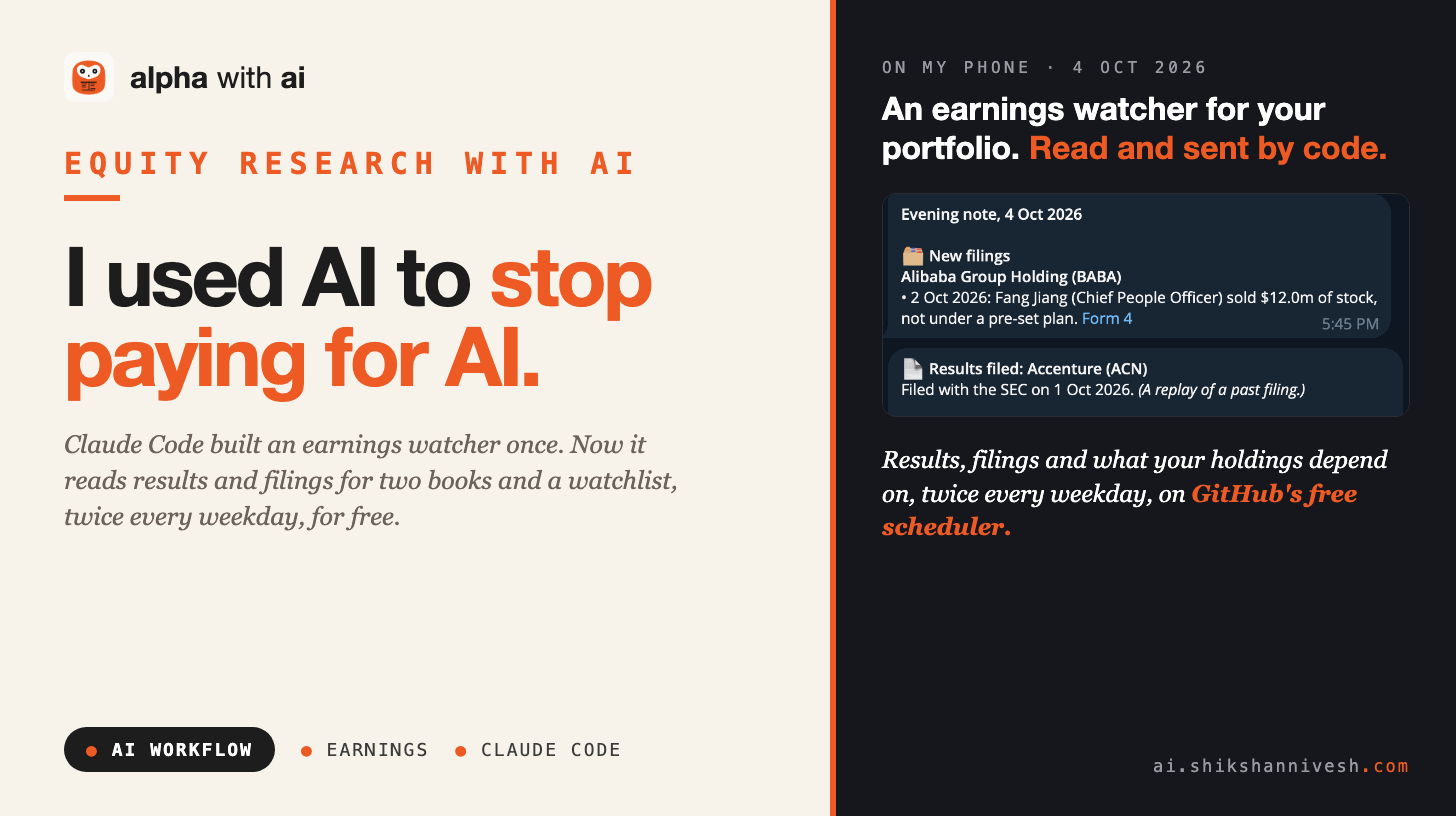
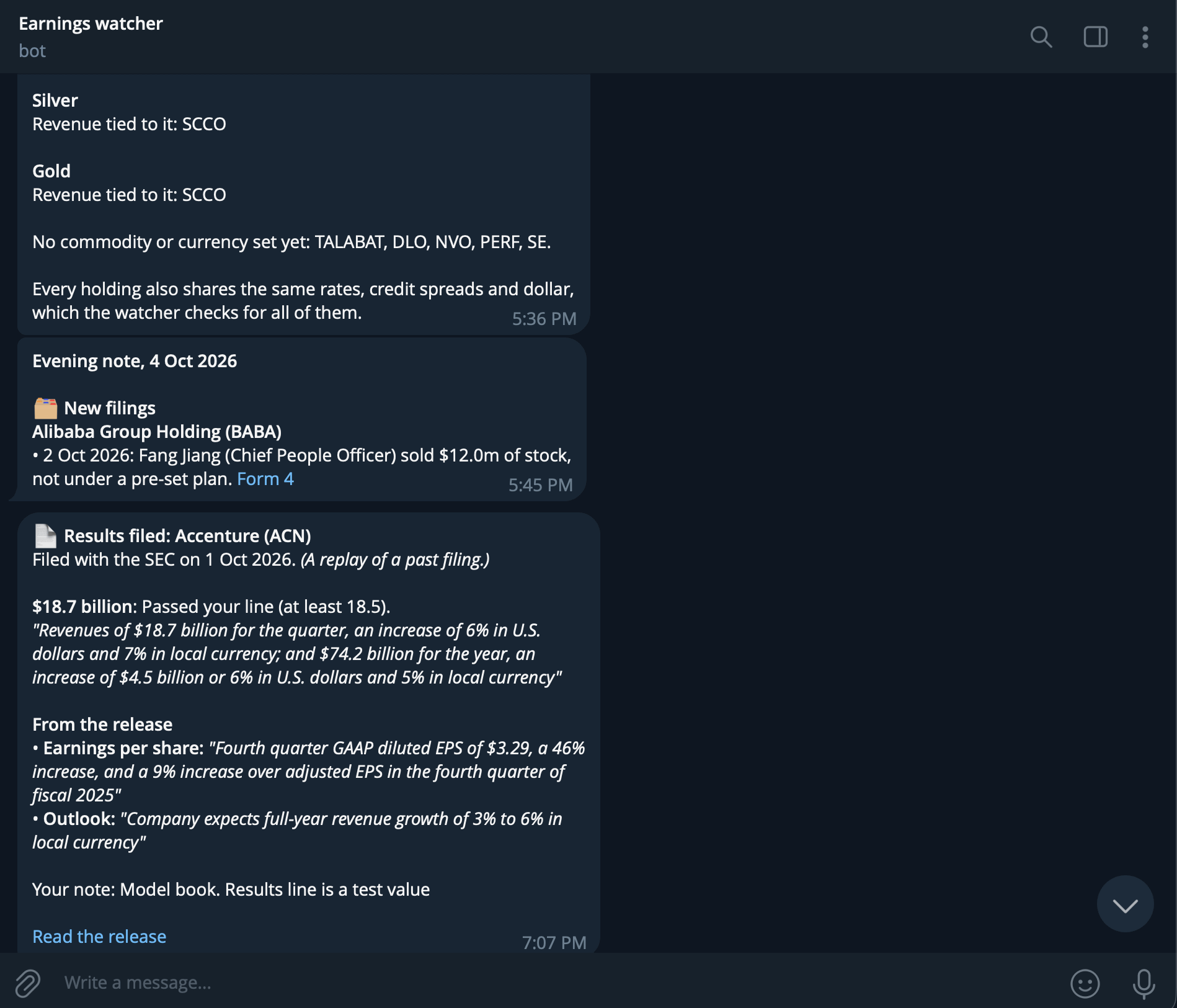
Between now and early November, most of the companies you own will report, and for most of us the way we find out what a company actually said is a headline the next morning, or a summary somebody wrote in between. These two messages came to my phone this weekend from a program I built with AI, and no AI wrote either of them: an insider sale at Alibaba, read from the Form 4 the day it was filed, and Accenture’s 1 October results, quoted from the release itself and replayed so I could see what a results night will look like.
It runs twice every weekday on GitHub’s free scheduler, so it costs nothing. Alibaba is only on our watchlist, and one executive selling is a small thing on its own, but results season is when everything a company is tied to moves at once, its results, its filings, what it buys and sells, the currencies it earns in and the rates it borrows at, and until last month I was paying AI to watch all of that every day.
Why I stopped paying AI to watch
I have been using AI to keep an eye on my portfolios for a few years now, and I have tried a lot of different ways of doing it. It was extremely difficult when there were only chatbots, then Claude Cowork came, then I moved to Claude Code, and things got easier. Getting the fear of the terminal out of me took a long time, because in my head Claude Code meant technical, technical, technical, which was my own misconception, in a manner of speaking. My life became easier once I stopped looking at it as a coding tool.
The problem was the usage, which was extremely high over the last few months, because every check meant several tool calls and web searches, several times a day, across a huge watchlist, and when I was actively talking to it, it would sometimes run five, six, seven, eight, ten agents at once. Even on a schedule, it burned through a lot of my plan.
So what I did was use AI once to build a program, and let the program do the watching. Through this results season it reads the results and the filings for our model portfolio, our live account and a watchlist twice every weekday on GitHub’s free scheduler, and a run takes about 40 seconds and costs nothing, because once it is built, no AI is involved.
Deciding what it should send me turned out to be harder than building it, because much of what EDGAR files about a company on a normal day is routine: sales under plans set months in advance, Form 144 notices, and a company’s own filings about other companies.
A small note, and the only sponsor here is me. I keep getting messages asking how I set up Claude Code for stock research, beyond what the editions can teach. So I am opening a small consulting program: I set your system up with you, then support sessions over the following months as your real problems show up. I am doing a lot of other things, so seats are very few. If that is you, the waitlist is on the website or reply to this email.
How your portfolio connects
Most of what moves a holding in results season is not in its own filings. Southern Copper lives on the copper price, Uber’s drivers pay for fuel, Accenture earns in euros, and all of them borrow at the same rates, and the place a company says what it buys, what it sells and where it earns is in its annual report. For our list we went through each annual report once: code counted the commodity and currency words, and Claude and I decided what each one actually meant for the business, because a count on its own proves nothing. Uber’s report has the word “Sugar” in it twice, and both times it is the chairman, Ronald Sugar.
The first message in a new copy is that map. For our list it shows revenue tied to the euro at Accenture, S&P Global, PTC and several others, and costs tied to crude at Uber, Lululemon, Southern Copper and Walmart. In your own copy the program fills in what a company’s SEC industry code makes plain (a copper miner gets copper, an airline gets crude), never guesses a currency, and tells you which names are still blank. For those, ask claude code to access the annual reports once and ask what the business buys and sells and in which currencies, then type the answer into one file. The first run itself takes seconds, because it reads a code for each company, never the reports.
After the map, each check sends only what changed. A company’s results arrive the day they land, as their own message, with the release’s own sentences on revenue, earnings and outlook and the link. The filings that can change how you see a company come in plain words: an insider buying on the open market, an insider selling outside a plan set up in advance, a deal signed, new debt, an executive leaving. A holding that moved 5% or more in a day gets a line with its month beside it.
Those ties only speak when something breaks. Crude moving 5% in a day is noise, so a commodity, currency or rate sends a message only at a three-month high or low, with its range beside it, and then stays quiet for five days. On 1 October that was the high-yield credit spread: 3.24%, its highest in three months, against a range of 2.60% to 3.12% since 6 July. On Monday it puts the whole portfolio together: the largest positions, the last five trading days, how much of the portfolio has revenue or costs tied to each commodity and currency, and which holdings report in the next five trading days.
On a quiet day it sends nothing at all. We are testing all of this through the season, and once it holds up, a similar feature goes into GreekSoup, our open-source research desk, but a program only reads what is filed, and the first results night of the season showed me what that leaves out.
What it sends on a results night
Accenture reported on 1 October, the first of our names this season, a position in the model portfolio since July and one I hold personally. The message in the screenshot at the top is what the program sends on a night like that: the company’s own sentences on revenue, earnings per share and the outlook, with the link, nothing worked out and nothing reworded. For Accenture that was revenue of $18.7 billion for the quarter, up 6%, EPS of $3.29, and a guide of 3% to 6% for the year ahead, and the stock ran 15.8% that day. The position, bought at $138.40 in July, closed the week at $198.90, up 43.7%.
What the program cannot read is the earnings call. On Accenture’s call the CFO said that about 2.5 points of that 3% to 6% guide come from acquisitions, which is a different picture from the one the release gives, and no sentence a program can quote carries it. So the program sends the release the day it lands, and I read the call and decide, which is the part no program does for you.
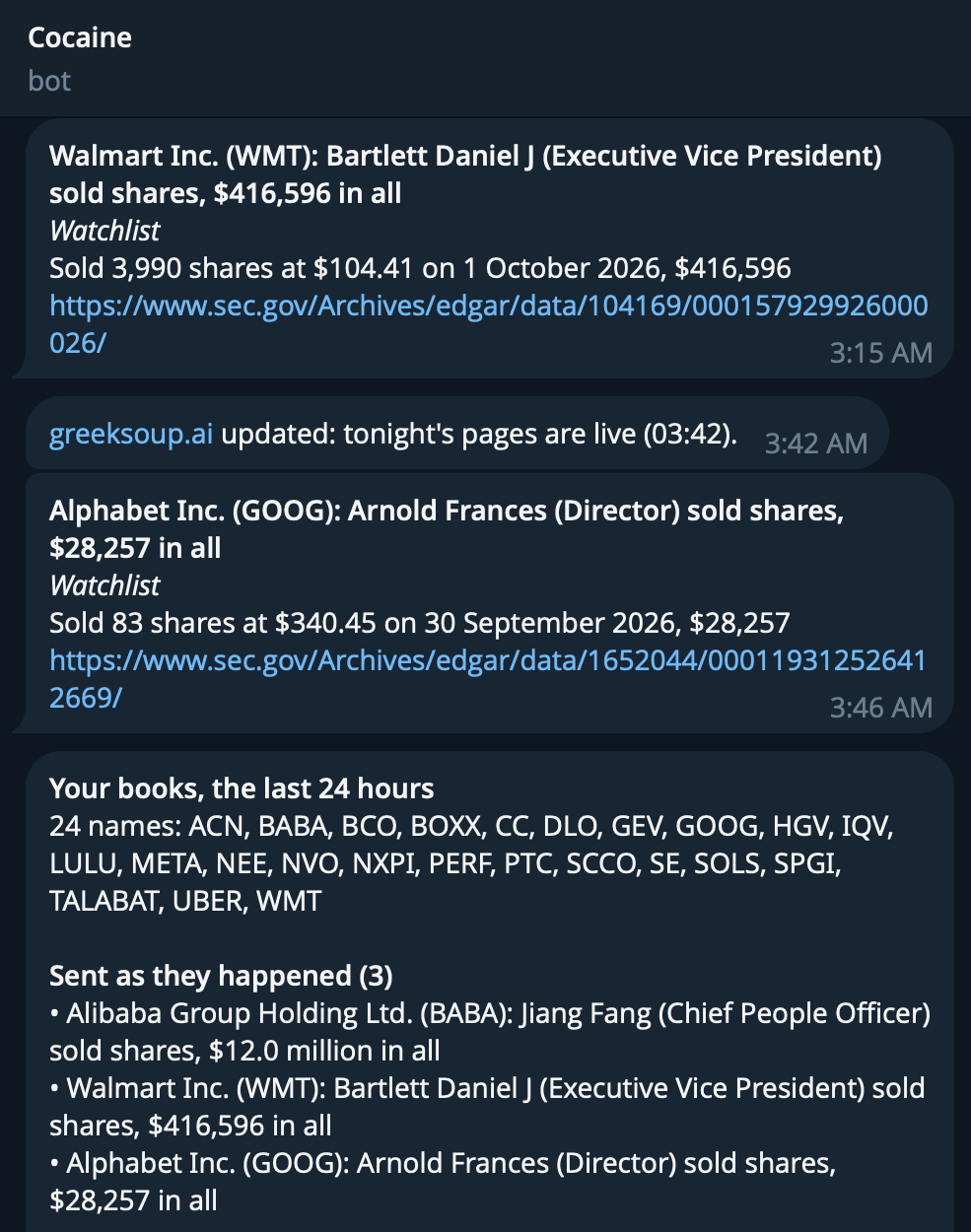
Your broker probably sends you alerts too, and for a single filing the difference is not big, which is why the two messages at the top of this piece look so simple. Everything your broker's app shows you was decided by somebody else, for everybody. This one starts with your problem, said in your words, and that is how powerful these models have become: you state the problem, Claude works out how to read the filing or the price or the document that answers it, and the program grows around what you actually hold and what you actually worry about. Say it has two hands today, the same two your broker's app gives you. Once you get the hang of asking, you can attach eight robotic arms, one for each thing that has ever cost you money because you found out late. That is what I mean when I say an investor today has to decide whether to stay a user of other people's apps or become a bit of a hacker, not a coder, somebody who understands the tool well enough to bend it, and the deciding is the only hard part. This is what mine looks like after a few of those arms: a different bot, with the filings for both books and the watchlist as they land, each with the filing itself linked rather than a news story about it, and in between them one line from another project of mine, telling me its website finished its scheduled build. Different hands, the same phone.
The asking is easy, and the second half of this edition is the asking, step by step.
One more thing from us. We have been testing, learning and researching with AI for a long time now, and over the last months mostly with the agentic tools, Claude Code and Codex, and from this month we are putting what we learned back into AI workflow editions like this one, as often as we can get them right.
We research great companies the market has sold on a story, with AI reading every filing, call and results release. Paid subscribers get the rest of this post, the full Research Dives, the AI workflow library and both our books, the model portfolio and the live one, with every trade as we make it. If you want them, upgrade.