


PTC makes the software that engineers at aerospace, defence, car and machinery companies use to design their products and to keep a record of every part that goes inside them, which is about as boring as software gets, and between 27 August 2025 and 23 June 2026 its share price fell 48 percent, from $216.53 to $112.33, while its annual recurring revenue, the yearly value of all its active software contracts, kept growing and was 9.1 percent higher in the latest quarter than a year earlier, leaving out the two businesses it sold and once currency moves are taken out.
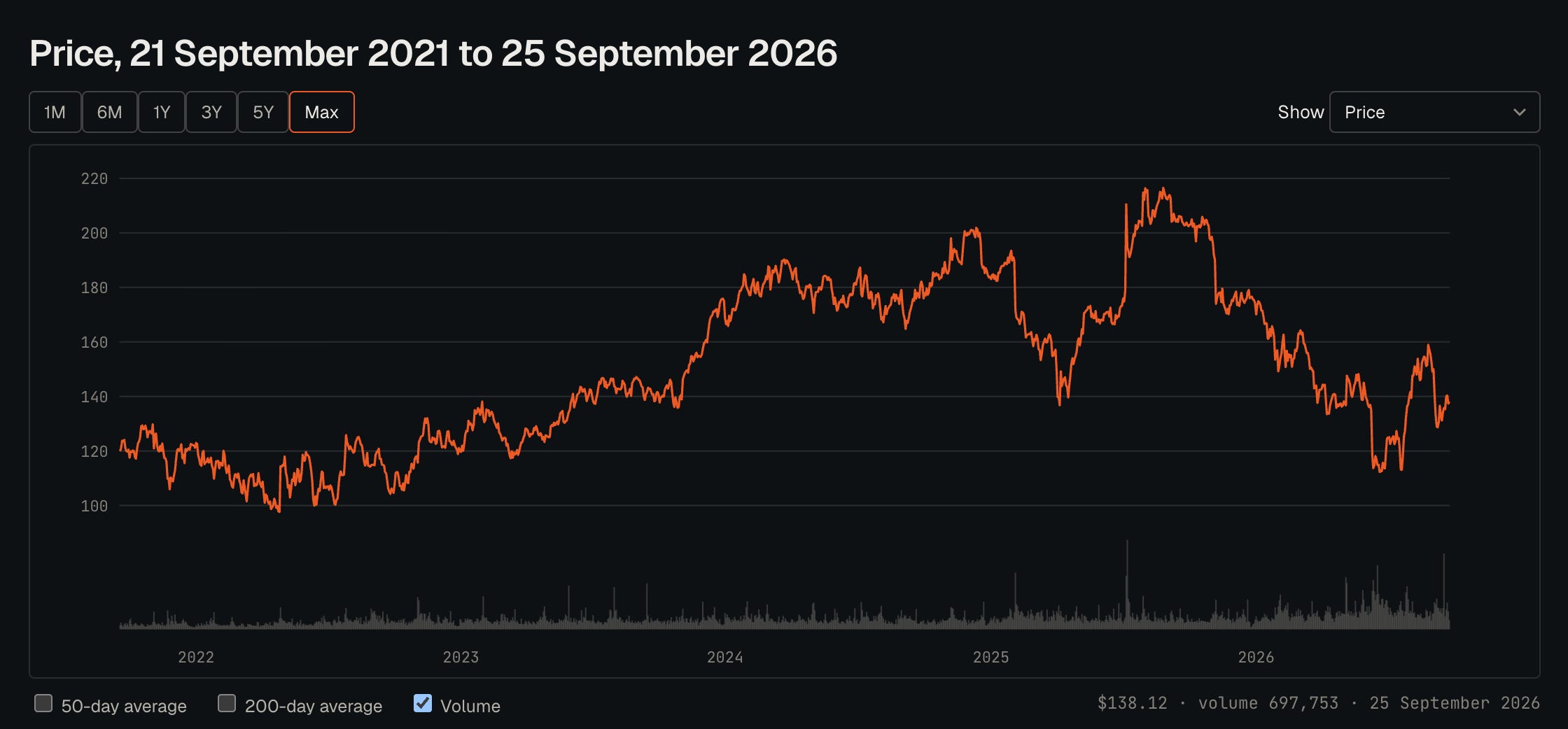
The reason almost everyone gave for that fall fits in one sentence, that AI will soon design the products engineers now design with PTC’s software, and when a story that short takes half the value out of a company whose own numbers are still going up, the first thing I want to know is whether anybody actually checked it before selling.
Claude Code is the AI agent I do my research with, and it runs on my local computer, so every filing it downloads and every number it works out stays with me as a file I can open and check later. The question I gave it was a plain one: is there any evidence, in PTC’s filings, in what its competitors report, in what the analysts wrote or in the way the price actually moved, that AI is already taking business away from this company? I also asked it to build the strongest case against the stock first, because I wanted the bear argument at full strength before a single number of mine was checked against it.
Alpha with AI is read by 5,000+ analysts, investors and business leaders. We publish investment research and the AI workflows behind it, and our one-person equity research desk, GreekSoup, is now open source and completely free. If pieces like this one are useful to you, consider upgrading to support the work: for now a paid subscription is 25 percent off forever through below link.
The AI case against PTC was never made with numbers
Who was actually making the case against PTC, and what were they saying? Through twenty months of analyst ratings and the whole 48 percent fall, only one research team changed its rating on the stock, a large US bank, and it did so twice, first from Overweight to Neutral in April 2025 because of tariffs and PTC’s exposure to industrial customers, and then from Neutral to Underweight on 2 February 2026, when it cut its price target from $205 to $162, before cutting it again to $145 around 26 June 2026. Every other analyst kept the rating they already had and moved the target down as the price fell, and nobody upgraded the stock at the June low.
The February downgrade landed in the same week that software stocks as a group were being sold on fears about AI, and the reasons the bank gave had nothing to do with AI. Its argument was that most of PTC’s customers still run the software on their own servers, that moving them to PTC’s cloud version is hard and expensive because they first have to strip out the custom changes they have built on top of the product over the years, and that some of them would use that moment to look at Siemens, Dassault, Autodesk or the newer cloud-only products instead. In the bank’s own words, customers “face complications when decustomizing existing implementations, often resulting in reduced flexibility and higher migration costs”, and it saw “some enterprises actively evaluating alternative vendors”.
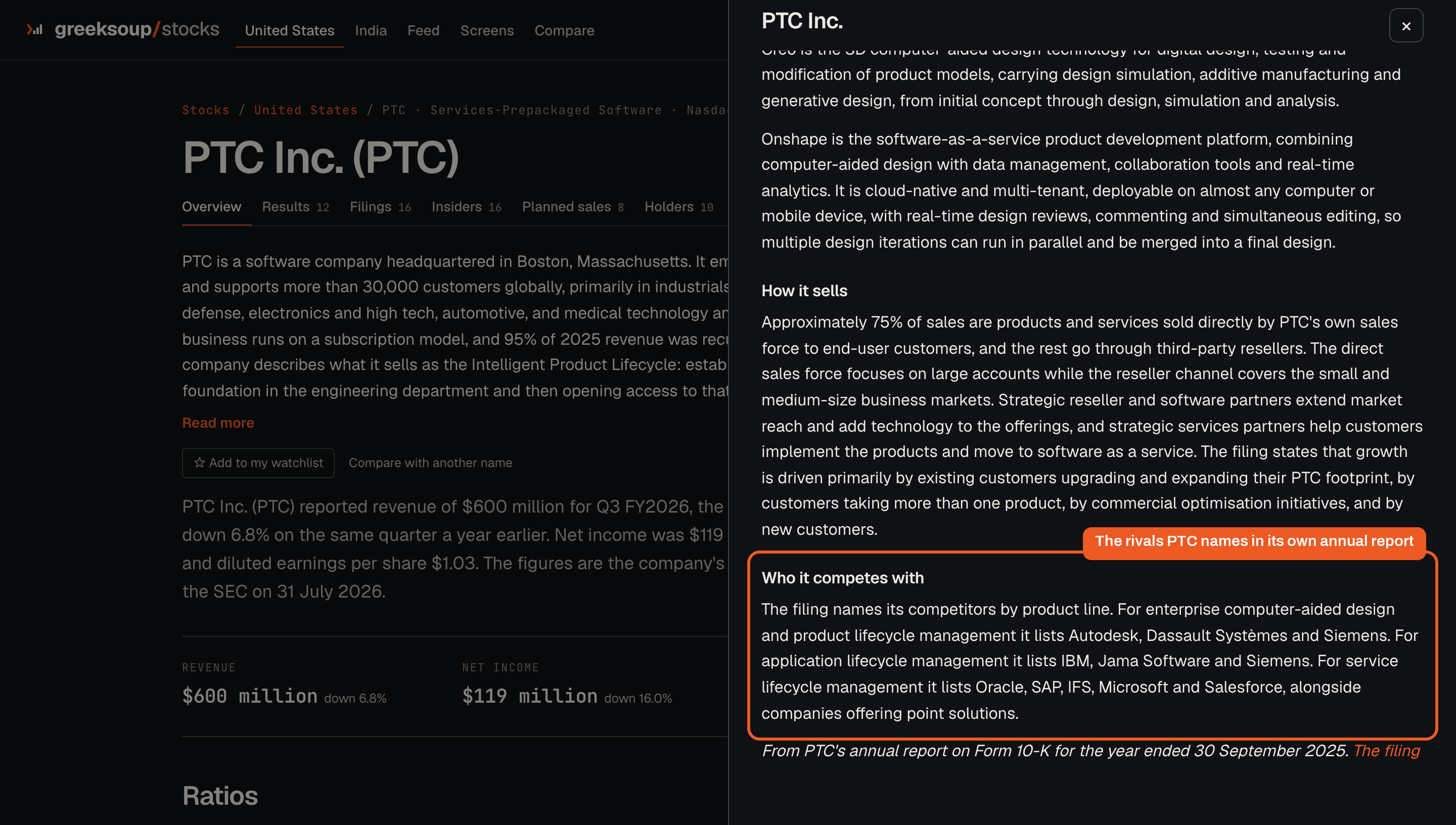
That is a real argument and a specific one, about what the move to the cloud costs and how many customers might leave on the way, and it is the only bear case on the record with a price target behind it.
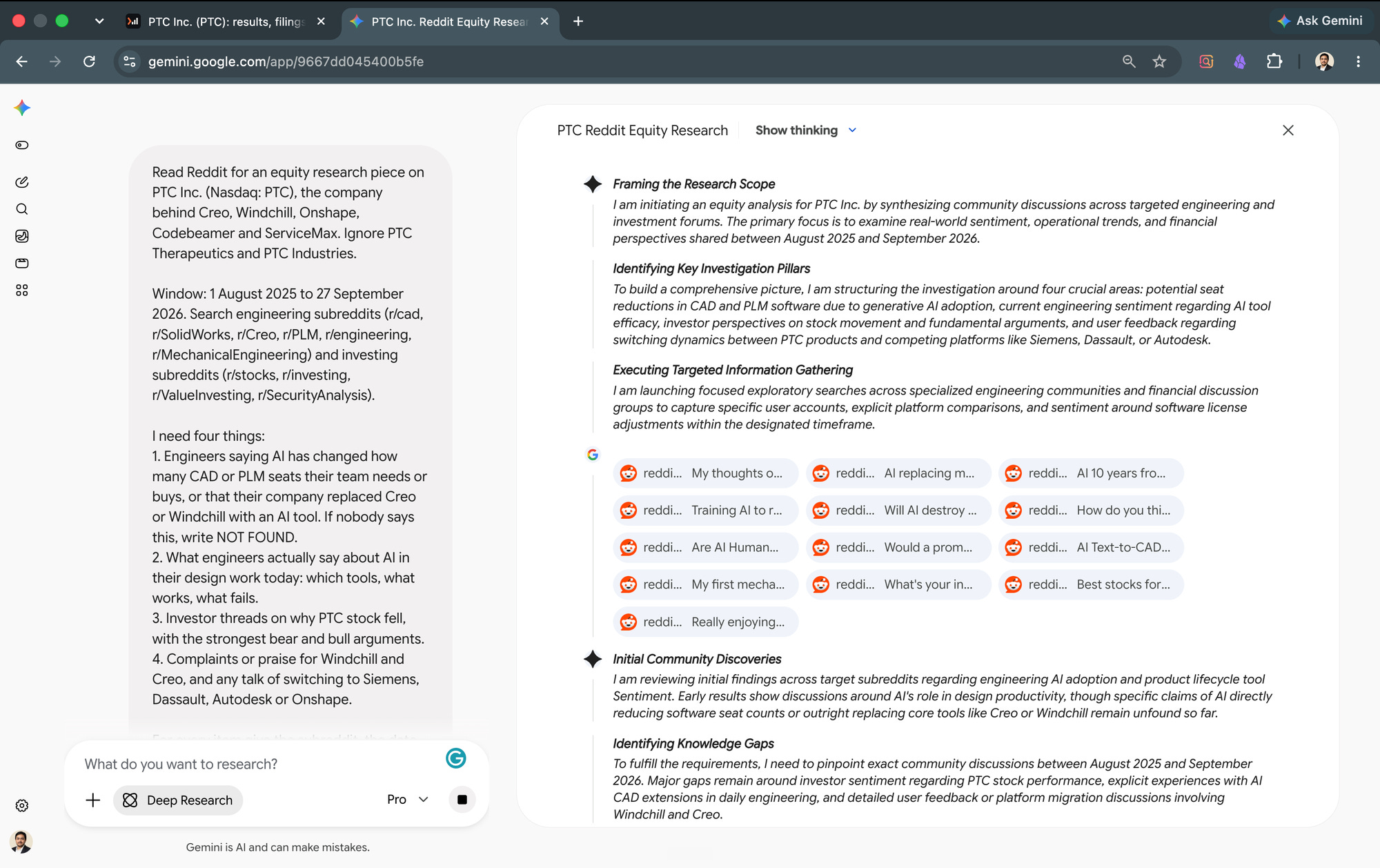
The AI version of the bear case, the one most people gave as the reason for the fall, is really about the whole industry, that AI will cut the number of engineers who need design software at all, whether they buy it from PTC or from Siemens, Dassault and Autodesk, and I could not find it written down with numbers anywhere. The research helper Claude Code sent out went through analyst notes, fund letters, independent writers and investor forums and found nobody who had put numbers behind it for PTC, and the closest anyone came for the wider industry was an analyst on Siemens’ earnings call asking whether “AI may drive down the number of seats”, which Siemens’ finance chief answered with “We believe the usage goes up”. The analysts who stayed neutral were cautious about the valuation and about execution, and the one who brought up AI was asking how much of PTC’s own AI potential the price already reflected. On the engineering forums nobody was saying AI removes the need for design software; the talk there was about which design program automates more of the work, along with plenty of complaints about Windchill, PTC’s product-records system, which one engineer called “the worst software for document management”. X and Reddit were the two places the helper could not read properly, because X is not searchable with the tools Claude uses and Reddit often blocks automated reading, so I gave the same question to Grok, which reads X live and runs as Grok Build on the same computer, and to Gemini’s Deep Research for Reddit. If you want to do this for a stock you own, that is the best pairing I have found, and the full Gemini report is open for you to read here: https://share.gemini.google/NF0kX6sBbH8x.
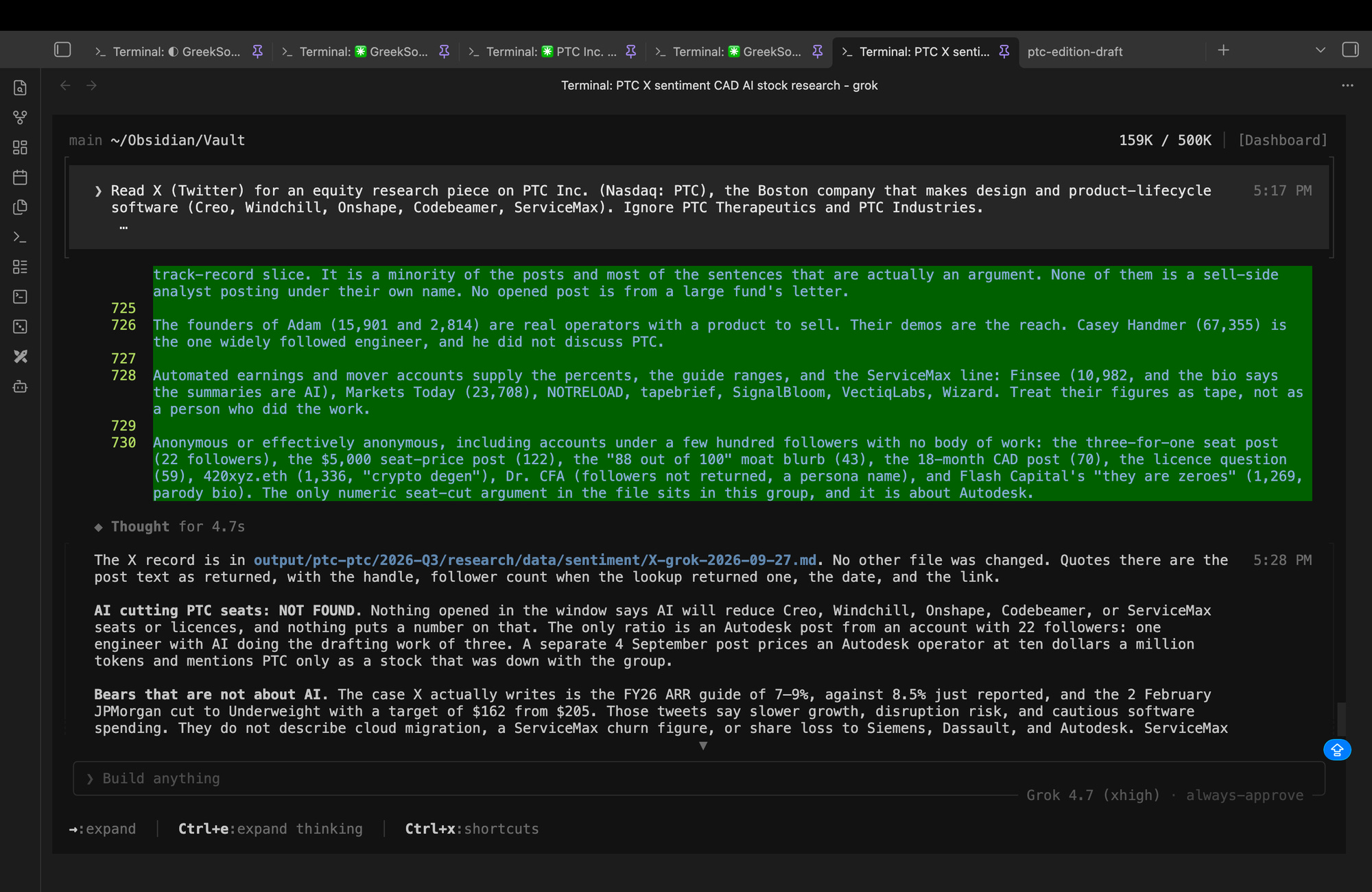
Grok went through fourteen months of posts about PTC and found the same gap. The only post it opened that put a number on the AI argument was about a peer, Autodesk, saying one engineer with AI can do the drafting work of three, and it came from an account with 22 followers. The case people actually wrote on X was the slower recurring-revenue guidance in November and the bank’s downgrade in February, and the posts with millions of views were demos of AI models drawing parts, none of which was a researched view of the company. Gemini came back from Reddit with the same answer: no engineer saying AI had changed how many design-software seats their team buys, from PTC or anyone else, and no company replacing Creo or Windchill with an AI tool. What engineers did describe was using AI for Python scripts, for keeping track of their team’s design rules and for small tools such as an O-ring calculator, and one of them wrote that they could not “think of a time that I felt it would be easier to describe the part I am looking for (using either text or voice), in the level of fidelity required to actually get the part I want compared to just modeling it myself”.
So after the analysts, X and Reddit, the written case against PTC was still one bank’s argument about the cost of the cloud move, which PTC itself has never put a number on, and the AI story that took the blame for the fall, for PTC and for its whole industry, had nothing behind it with numbers except one post about a peer from an account with 22 followers, so Claude Code started where a claim can actually be checked, with ten years of PTC’s own filings pulled straight from the SEC.
A small note, and the only sponsor here is me. I keep getting messages asking how I set up Claude Code for stock research, beyond what the editions can teach. So I am opening a small consulting program: I set your system up with you, then support sessions over the following months as your real problems show up. I am doing a lot of other things, so seats are very few. If that is you, the waitlist is on the website or reply to this email.
Why PTC’s 13x P/E is the wrong number
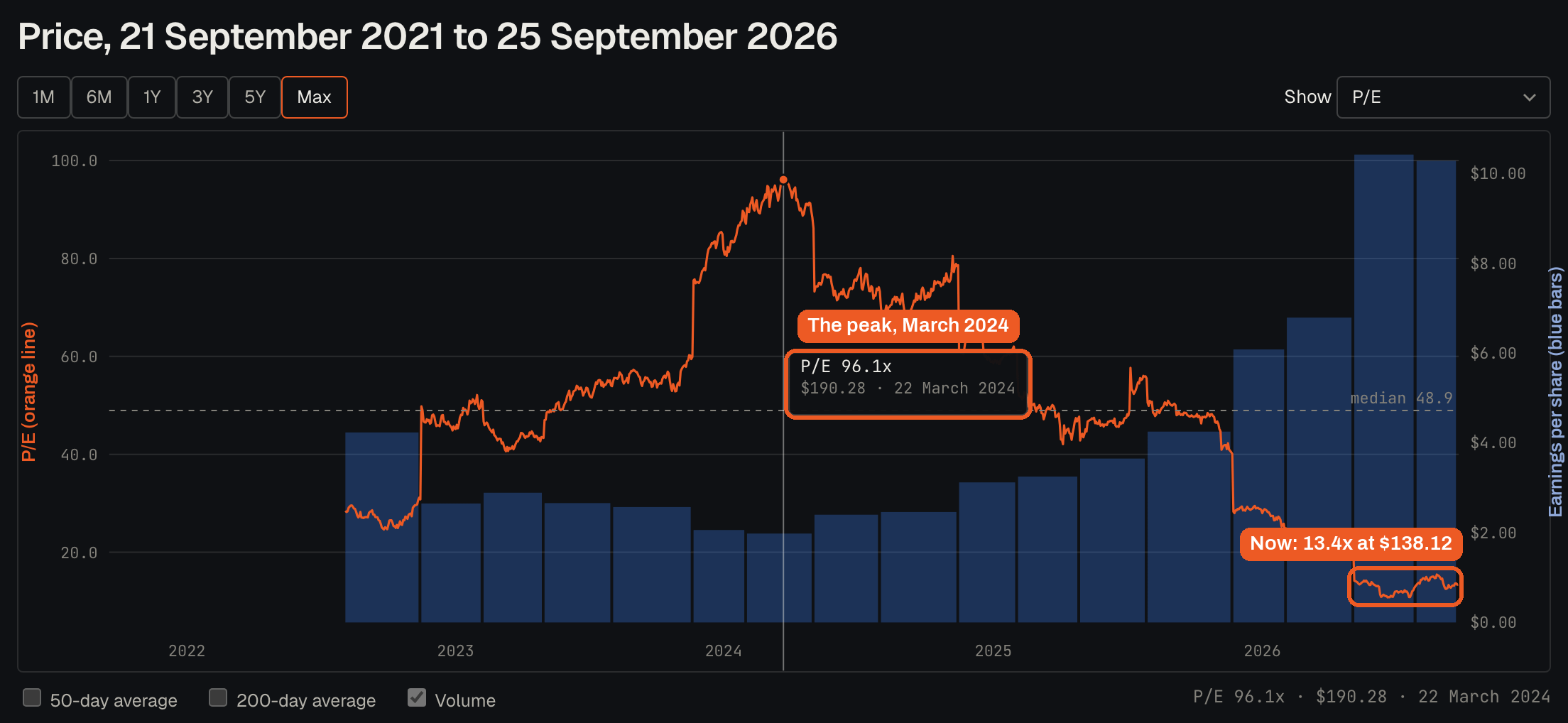
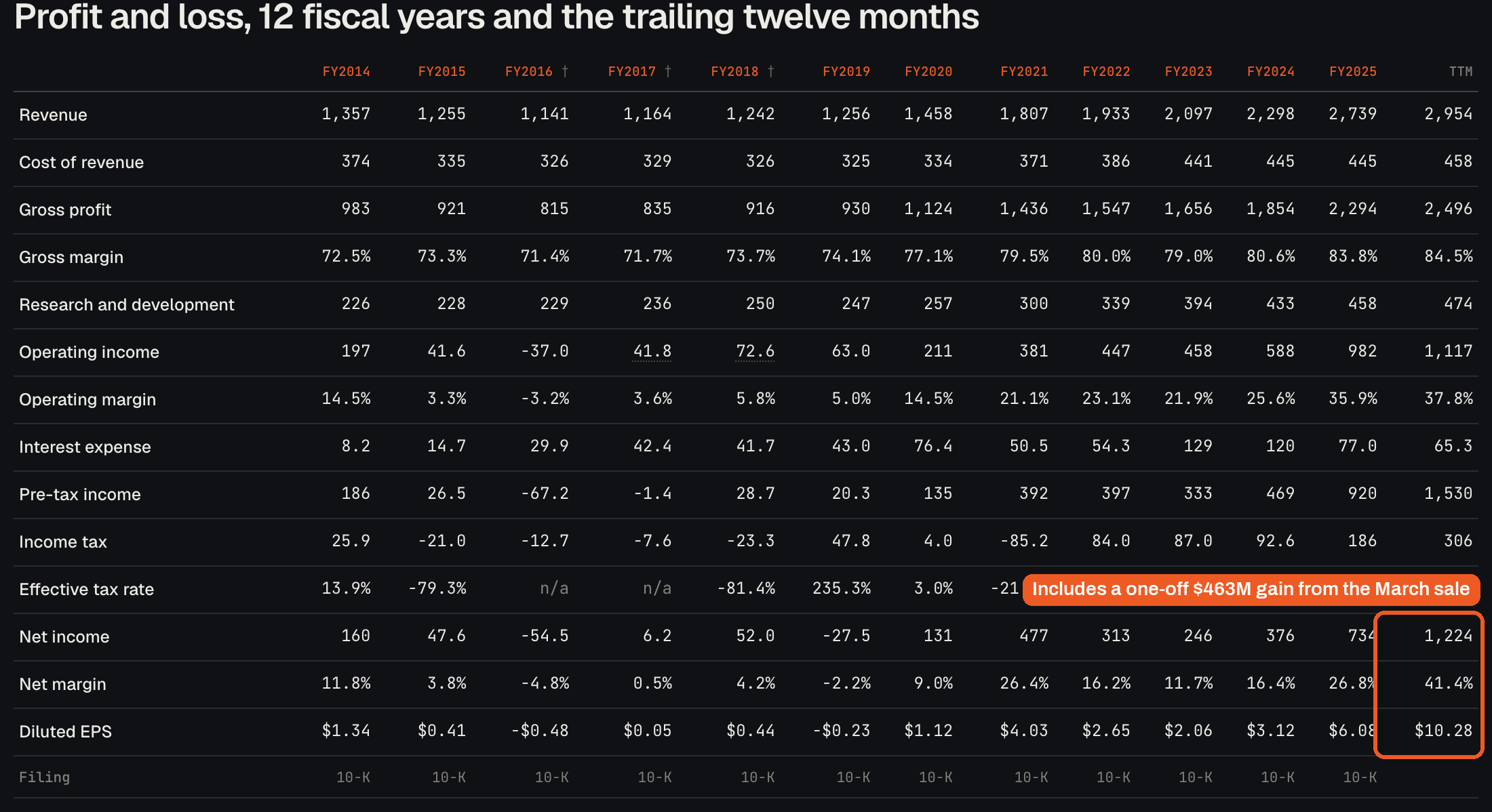
Before any money goes into a stock, the first question is what the company actually earns, because that is what the price is buying. Open PTC on almost any stock screen and the answer looks like a gift, a price-to-earnings ratio of about 13 for a software company still growing its recurring revenue at 9 percent. In March 2024 the same screen showed 96 times earnings at $190.28, so the price has fallen 27 percent since then while the P/E has fallen 86 percent, and the difference is earnings per share, which went from about $2 to $10.28 in two and a half years.
That rise came in two steps. By fiscal 2025, the year to September 2025, operating profit had more than doubled in two years, from $458 million to $982 million, and earnings per share reached $6.08. Then in March 2026 PTC sold two smaller businesses, Kepware and ThingWorx, for a pre-tax gain of $462.6 million, about $367 million after tax, and that one-off gain is most of the jump from $6.08 to $10.28. On fiscal 2025’s $6.08, PTC trades at about 23 times earnings.
Fiscal 2025 is already a year old, so the better question is what the business PTC kept will earn this year, and Claude Code answered it in cash, from the footnotes of PTC’s July results, where PTC guides for about $850 million of free cash flow this fiscal year, which is the cash left after running the business and paying for its equipment, and footnote 3 lists what is inside that number and will not come back: about $50 million of costs from the sale, about $100 million of tax on it, about $20 million to move a research centre into a new office, and, going the other way, about $70 million of cash from the businesses it sold. Take those out and the business PTC kept produces about $950 million a year, which is the same figure its finance chief gave on the call in May, “you get to a fiscal ‘26 baseline of $950 million”.
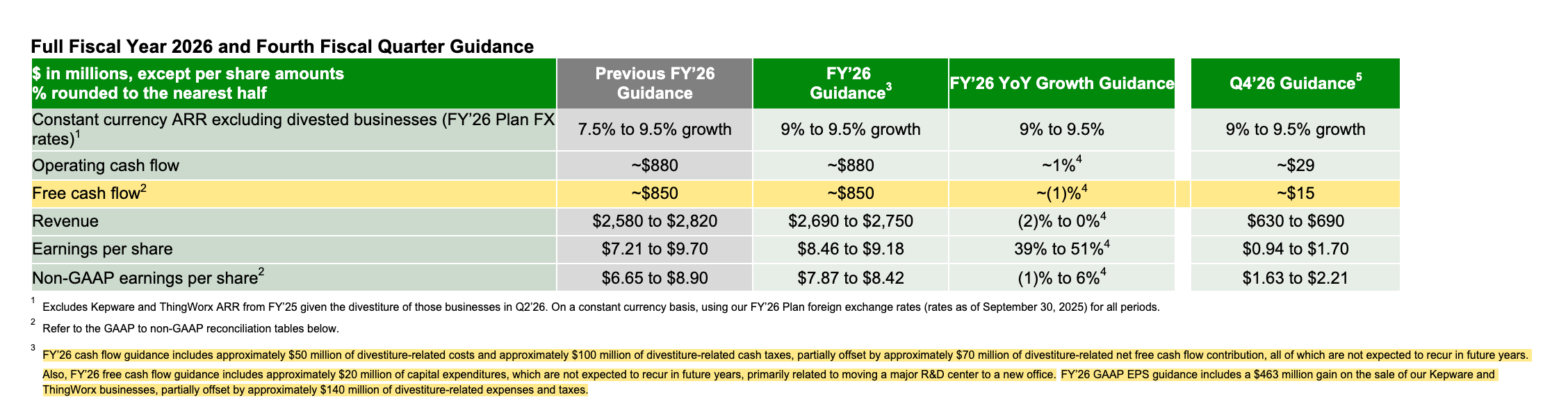
On that $950 million, the stock trades at 16.7 times its free cash flow, which is a higher number than the screen shows and the one everything after this is built on. The business behind it has grown the way a compounder should, with recurring revenue going from $1.27 billion in fiscal 2020 to $2.48 billion in fiscal 2025, partly through acquisitions, and free cash flow going from $214 million to $857 million over the same years, and nothing in those numbers explains a company losing half its value in ten months. The revenue line on a stock screen tells a different story, down 7 percent in the June quarter, because PTC sold two businesses and books the licence part of a long contract up front, so reported revenue jumps around with contract length while the value of its contracts keeps growing.
Which of PTC’s worst days were about PTC?
When a stock falls this far, the question that decides what an investor does next is whether the fall came from the company or from the group it belongs to, because a company problem shows up in its own numbers, while a fear about the whole industry can knock the price down on a day when the company has done nothing wrong, and can do it again. So Claude Code took the biggest down days from the daily closing prices and set PTC beside three companies that sell the same kind of software, Autodesk, Dassault and Bentley, and beside IGV, a fund that holds the large US software companies, which is the same sell-off check we built in an earlier edition.
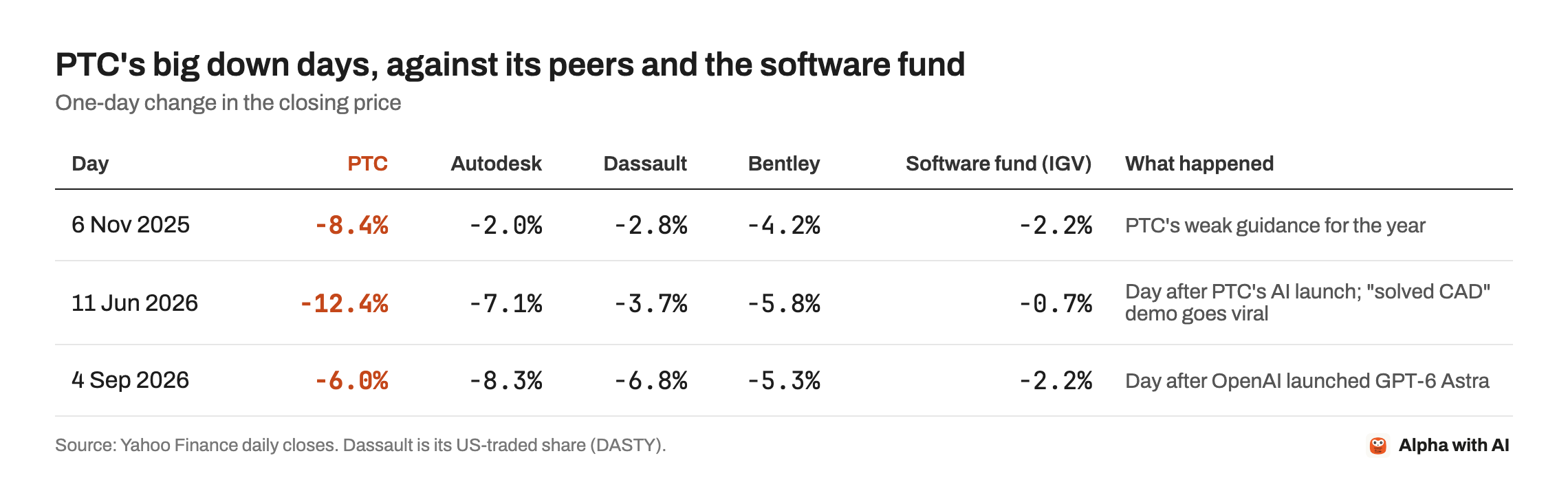
On 6 November 2025 PTC fell 8.4 percent while the others fell between 2 and 4 percent, and that day was about PTC, because it came right after the company gave weaker guidance for the year. 11 June 2026 looked very different. PTC fell 12.4 percent, Autodesk 7.1, Bentley 5.8 and Dassault 3.7, while the software fund fell only 0.7 percent, and one market summary site put PTC’s drop down to “Oracle’s staggering capital spending forecast”, which it said “triggered a broad software sector selloff”. The software fund’s 0.7 percent says there was no broad selloff that day, and the selling was in design software. What Grok found on X in the hours before that open was PTC’s own AI launch at its customer event the day before, and a post from the founder of an AI design startup that read “claude fable 5 has solved CAD”, which had been viewed 800,000+ times.
The clearest case came on 4 September 2026, the day after OpenAI launched GPT-6 Astra, a model reported to be built to operate software. Autodesk fell 8.3 percent, Dassault 6.8, PTC 6.0 and Bentley 5.3, against 2.2 percent for the software fund, so every design-software company fell together on news about somebody else’s product.
So the price data answers the question in two parts. PTC had one bad day of its own, on its guidance, and on the other two the whole design-software group fell with it while the wider software market barely moved. Whenever a new AI model launches, these stocks seem to go down on the fear that spreads across social media, and the models are extremely, extremely good, I use them every day, but they are still not there from my point of view. For anyone who owns the stock, that means more days like 4 September, and the thing to watch is whether the fear ever reaches the numbers, which it has not in anything PTC has filed so far. The first place it would show is in what management tells investors about customers, renewals and prices, so the next step was to hold them to their own words.
What PTC’s management says about the bank’s case
A helper agent running on Sonnet, Anthropic’s mid-sized model, pulled the transcripts of PTC’s four earnings calls from November 2025 to July 2026 and of two investor conferences, in March and September 2026, and Claude Code set what management said in them against each of the bank’s three points, because if customers, renewals or prices were starting to go wrong, this is where the people running the company would have had to talk about it.
On the first point, that most customers still run the software on their own servers, management agrees with the bank. “The vast majority of our install base is on premises,” PTC’s head of products said in September, and his answer to why that does not stop those customers from using AI is that the setup works both ways, with a customer’s files staying where they are while the software reaches the AI models through the cloud (”Their data will stay on their tenant”).
On the second point, the slow and costly move to the cloud, the chief executive has been saying since February that “the dam has not broken”, meaning customers are not all moving to the cloud version at once, and PTC is happy to let them move when they are ready, because the recurring revenue from a customer who moves goes up by “one and a half to two and a half times”, and at the March conference he said that “every one of the new deals that we’re winning, meaning from a competitive displacement, is going on Windchill Plus”, the cloud version of its product-records system. What management has never given is the number that would settle the bank’s point, which is what the move costs PTC, how many customers are already on the cloud version and what margin that version earns. The one place a costly move would show is the gross margin, and on the company’s adjusted basis it was 86 percent for fiscal 2025 and 85 percent for the first nine months of fiscal 2026, so there is no damage in it so far.
On the third point, the newer cloud-only rivals, the chief executive’s answer in March was about what a customer would have to give up to switch, because “product data is the IP” of these manufacturers, and it sits on Windchill. He also said in July that the number, or the value, of the customers PTC won from competitors had doubled over the year, without saying doubled from what, and PTC’s head of products said its own cloud-only design product, Onshape, mostly wins customers “coming off CATIA or coming off of SolidWorks”, which are both Dassault products.
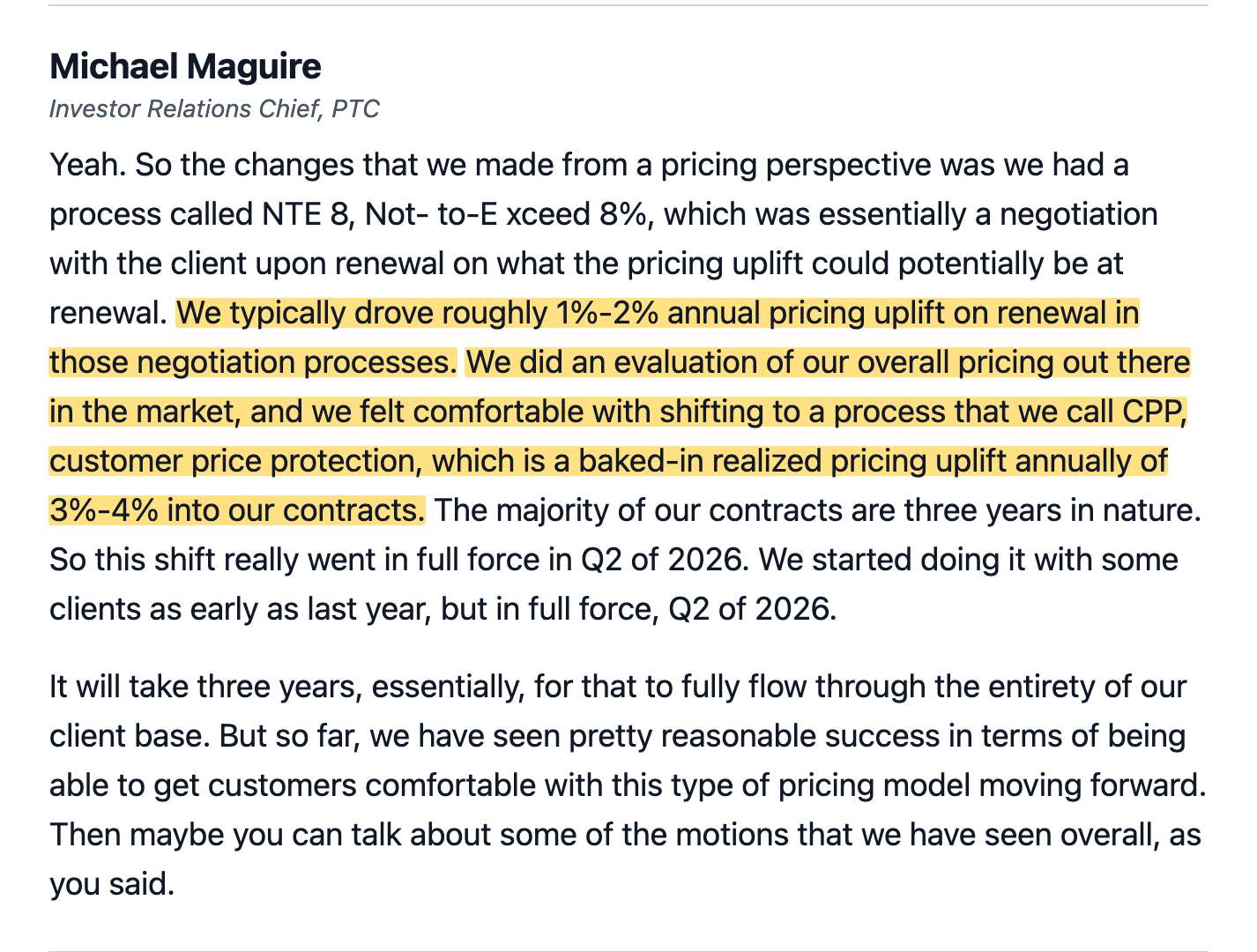
The part of management’s account that the bank’s case does not touch came at an investor conference on 9 September 2026, when PTC’s head of investor relations explained a change to how the company prices its contracts. Until recently the price rise was negotiated at each renewal and “typically drove roughly 1%-2% annual pricing uplift”, and now a rise of 3 to 4 percent a year is written into the contract itself, in full force from the quarter that ended in March 2026, and because most contracts run for three years it will take “three years, essentially” to reach the whole customer base. Once it has, that is about two more points of growth a year from price alone, from customers PTC already has, and he said customers have accepted it with “pretty reasonable success”.
Two more things management has said point at next year. In July the finance chief said PTC has “approximately 2x the amount of deferred ARR” for fiscal 2027 that it had at the same point a year earlier for fiscal 2026, which is recurring revenue already signed that starts counting next year, and she has never given the dollar figure behind the 2x. Her path to faster growth is that if PTC wins as much new business next year as it did this year and the signed revenue is added on top, “you would see an acceleration”. Against that, management says ServiceMax, its software for field-service teams, lost seats at renewal over two years and will “still be dilutive to growth”, with no revenue figure for it anywhere, and that AI will bring in some money in fiscal 2027, “but not overly material”.
So management answers the bank’s case in words, and the numbers that would settle it, the cost of the cloud move, the share of customers already on it, the margin it earns and the size of ServiceMax, it has never given. The first number that tests those words is the fiscal 2027 guidance on 4 November 2026, where recurring revenue growth at or above the 9.5 percent in constant currency that PTC now guides for fiscal 2026 would mean the signed revenue and the price rise are coming through.
Is AI taking seats from design software yet?
The AI fear hits the whole design-software group at once, so if AI really were cutting the number of engineers who need these licences, PTC’s competitors would be the first to say so to their own investors, because they sell the same kind of software to the same kind of customers. Claude Code went through what three of them said and did this year, and then through the tests that measure what the AI models can actually do in design work.
Bentley, which makes the software engineers use to design roads, bridges and power plants, said the opposite on its second-quarter call. Its chief executive, Nicholas Cumins, told investors that “across accounts large and small, the constraint is the same. There are not enough engineers”, and in that quarter Bentley’s recurring revenue grew 12 percent in constant currency, with existing customers spending 9 percent more than a year earlier. In February Hexagon, a Swedish technology group, sold its design and engineering software business to Cadence, an American design-software company, for about €2.7 billion in cash and Cadence shares, and Hexagon said the business was more profitable than the rest of its group, so in the same month the whole industry was being sold on the AI fear, a buyer paid €2.7 billion to own a piece of it.
Dassault, the French company behind CATIA and SolidWorks, is the one competitor that is changing how it charges. These companies charge by the seat today, which means a yearly fee for each engineer who uses the software, and in March 2026 Dassault said it will move toward charging for how much the software is used and what it produces, because once an AI assistant does part of an engineer’s work, counting engineers no longer measures what the customer gets out of it. Its chief executive, Pascal Daloz, said openly that investors see the company as vulnerable and pointed to its share price as the proof, and in the same briefing he said that “Our customers make these decisions every 20 years”, because a manufacturer that picks one of these systems keeps it for decades.
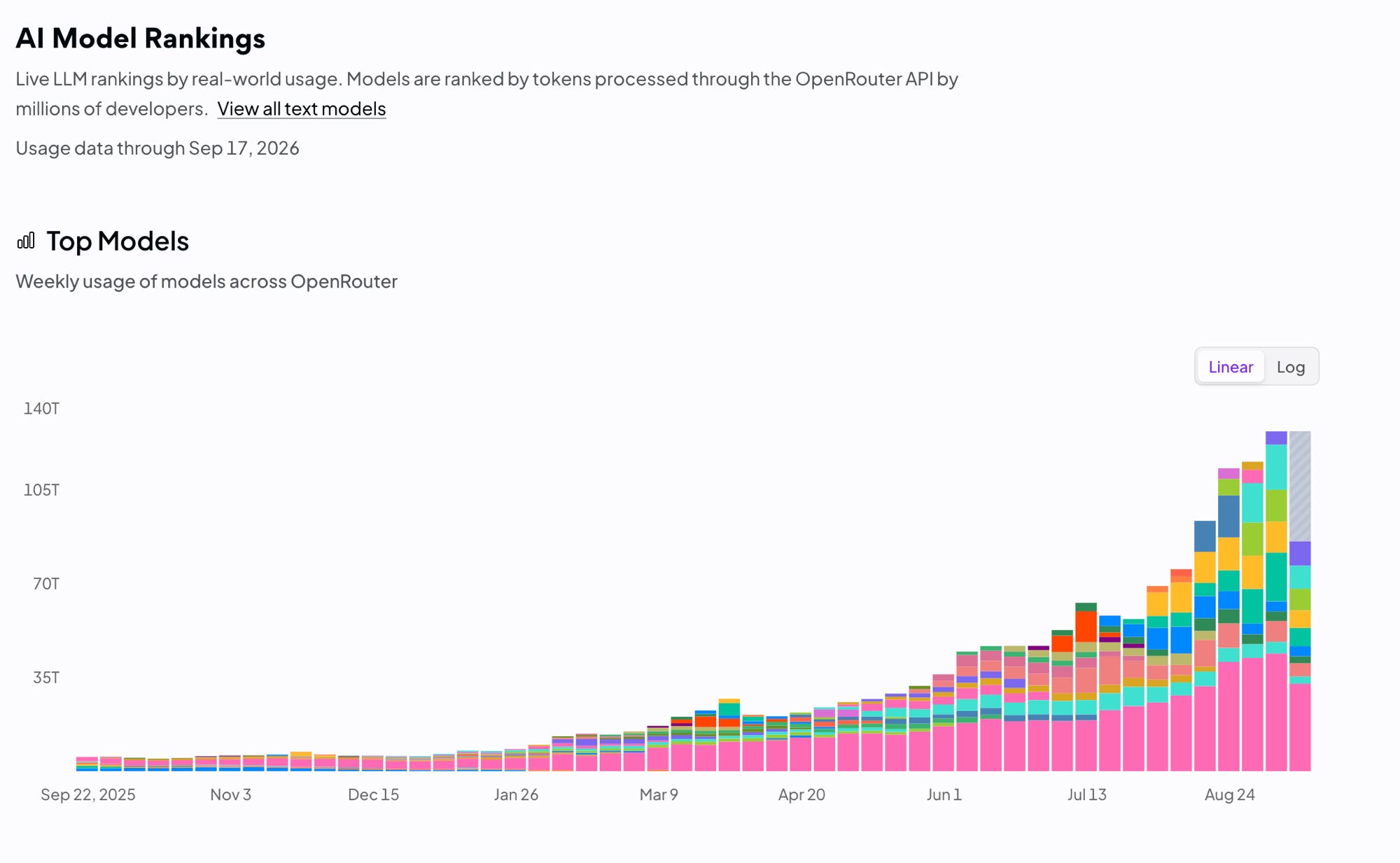
For an owner of PTC, this is how AI would actually show up in the numbers: if AI lets a customer do the same work with fewer engineers, a company that charges by the seat sells fewer seats, and charging for use is how it keeps getting paid for the work. PTC still charges mostly by the seat, “largely seat-based right now” in its finance chief’s words, and its plan for its new AI features is to sell each one with a set amount of use included and to charge for anything beyond that. Use of AI is counted in tokens, which are small pieces of text a model reads and writes, and on OpenRouter, a service where developers pay for models from all the big AI labs through one account, the tokens used each week went from under 10 trillion in September 2025 to more than 100 trillion in September 2026, so the use is there to be charged for.
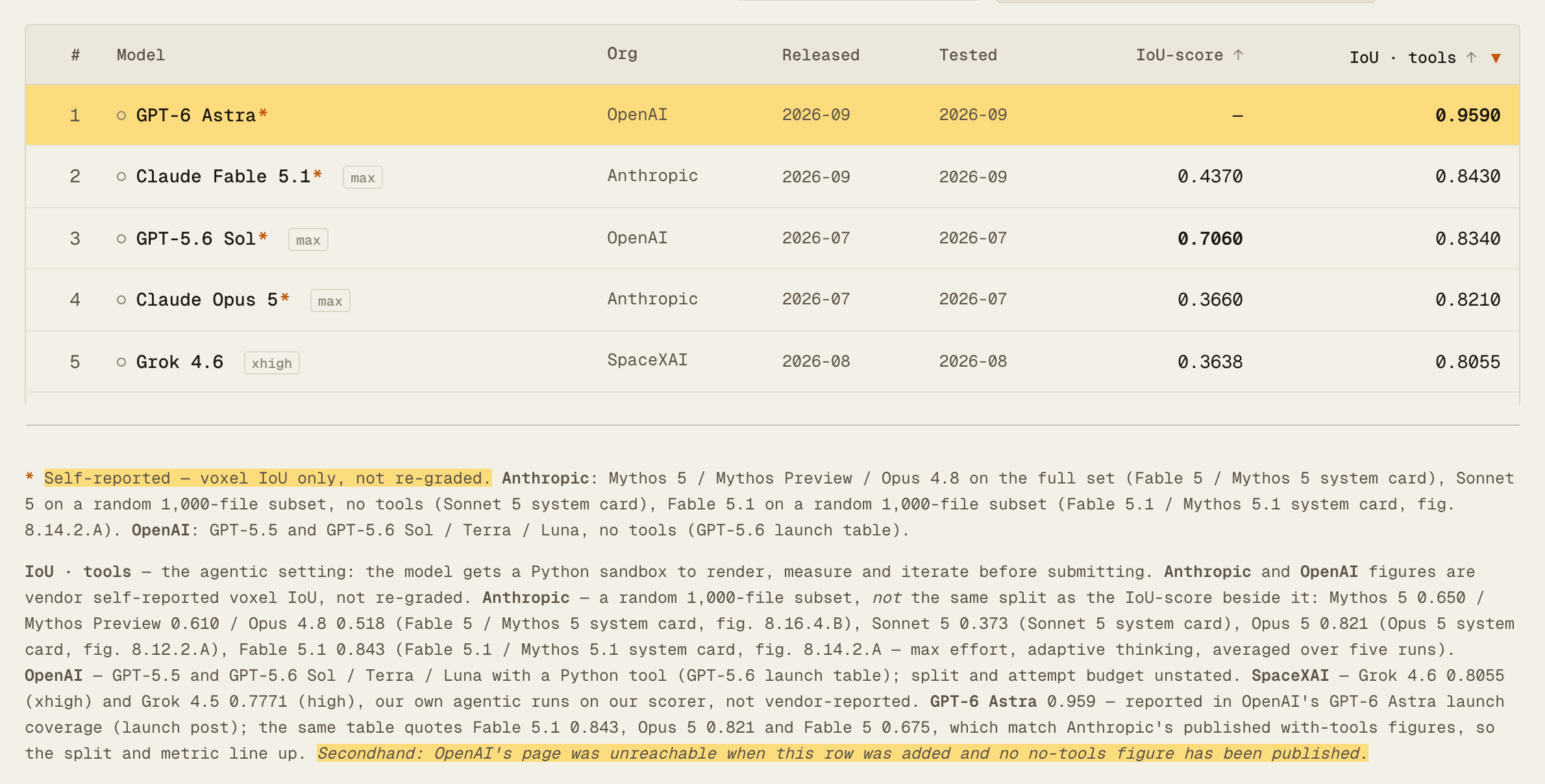
The other half of the fear is the AI models themselves, and the number that went around after OpenAI launched GPT-6 Astra on 3 September was its score of 95.9 percent on BenchCAD, a public test that shows a model pictures of industrial parts such as gears, springs and pipe fittings and asks it to write the instructions a design program needs to rebuild each one. On the test’s own leaderboard that score carries an asterisk, because OpenAI reported it itself and the people who run the test have not checked it again. The same people show why a high score is not a finished part, with one design that matched the original 96.1 percent and was still wrong, because a later step had closed an opening that was supposed to stay open. On the harder job, changing an existing design the way an engineer does all day, the best model tested in April 2026 finished 53 percentage points behind experienced engineers, and no Astra score on that test has been published. OpenAI’s own Astra demo, a concept for a building, ends by saying the plan “still needs professional review of the site, structure, and building requirements before it could inform construction”. I worked with CATIA and SolidWorks for design and Ansys for simulation for a couple of years early in my career, when I came out of mechanical engineering, and they were the bread and butter of the job, so I can say this as someone who has built parts in them: AI can definitely help with some of this work, but a three-dimensional design of a real part is nowhere near as simple as building a financial model, because it is an extremely complicated setup, and a lot of manual work still goes into getting it right.
The new companies built around AI have real money behind them. PhysicsX, which uses AI to predict how a design will behave before it is built, raised $300 million in June 2026 at a value of about $2.4 billion and said its revenue had doubled in a year, and that is the strongest sign of disruption Claude Code found. None of these new companies has named a large manufacturer that stopped using Creo, Windchill, CATIA or Teamcenter for its tool, and a research firm that follows more than 1,100 of these startups wrote that the most common mistake investors make is assuming they are trying to replace SolidWorks, CATIA or Creo, “They are not”, because they go after the roughly 60 percent of an engineer’s time that goes on repetitive work. Aerospace and defence customers also have to keep a record of every design decision to get their products certified, and the AI tools being built for them feed that record, which at a PTC customer lives in Windchill.
So the peers’ own calls, the tests of the models and the new companies all say the same thing, that AI is not taking engineering seats today, and the one thing actually changing is how the industry charges for its software, with Dassault moving first. For PTC that change would show first in the price it gets from each customer and in how many customers renew, and on both, so far, its own numbers point the other way, with a price rise now written into its contracts every year and renewals that, in the finance chief’s words in July, “performed better than anticipated”.
This is where the free part ends. In the paid part we check how PTC’s management, insiders and accounts actually behave, work out what the $138 share price already assumes about the next ten years, put a value on the stock in a bear, a base and a bull case, lay out everything that could still go wrong, and show the size and price at which PTC goes into our model portfolio, with the dated checks that would tell us we are wrong.