I Taught Claude to Pull a Company's Whole Debt Structure from One Filing
The most expensive thing equity and credit investors skip is the debt that gets paid before they do. I built a skill so I never skip it again.
A quick note before we start: this is one of our deepest builds yet, and it is going out free, to everyone. No paywall on this one. If you find it useful, the best thing you can do is subscribe and pass it on.
I have been in the equity market since 2018. I still make mistakes every single day.
I do not say that the way people say it when they want you to think they are humble. I say it because it is the truest thing I know about this business. I make a mistake, I sit with it, I rethink it, I learn the lesson, and then I make a slightly different mistake the next week. That is the whole job. Anyone who tells you the best investors stop making mistakes has not watched the best investors closely enough.
Look at Mohnish Pabrai and Micron. One of the sharpest value investors of his generation sold most of his Micron position in 2023, before one of the great runs in semiconductors. That is not a small investor fumbling. That is a master of the craft, and the market still handed him a regret he will carry for years.
Because that is what the market is. The market is a place of regrets.
You regret buying the stock. You regret selling the stock. You regret not buying it. You regret not selling it. You regret the opportunity you took and the one you let walk past. There is no version of this game where you escape the pile. Everyone has a pile. The best investors do not have no regrets. They just work, every single day, to make the pile a little smaller than it was last year.
I used to write this newsletter about tools. The hot thing that month. Sometimes it was Claude, sometimes Perplexity, sometimes Chatgpt, sometimes something else. And somewhere along the way I realised I was doing my readers a quiet disservice. Because a tool you learn this month is stale next month. A tool does not make you a better investor. The only thing that makes you a better investor is becoming one, slowly, over years, by learning from people a few mistakes ahead of you.
So I changed what this newsletter is. It is not about tools anymore. It is about the regrets I am trying not to repeat, and the systems I build so I do not. I will never be a perfect investor. Not in twenty years. What I can do is show you my mistakes early enough that some of them never have to become yours.
Most of what I build, I give away here, free, because the point was never to gate the work. It was to make more investors better at this. If you want every skill, every workflow, and the downloadable guides as they ship, there is a paid tier that keeps this whole thing running, and I am grateful to everyone who is on it. But this edition, like the work itself, is yours.
This edition is one of those mistakes.
It is about the part of a company almost no equity investor reads. The part that has a legal claim on the cash flows and the assets before you ever see a rupee or a dollar. The debt stack sitting directly above your shares.
I have held companies whose equity story I knew cold and whose debt I had never truly read. I knew the growth narrative, the margins, the management. And I had no real idea which notes were secured against the actual assets, which covenant flipped if the rating changed, or how many new shares a quiet convertible settlement was about to print on top of mine. I found those things out the way most equity investors find them out. Afterwards.
That is a regret. And it is one of the most common and most expensive regrets in all of equity investing, because almost nobody does the work to avoid it. Not because they are lazy. Because the work is genuinely brutal. You are hunting through a 10-Q, cross-referencing three footnotes to find one put date, squinting at conversion language buried thirty pages deep, trying to assemble a picture the company has deliberately scattered across the document.
So I built something so I would never have to skip that work again. And so you do not have to either.
I am going to show you the exact case, the exact filing, and the exact build. And by the end you will not just have a skill. You will see the stack that has been sitting above your equity this whole time.
What Sits Above You
Everyone has a view on Carnival.
The cruise line that almost drowned in debt when the world stopped sailing. The one that loaded up on borrowings just to survive 2020 and 2021, and has spent every quarter since trying to dig back out. If you follow the stock, you know this story. The recovery. The deleveraging. The slow climb back.
This is what most of us look at when we follow a company like this.
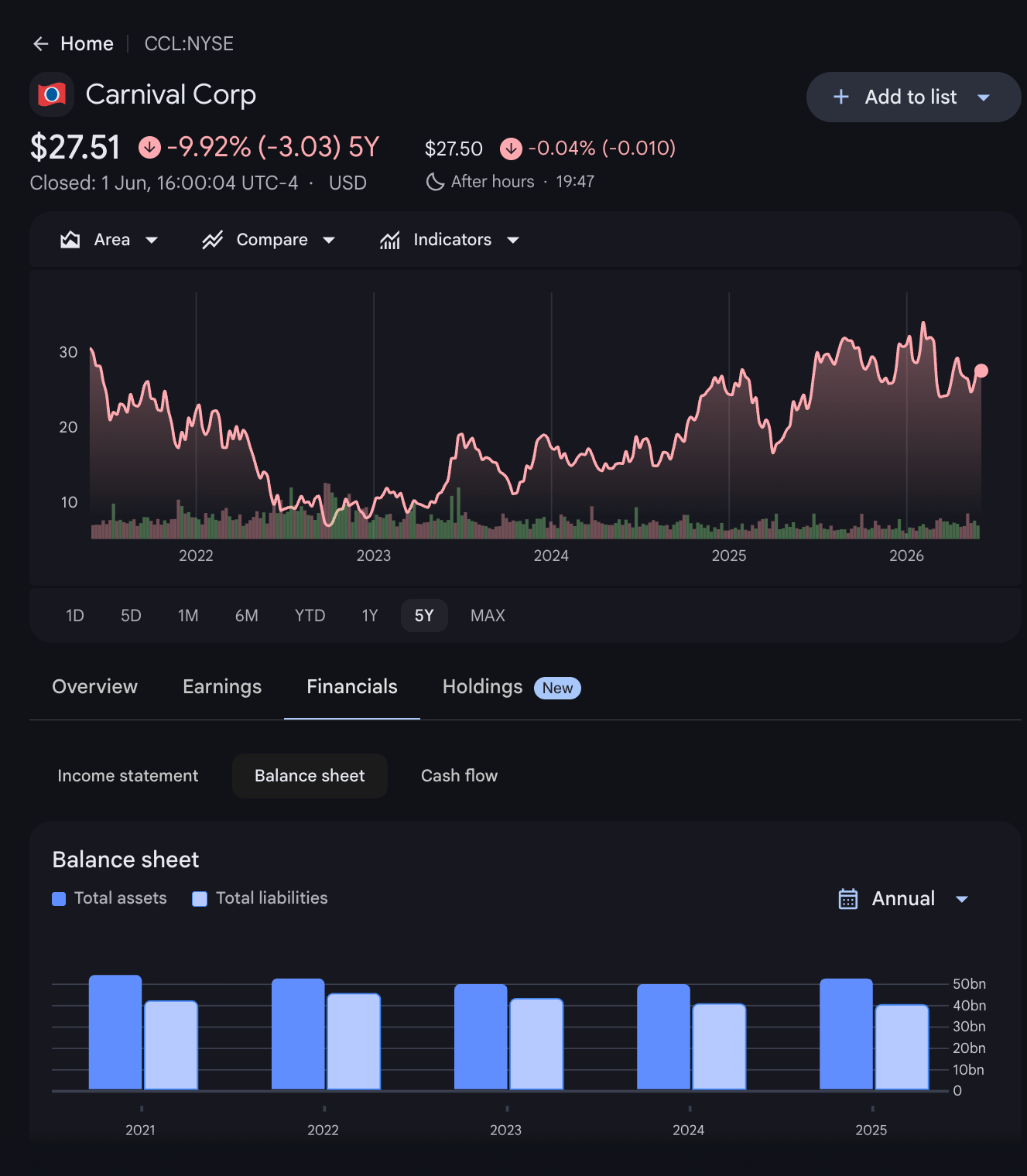
Now let me ask you the question I could not answer for years on companies I actually owned.
As an equity holder in Carnival, what exactly sits above you?
Not “the debt.” That single light blue liabilities bar is hiding the only thing that matters here. Because debt is not one thing. It is a stack. And every layer in that stack has a legal claim on Carnival’s cash and Carnival’s ships that comes ahead of your shares.
I pulled Carnival’s most recent quarterly filing and read the debt note properly. Here is what that one bar is actually made of.
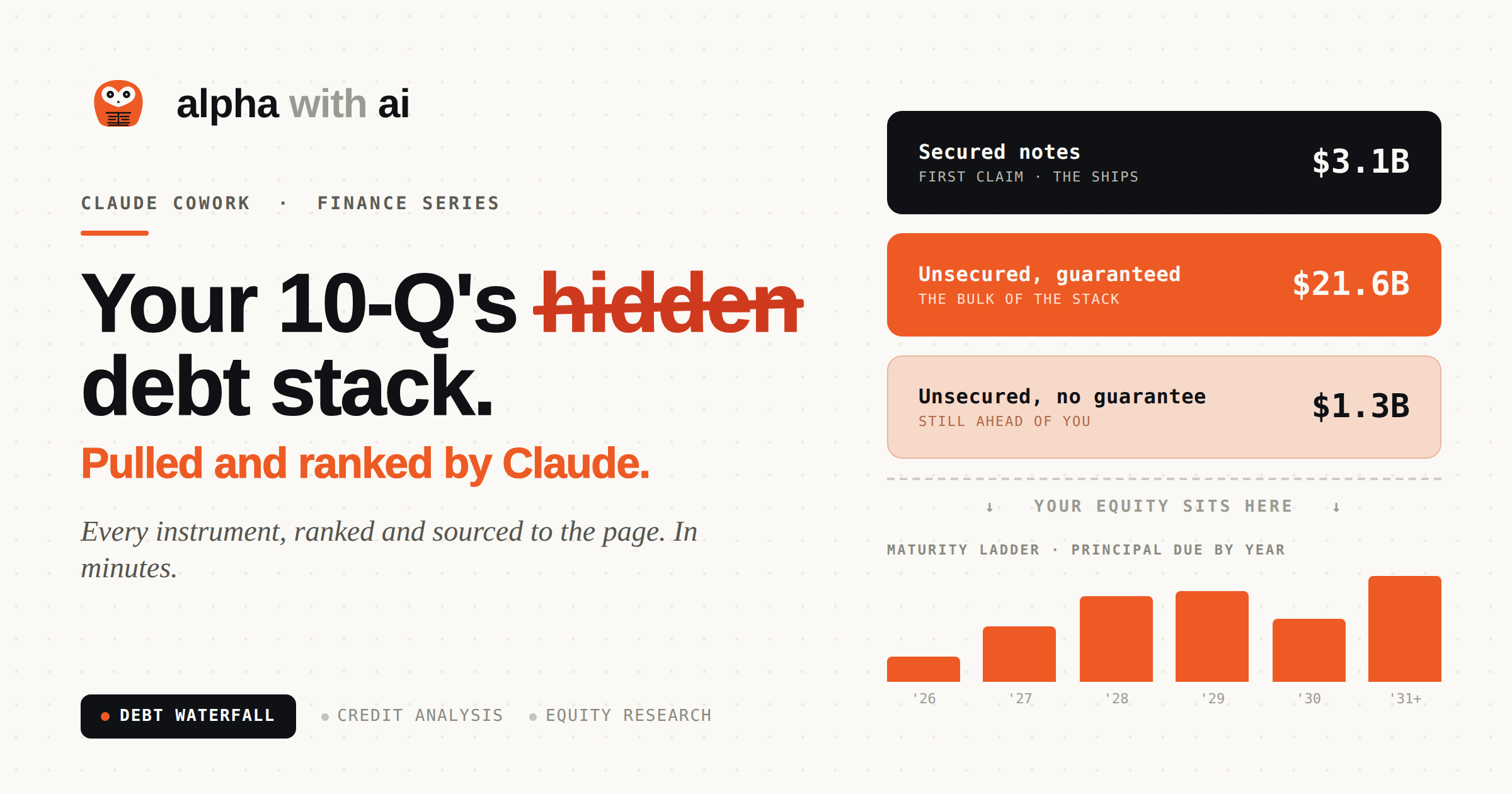
At the top, with the first claim, sits roughly three billion dollars of secured debt, backed by collateral and guaranteed by the operating subsidiaries. These get paid first, and they have assets pledged behind them.
Below that, the bulk of it. Around twenty one billion dollars of unsecured debt that is still guaranteed by the subsidiaries. Notes running out to 2033. Euro notes. Export credit facilities stretching all the way to 2037. No collateral, but a guarantee from the companies that actually operate the ships.
And below that, the weakest tier of the debt, a little over a billion dollars that is unsecured and carries no subsidiary guarantee at all. Structurally the most fragile borrowing Carnival has. And it is still ahead of you.
Three separate layers. Roughly twenty six billion dollars of claims. All of it stacked above the equity. All of it gets satisfied before a single dollar reaches a shareholder.
And here is the part that should bother you most. This stack does not sit still. In the most recent quarter alone, one set of convertible notes that had been sitting in that pile simply disappeared from the debt and reappeared as equity. Converted. New shares, printed on top of yours, while everyone was busy watching the price chart recover.
None of this is hidden. It is all in the filing. Every number I just gave you is disclosed, sitting in a debt note, available to anyone willing to read it.
That is exactly the problem.
It is disclosed, but it is scattered. The principal is in one table. The maturity is in another column. The guarantee structure is in the row headers. The conversion that reshaped your ownership is buried in the equity statement three pages away. To see the stack the way I just laid it out, you have to hunt through the document, cross reference footnotes, and assemble by hand a picture the company has deliberately spread across the entire filing.
So almost nobody does it. Not because they are lazy. Because it is genuinely brutal, and slow, and the price chart is right there looking like enough.
That is the regret I kept making. Knowing the equity story cold, and never reading the stack that sat above it.
This is how I make sure I never skip that work again. On Carnival, or on any company I own.
The Build, In Four Moves
I am not going to read that filing by hand. Not anymore.
Not because I cannot. Because I have done it enough times to know how it ends. I find the debt table. I start pulling tranches into a spreadsheet. Somewhere around the third Euro note I lose my place. I go hunting for a maturity date and end up reading a footnote about something else. An hour later I have half a table, I am not sure I caught everything, and I still have not touched the conversion language sitting three pages away in the equity statement. The work is real. It is just the kind of work that falls apart the moment my attention does.
So I wrote down the method once, in a form that runs the same way every time, and never gets bored on the third Euro note.
That written-down method is what I mean by a skill.
Let me be precise about this, because it is the heart of the whole edition. A skill is not a prompt I paste and lose. It is a small instruction file that holds my methodology permanently. The difference matters more than it sounds. A prompt you re-type from scratch each time forgets things. You forget to ask about make-whole provisions on one company, about the fundamental-change put on another, about the events that quietly moved the balances on a third. A skill does not forget. Every nuance I care about is written into it once, so every company I point it at gets the same thorough treatment, in the same shape, with the same discipline.
And here is the question I know you are asking, because it is the right one. If I build this looking at Carnival, how can it possibly work on Walmart, or Tesla, or an aircraft manufacturer, when their debt looks nothing alike?
Because the skill does not encode Carnival’s debt. It encodes how debt is disclosed.
This is the part worth slowing down on. Every company that files with the SEC, regardless of industry, discloses its debt the same way, because the accounting rules force it to. A debt footnote. Each instrument. Its principal. Its maturity. Its coupon. Whether it is secured or unsecured. Whether it is guaranteed. Where it ranks. The conversion, call, and put terms. The events that changed the balance over the period. Tesla’s convertibles, Walmart’s plain senior notes, an airline’s debt secured against its aircraft, Carnival’s three tiers stacked above the equity. The instruments are wildly different. The disclosure skeleton is identical.
So the skill never assumes what the debt is. It only knows the questions to ask of any filing, and it asks them every time. That is what makes one skill work across thousands of companies. Not luck. Structure.
There is one honest limit, and I will say it plainly because it is what makes the output trustworthy. The skill is only as complete as the filing. If a company buries a key term in an indenture that the 10-Q only references, the skill cannot invent it. But it will tell you that the term is missing and point you to where to go find it. It does not paper over the gap. It marks it.
The build itself is small. Four moves. Most of it is the model working while I drink my protein shake.
Before the moves, one thing about why this is worth your time even if you never look at a single bond.
What I am about to walk through is not really a debt lesson. It is a pattern. A mistake I kept making, turned into a small tool that stops me from making it again. The mistake here happens to be ignoring the debt stack. But the four moves are the same whether the skill you build checks a company’s debt, runs a macro lens, or forces a pre-mortem before you size a position. Learn the four moves once, and you can build a tool around any mistake you are tired of repeating. The debt skill is just my example. Yours will be different.
Move one. Define the job.
Before I touch a filing, I write one sentence. Who the skill is for, what situation it runs in, what it produces. Mine:
An equity or credit investor, looking at any company with meaningful debt, who needs every instrument, term, and ranking pulled from the filing into one clean, sourced structure before they trust their view of the company.
That sentence is the filter for everything after it. It tells the skill to work at the instrument level, not the summary level. It says the company is a variable, never a constant. Skip this and you get a vague “summarize the debt” tool that hands back the same shallow view we are trying to escape.
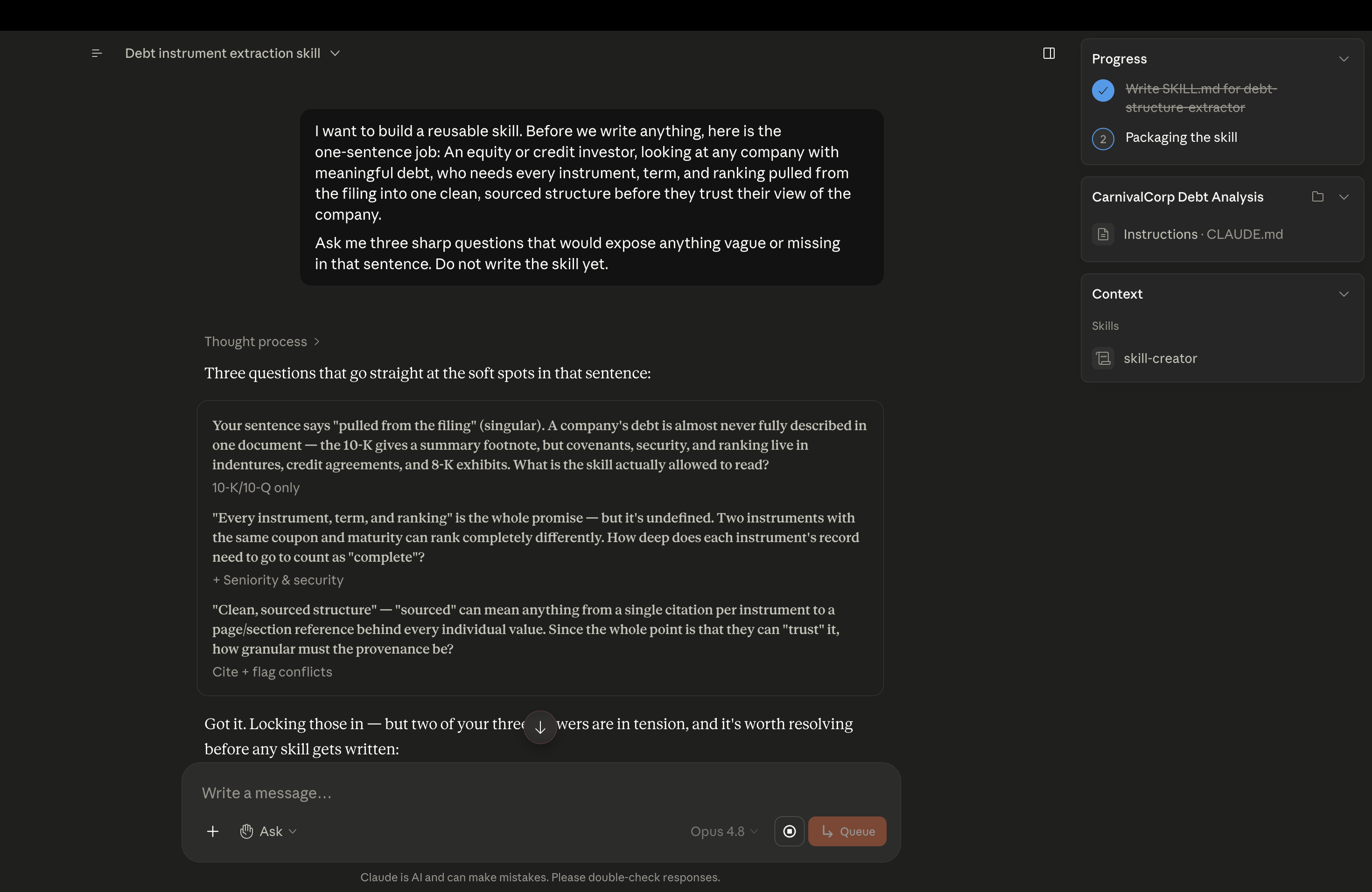
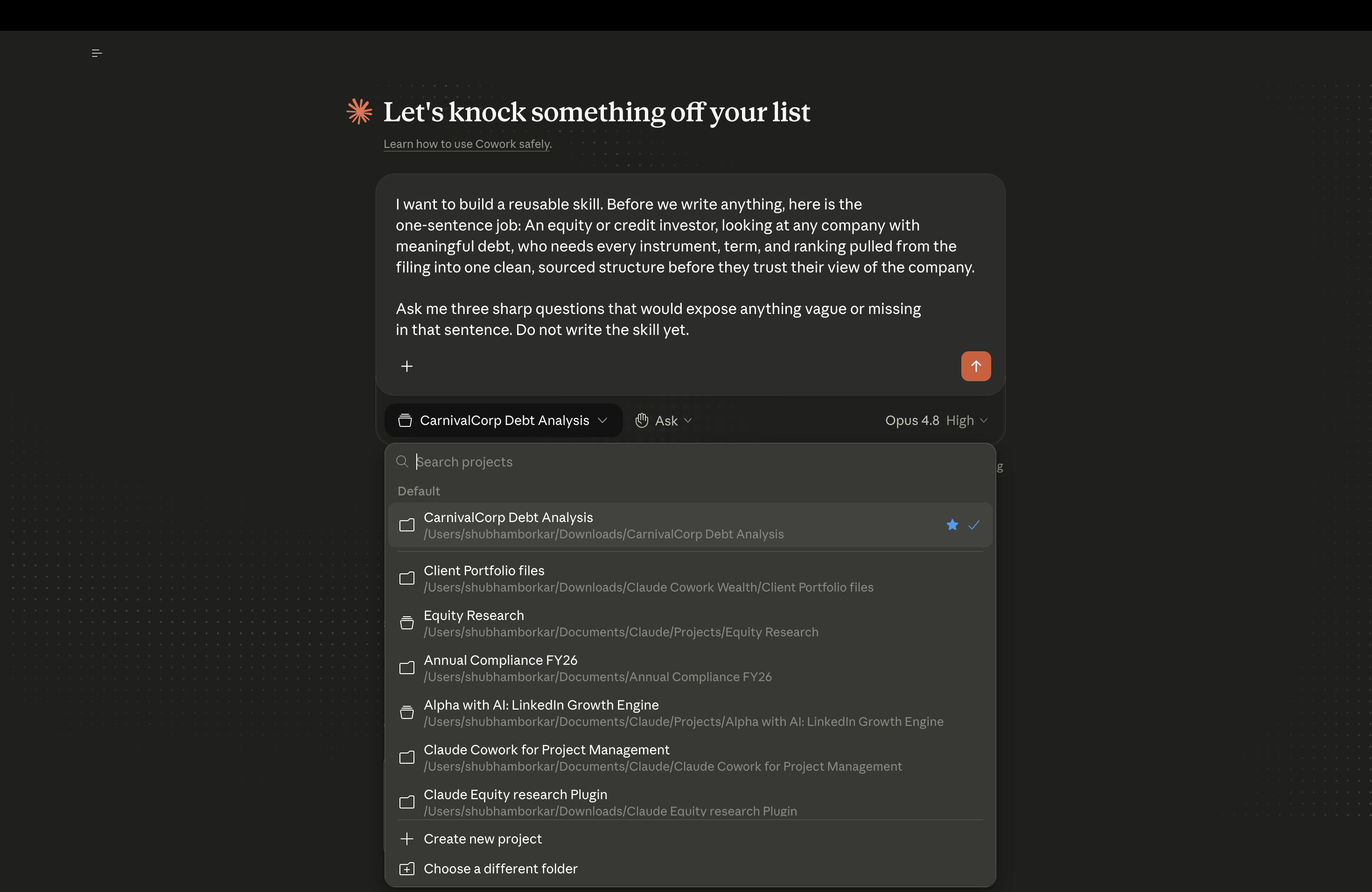
Here is the prompt I actually used to pressure-test that sentence before building:
I want to build a reusable skill. Before we write anything, here is the
one-sentence job: [paste your sentence].
Ask me three sharp questions that would expose anything vague or missing
in that sentence. Do not write the skill yet.It will create an iteration 1 of the Debt structure skill on the questions answered by you.
Move two. Teach Claude the structure of a good output.
This is the move people skip, and it is the one that matters most. I do not write the skill from my own head. I have spent couple of years half-knowing what a debt waterfall needs, and half-knowing is exactly how things get missed. So I hand Claude a real filing and have it work out, with me, the full structure of what a complete extraction must capture, before any skill exists.
This is where the hard-won detail comes from: every field a debt instrument has, every event that moves a balance, every footnote nuance, every gap that needs flagging. I am not asking Claude to remember debt. I am asking it to lay out the skeleton that any company’s debt is disclosed within.
The prompt:
Read the attached SEC filing's debt note. Do not summarize it.
Lay out the complete STRUCTURE a credit analyst would need to extract a
debt waterfall from ANY company's filing, not just this one. Organize it as:
1. The fields every individual debt instrument has (principal, maturity,
coupon, secured/unsecured, guarantee, ranking, conversion/call/put terms,
status).
2. The kinds of EVENTS that change a debt balance over a period (issuance,
repayment, conversion, redemption, repurchase, amendment).
3. The qualitative footnote terms that matter for risk (collateral,
covenants, make-whole, fundamental-change puts, special interest).
4. The categories of information that are often MISSING from a filing and
must be pulled from other documents.
For each, note where in this filing it appeared, so I can see the structure
is real. This becomes the backbone of a reusable skill.What comes back is the backbone: the fields, the events, the nuances, the gaps. The domain, laid out. Now the skill has something true to be built on.
Move three. Write the skill.
Now, and only now, I have Claude write the instruction file, using the structure from Move 2 and the discipline rules I insist on: read only the filing, cite every figure, flag what is missing, stay at the instrument level, never assume the company.
The prompt:
Using only the structure we just laid out, write a SKILL.md for a reusable
skill named debt-waterfall.
The skill must:
- Take any company's SEC filing as input and produce four outputs: a debt
master table ordered by ranking, an events ledger, qualitative notes, and
an open-items list.
- Read ONLY the filing given. Never use outside knowledge about the company.
- Put "NOT DISCLOSED" wherever the filing is silent, and record it in open
items. Never fill a gap from memory.
- Cite the page and section for every figure and every legal term.
- Stay strictly at extraction. No valuation, no recommendation, no opinion.
- Work on any filer in any industry, because it encodes how debt is
DISCLOSED, not any one company's debt.
Format as a standard SKILL.md with frontmatter, role, the four outputs,
reading instructions, output discipline, and what it does not do.What comes back is the skill. I read it once, tighten a few lines, and lock it. Here it is in full, free to copy:
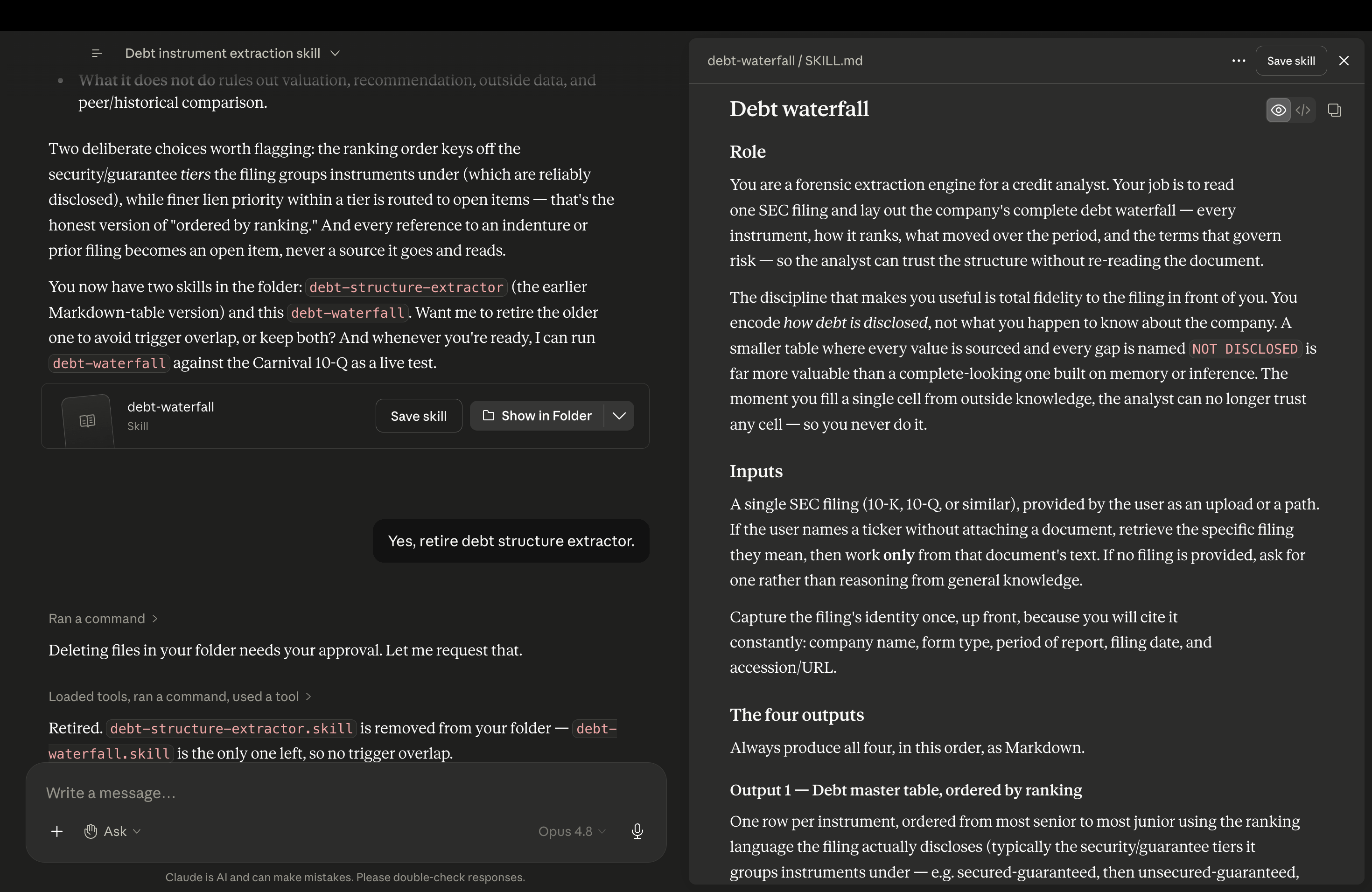
Read the rules in it. The one that governs everything: if a number is not in the filing, the skill does not supply it. That single rule is why I trust this output in a way I would never trust a raw AI answer.
Move four. Install it, run it, and carry the result into Excel.
I drop the skill into my skills folder so it loads automatically from now on. Then I test it. One folder for the company, the actual Carnival 10-Q from SEC EDGAR dropped inside, and I run the skill on that filing in the same chat where I built it.
It reads the whole filing and writes a single Markdown file: four parts, every figure cited back to the page it came from.
When the output came back, I did what I want you to always do. I did not trust it. I checked it.
I went down the events ledger and one line stopped me. It said the convertible notes had been settled for 69.1 million new shares and a 500 million dollar cash payment. I had read this 10-Q. I had skimmed the debt table and the cash flow statement, and I had not seen that anywhere. So my first instinct was that the skill had invented it. A clean, confident, completely made up number. Exactly the thing I had been warning you about.
I challenged it. I asked it, plainly, where did that figure come from, because I only gave you one document.
It went back to the filing and quoted the sentence to me, word for word. It was there the whole time. Not in the debt table. Not in the cash flow statement. In a single line of narrative further down the page, below the collateral section, in a part of the note I had skimmed straight past. The skill had read the whole filing. I had not.
Sit with that for a second, because it is the real lesson, and it is not the lesson I expected.
I assumed the machine was wrong. The machine had the receipt. The thing that saved me was not my own reading, because my own reading missed it. The thing that saved me was that every figure carried a citation, so I could go straight to the source and find out, in ten seconds, that I was the one who had been sloppy.
That is the entire point of building it this way. Not that the skill never needs checking. It always needs checking. But because it cites every number, checking takes seconds instead of an afternoon, and when I check, I find out the truth, whether the truth is that the skill missed something or that I did. This time it was me.
That is a smaller pile of regrets. Not because I stopped making mistakes. I will skim a filing and miss a line again next week. But the system caught it, the way a good system is supposed to, and it caught it before the number ever made it into anything I would have shown you as fact.
The full conversation, every prompt and every answer including this exact exchange, is shared here so you can watch it happen rather than take my word for it:
What Came Back
So here is what the skill pulled, and what I did with it.
The output was a single Markdown file. Four parts. A debt master table with every instrument ordered by where it ranks, from the secured notes at the top down to the unguaranteed debt at the bottom. An events ledger of everything that moved over the quarter. A qualitative note holding the covenants, the collateral, the cross-default language. And an open-items list telling me exactly what the filing could not answer and where to go find it.
A quick word on why the skill writes a Markdown file and not, straight away, an Excel sheet, because the obvious question is why add a step.
The Markdown file is the record. It is plain text, it will open in anything years from now, and it drops straight into my notes system as a permanent, searchable, sourced page on Carnival’s debt as it stood on this filing date. Next quarter, I run the skill again on the new filing, and I can lay the two text files side by side and see exactly what changed. The record is the thing worth keeping, and Markdown is the format that keeps.
Excel is the workspace. It is where I go to work the numbers, not store them. So once I have the record, I open it in Excel and let Claude in Excel turn it into something I can model on.
In Excel, the four parts became tabs, and Claude in Excel built a fifth: a maturity ladder, charted straight from the schedule the skill had pulled. Every figure and citation carried over verbatim. It even caught something I would have missed: the disclosed annual maturities sum to 26,003 against the filing’s own stated total of 26,004, a one dollar rounding difference inside the filing itself. It did not quietly fix it. It kept the disclosed number and flagged the gap. The same discipline that ran in Cowork was still running in Excel.
Now I could finally ask the questions that the price chart can never answer.
I asked how much debt comes due in the next two years. The answer came back as a live formula, not a guess: 7,568 million dollars, the remainder of 2026 plus 2027 plus 2028, which is 29.1 percent of the entire debt load. Nearly a third of everything Carnival owes falls due inside twenty-four months. That is a fact about the company you simply cannot see from a recovering stock price.
Then I asked how the stack splits across the three tiers. Secured and guaranteed, the debt with the first claim on the ships: 11.9 percent. Unsecured but guaranteed, the great bulk: 83.2 percent. Unsecured with no guarantee at all, the most fragile tier: 4.9 percent. So the thing sitting most directly above the equity is not the secured debt everyone pictures. It is twenty-one billion dollars of unsecured, subsidiary-guaranteed notes, more than four out of every five dollars of debt.
And then the check that matters most. I asked it to confirm the three tiers actually add up to the total. They tied exactly. 3,098 plus 21,644 plus 1,262 equals 26,004, the disclosed gross debt, difference zero. Every percentage I just gave you is a live formula dividing one disclosed figure by another. Nothing was re-keyed, nothing was rounded by hand, and I can click any cell and trace it back to the filing.
This is the part I could never do quickly by hand, and it is the part that changes how I see the company. Not the price. The shape of what has to be repaid, when it comes due, and who stands ahead of me if it ever goes wrong. Thirty percent due in two years. Eighty-three percent of the stack unsecured but guaranteed. That is a view of Carnival most people who own the stock have never once looked at.
If you want to poke at the actual workbook, the five tabs, the maturity ladder, the tier-mix and the reconciliation checks, I have shared it here:
Note: every figure in it traces back to Carnival’s 10-Q, and the cells are live formulas, not typed-in numbers. Open any one and you can follow it to the source. I have left it exactly as the skill produced it, including the one dollar rounding gap the filing carries in its own maturities table, because the point is fidelity to the document, not a tidier version of it.
I have shown before how Claude works directly inside Excel to build a full model from scratch. If you want to see it handle a model rather than an extraction, I wrote about that here:“Claude Now Lives Inside Excel”. There, it built. Here, it organized what the skill pulled and let me interrogate it, so the answers still trace to the filing.
But Doesn’t Claude Already Do This?
A fair question, and one I had to sit with before I bothered building any of this.
I am not new to the official plugins. I have run the Equity Research plugin inside Cowork to initiate coverage on a company, build the model, and write the full thesis in an afternoon, work that used to take three days. I wrote that one up here, and it is the most-read thing I have published, so if you want to see an official plugin doing serious equity work, start there: “How I used Claude Cowork to write a full equity research report in 90 minutes”. So the question is honest. The platform already ships broad finance tools, equity research, investment banking, private equity, each a purpose-built workflow. Why write my own narrow skill for one slice of the job when these exist?
Because broad and deep are different things, and a debt waterfall needs deep.
The general tools are built to cover a lot of ground. They initiate coverage, build the model, draft the thesis, format it to your firm’s template. They are genuinely powerful, and they are the right tool for most of the work. But notice what that power comes with. When the equity plugin built me a six-sheet model, the balance sheet did not balance on the first pass. That is not a failure. It is the nature of a tool that generates a whole view fast: it produces something complete-looking that you then must audit, line by line, before you trust it.
A debt waterfall is the opposite kind of job. I do not want the tool to generate a view. I want it to refuse to generate one. I want it to read the filing, pull every instrument, rank it by seniority, separate the guaranteed from the unguaranteed, trace each figure to its page, flag the one sentence on page ten everyone skims past, and then tell me plainly what the filing could not answer. Not a confident model I have to debug. A sourced structure where every number already carries its receipt.
That is the difference. A broad tool, asked about debt, gives you a clean, complete-looking answer you then have to verify. My narrow skill gives you a structure where the verifying is already half done, because every cell points at its source and every gap is named out loud. For generating a thesis, complete-looking and then audited is the right shape. For the debt stack, where one missed put date or one buried conversion changes the whole picture, I want the tool that tells me where the holes are, not the one that smooths over them.
This got easier to trust recently, and it is worth naming why. The newest model underneath all of this(opus 4.8), the one I ran the build on, was tuned specifically to do less of the thing that makes AI dangerous for this work. It is measurably less likely to state something it cannot support, and more likely to flag when it is unsure. For a debt extraction, that is not a minor upgrade. The single most valuable output my skill produces is not the table. It is the open-items list, the honest accounting of what the filing did not say. A model more willing to admit a gap than to paper over it is the difference between a research tool and a liability.
So the answer is not that the official tools are wrong and mine is right. They do different jobs. The broad plugins handle the everyday, the coverage, the model, the report. The narrow skill handles the one place where I cannot afford a confident guess, and where what I most need from the tool is the discipline to say “this is not in the filing.” I use both. I just do not let the broad tool near the part of the work where being wrong is expensive.
It does one thing the broad plugins do not. It refuses to tell me what it does not know. On the debt stack, that is the only thing I actually want.
Where This Breaks
I would be doing the opposite of everything this newsletter stands for if I told you the skill solves the whole problem. It does not. Here is exactly where it stops.
The skill is only as complete as the filing you feed it. A 10-Q’s debt note tells you an instrument is “senior secured,” but the true lien priority among the secured tranches, who actually gets paid first if it comes to that, lives in the indenture and the intercreditor agreement, not in the filing. The skill cannot tell you what the document does not say. For Carnival, it pulled the three secured notes cleanly, but the relative ranking among them came back as an open item, pointing me to the agreements. That is correct behavior. It is also a real limit.
The same is true for covenant definitions, call and redemption schedules, make-whole formulas, the conversion terms on a convertible. The filing gives you the thresholds and the headline terms. The precise definitions sit in documents the 10-Q only references. The skill flags every one of these and tells you where to go. It does not pretend to have read what it was never given.
So this is not a tool that ends your diligence. It is a tool that starts it from a clean, sourced base instead of a blank page, and hands you a map of exactly what is left to chase. On a company with a genuinely complex secured structure, you will still be opening the indenture. The skill just makes sure you know precisely which one, and why.
That is the honest shape of it. It does the brutal, mechanical, error-prone part fast and with citations, and it is candid about the part it cannot do. I would not trust a tool that claimed more. Neither should you.
The Smaller Pile
I started this by telling you the market is a place of regrets, and that the only work that matters is carrying fewer of them than you did last year.
This skill is one regret, handled.
The regret was knowing a company’s equity story cold and never reading the stack of claims sitting above my shares. Not because I could not. Because the work was brutal, and the price chart was always right there looking like enough. So I did what I have started doing with every recurring mistake. I stopped trying to be more disciplined by willpower, and I built something that carries the discipline for me. Read the filing. Cite every number. Rank every claim. Say plainly what is missing. Every time, the same way, in minutes.
But the debt skill is not really the point, and I hope that came through. The point is the four moves. Define the job in one sentence. Let the model learn the structure from a real document. Have it write the skill. Install it and test it. Those four moves do not care whether the mistake is ignoring the debt stack, or skipping the macro picture, or sizing a position before you have written down what could break it. The mistake is yours to name. The method is the same.
I have been building these for a while now, across the parts of my work where I kept slipping.
A skill that runs Dalio’s Big Cycle on any country before I commit to a cross-border thesis, which I walked through here:“I Built a Claude Skill That Replaced the Finance Books I Will Never Read”.
The everyday workflows too, the unglamorous ones, like prepping thirty client portfolios before a Monday open:“How I used Claude Cowork to prep 30 client portfolios in 20 minutes”, or
handing a month of compliance to Cowork instead of dreading it:“Claude Just Replaced My Accountant”.
Each one started the same way. A mistake I was tired of making. A piece of the work I kept doing badly because doing it well by hand was too slow.
None of this makes me a better investor in the way the books promised. I am not more disciplined than I was in 2018. I still skim a filing and miss the line on page ten. I proved that to myself in the middle of building this very skill. What has changed is that the misses get caught now, by a system that does not get bored and does not skim, before they cost me anything.
That is the whole of it. You will never stop making mistakes in this market. Neither will I. But every recurring one is a candidate to be turned into something that catches it for you. Build the skill around the mistake. Carry a smaller pile.
The book you will never finish, the filing you will always skim, the diligence you will always cut short when you are tired. You do not need to become the person who never does those things. You need to build the thing that does them when you do not.
Files in this release
Everything from this build is in one public repo, free to read and run:
Note: the skill reads only what a filing discloses. Where Carnival’s terms live in the underlying indentures, the output says so and points you there. It starts your diligence from a sourced base; it does not end it.
That's it for this one. If it was useful, hit the ♡ Like, it genuinely helps this reach the investors who need it.
Know someone who owns a stock but has never read its debt stack? Send it their way.
Hours of research and building go into each of these. If you want every skill, workflow, and the downloadable companion guide as they ship, consider upgrading. A few past editions worth your time:
Disclaimer: Alpha with AI is written and covers US-listed and other global securities for educational and research purposes only. Nothing here is investment, legal, or tax advice. The skill and its outputs read only the filings provided and cannot capture terms held in documents a filing merely references. Always verify against primary sources and consult a qualified professional before making investment decisions.
Written by Shubham Borkar | Research & Insights by Shikshan Nivesh AI Team
Financial Clarity. Insightful Ideas.
The launch offer
Here’s the part for anyone who’s been reading and wants in.
For the next two weeks, until 8 June, you can join at 25% off your first year. It’s my way of thanking the people who showed up early, before there was ever a paywall.
Prices show in your own local currency automatically, so you’ll see a familiar number at checkout. As a rough guide, membership works out to around $39 a month or $345 a year, with the launch discount bringing the first year down to about $260.
If you’ve found these workflows useful, this is the moment. The offer closes on 8 June, and after that it’s full price.