


I have learned to distrust a stock that looks perfect.
That distrust is earned. I have paid for the lesson more than once, buying the clean-looking thing and finding out later what the clean was hiding. So now when a business screens as the best in its industry and trades like one of the worst, I do not get excited. I get suspicious. A gap that wide is not a gift someone left out for me. Somebody on the other side of it knows something, and the work is finding out what.
This one screens close to perfect.
Margins at the top of its entire global industry. No real debt. A cash balance bigger than the business needs. Almost all of its profit handed back to shareholders every year. Number one in every market it operates in, not most of them, all of them. And it trades for a fraction of what the big Western name in the same business commands.
Read that list and you want to own it. I wanted to.
Then you find the part the list leaves out.
It does not own its own technology. The system that moves the drivers, the payments, the data underneath all of it, none of that belongs to the company. It rents it. From the parent. The same parent that holds most of the stock and nearly every line of the software, and that is, right now, being bought by the company’s single biggest competitor in the world.
So the clean screen is not clean. The business is genuinely very good, and that part is not really in question. What is in question is whether a small shareholder standing on the outside ever gets to collect on it, or whether the people holding the controls quietly decide that for you.
The company is Talabat.
The odds are, probably you have never heard of it unless you have spent some time in the Gulf, in which case you have probably used it. It is an app which large part of the Middle East opens when it wants food, groceries, or medicine at their doorstep. It has traded in Dubai since December of 2024, which is carved out of a German parent that has itself become a takeover target since.
I wanted this to be a simple one. It is not. And working out why is the whole point of what follows, because the thing that decides your return here may turn out to have almost nothing to do with how good the business is.
One housekeeping note before the dive begins. This Research Dive is free for most half. That is deliberate. I would rather show you what a paid Research Dive looks like than describe one. And the paid side of Alpha with AI has grown this month. Alongside the AI research workflows this newsletter started with, paid subscribers now get two or three Research Dives a month on US-listed and other global companies, and the live model portfolio every position sized, dated and tracked. If you want that, upgrade below.
What Is Talabat, and Why Is the Best Business in Food Delivery Trading at a Discount?
(The whole thesis up front, for anyone who reads nothing else.)
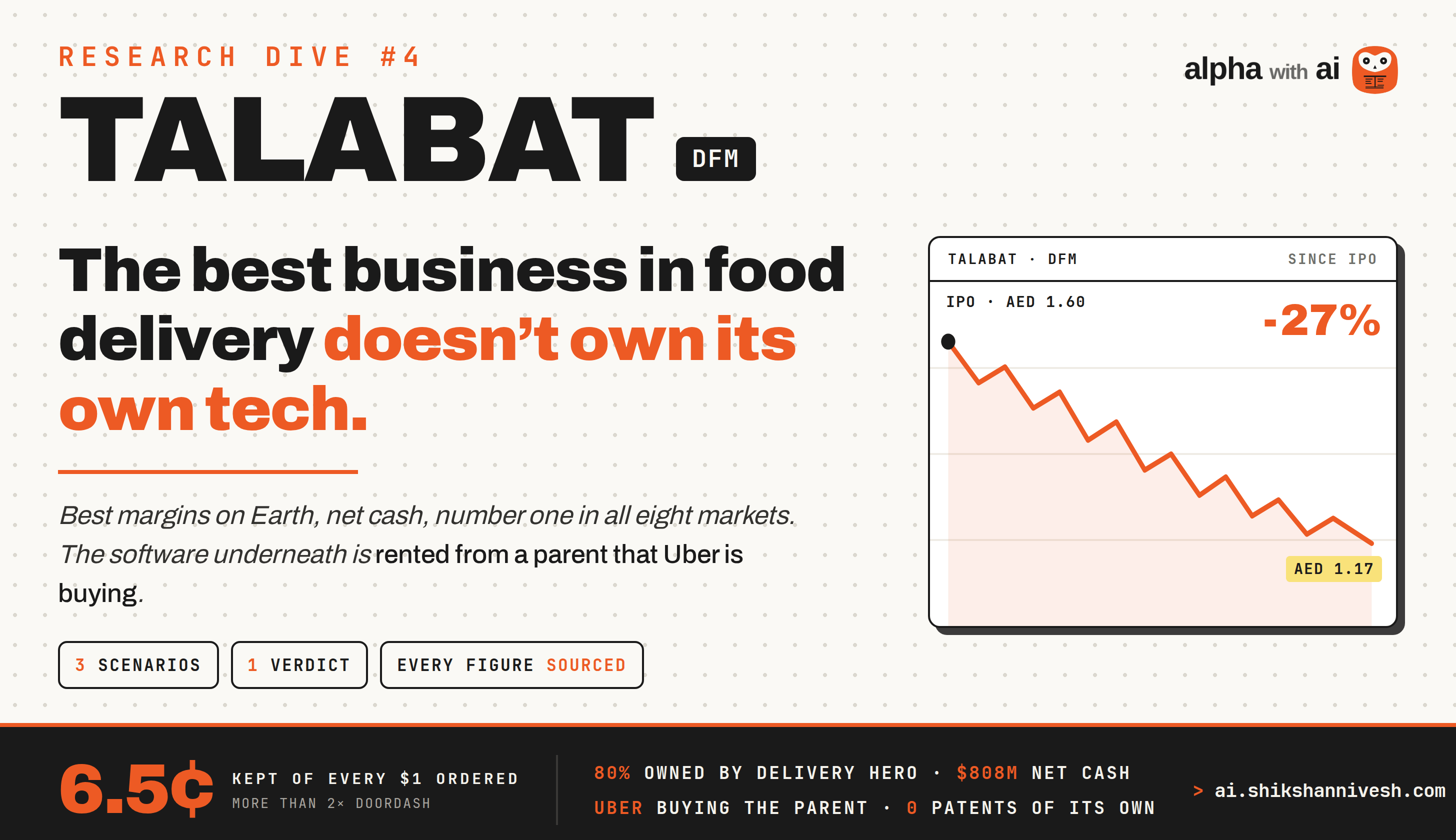
What it is. Talabat (DFM: TALABAT) is the largest food-delivery and quick-commerce company in the Middle East and North Africa, the app people in eight countries open to get restaurant meals, groceries, and pharmacy orders to the door. It listed in Dubai in December 2024. Delivery Hero, the German group that built it up, still owns about 80 percent.
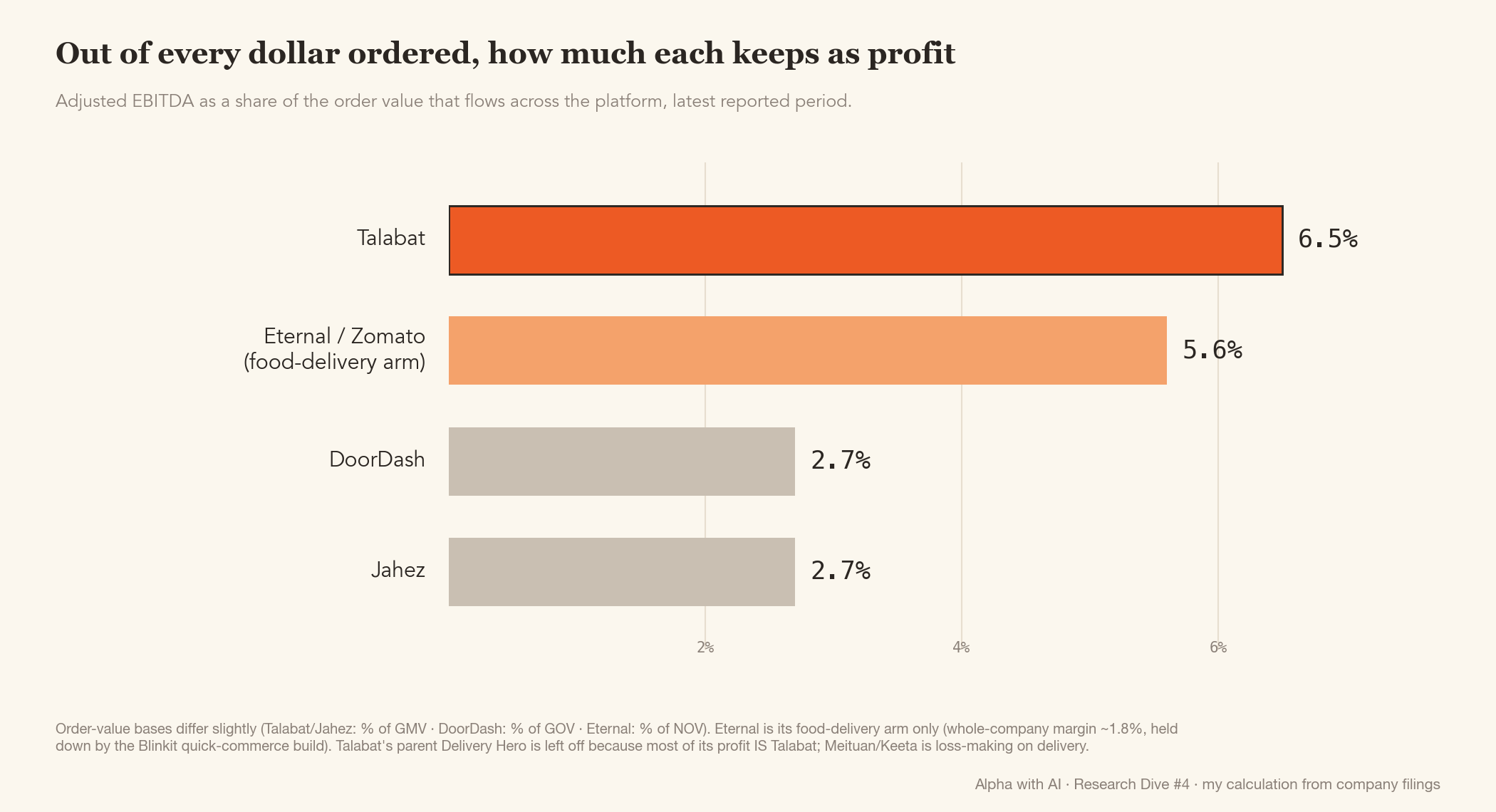
The one fact that matters. Out of every dollar that flows across its platform, Talabat keeps about six and a half cents as operating profit, on the adjusted measure the company itself forecasts and reports. That is among the highest margins of any listed food-delivery company, and more than double DoorDash’s. Even Eternal, the Indian company behind Zomato and Blinkit that Talabat is most often compared to, earns a little less on its food-delivery business than Talabat does. This high-margin food business is the engine, and it throws off cash: no debt, around 800 million dollars of net cash, and a dividend that returns about 90 percent of each year’s profit to shareholders. That last figure is a payout ratio, not a yield. The company hands out most of what it earns, which at today’s share price works out to roughly a 5 percent dividend.
Why it looks cheap. The market values the business at about 12 times a year of that operating profit. DoorDash, its closest Western peer, trades at 18 to 24 times while earning less than half the margin. India goes further still: in their sum-of-the-parts valuations, analysts there put Zomato’s food-delivery arm alone at something like 35 to 45 times a year of its profit, part of the steep premium Indian markets pay new-age technology companies. That Indian number is not a fair yardstick for Talabat, and I am not holding it up as one, but it shows how differently the same business gets priced depending on where it trades. So the best-margin, cash-richest name in the industry is also one of the cheapest. On the numbers alone, it looks like a high-quality business on sale.
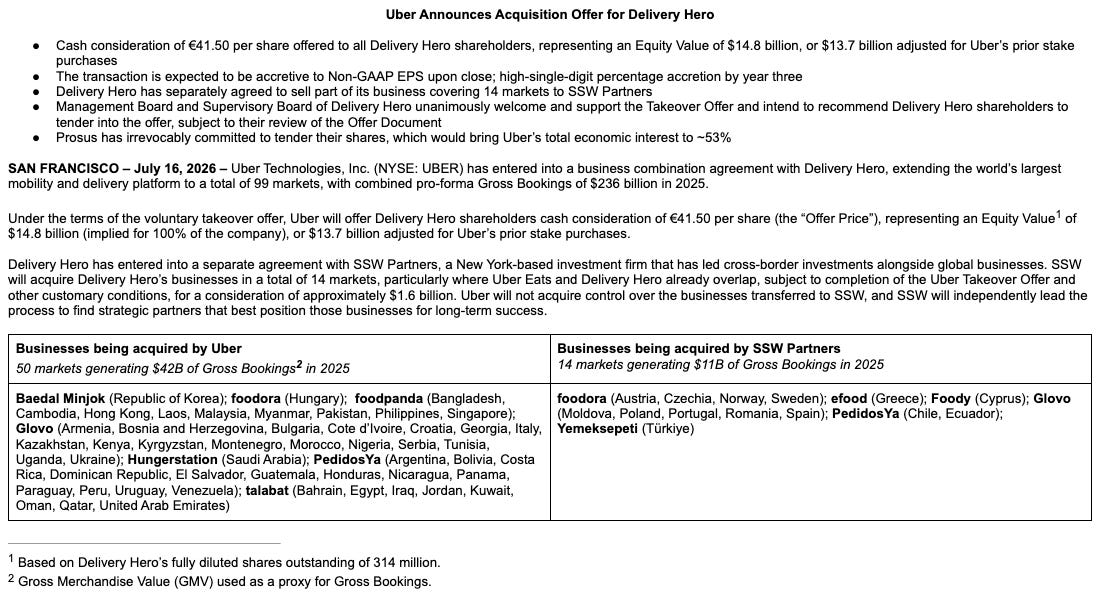
The catch, and it is a big one. Talabat does not own the software that runs it. The system that dispatches the drivers, the payments, almost all of it is licensed from its parent, Delivery Hero. And Delivery Hero is itself being bought by Uber, in a deal expected to close in the second half of 2027. So control does not simply pass to a new owner. It passes to Talabat’s biggest global competitor, the company behind Uber Eats. Talabat will still not own its technology afterwards. The licensor just sits inside Uber instead of inside a German group, and whether that licence continues on the same terms has not been spelled out anywhere. There is a version of this that cuts the other way: once the company that owns Talabat’s software sits inside the same group that controls Talabat, that owner has its own reason to keep the technology healthy, because it now profits when Talabat does. Whether that comfort or the competitive conflict wins out is genuinely open. For now Talabat keeps its brand, its Dubai listing, and its minority shareholders, who are not being bought out. What Uber does with it later, leave it standalone, merge it with its Careem business in the region, or fold it deeper into its own system, is an open question. And because of the way Talabat is legally set up, a small outside shareholder has no guaranteed fair-price exit if the controller ever decides to buy them out. The discount is not the market being slow. It is the market pricing all of that uncertainty.
What could turn it. Talabat stays cleanly listed under Uber with the dividend intact; margins settle as the current spending phase ends; the subscription and grocery arms keep scaling; or a buyer takes the whole thing private at a real premium.
What would break it: Keeta, the Chinese-backed challenger, winning the Gulf price war; a new owner cutting the dividend that is much of the reason to hold the stock; or a cheap, forced buy-out of the minority.
How Did Talabat Go From a Kuwaiti Startup to a Delivery Hero Company Trading in Dubai?
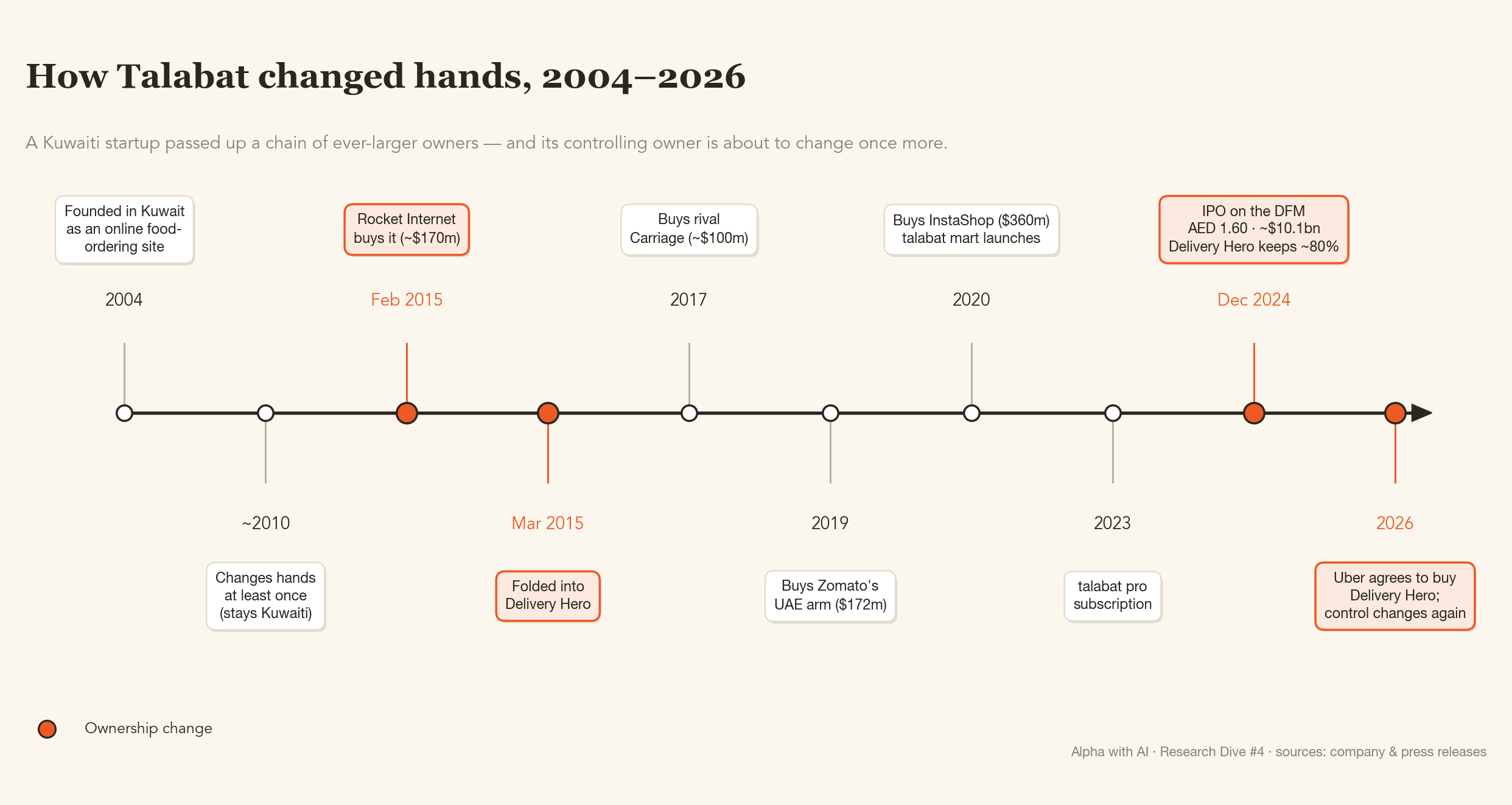
Talabat did not begin as anyone’s crown jewel. It began in 2004, in Kuwait, as one of the first websites in the region that let you order food without picking up the phone. The name is the Arabic word for orders. At the time fewer than a third of Kuwaitis were online, so this was an early, almost premature bet on people doing ordinary things through a screen.
Who exactly founded it is not settled, and I am not going to pretend it is. A group of Kuwaiti founders got it going; the name most tied to its early rise is Abdulaziz Al Loughani. What matters more for this story is what came after, because Talabat spent the next decade being handed up a chain of larger and larger owners, and control moved a little further from the people who actually used it at every step.
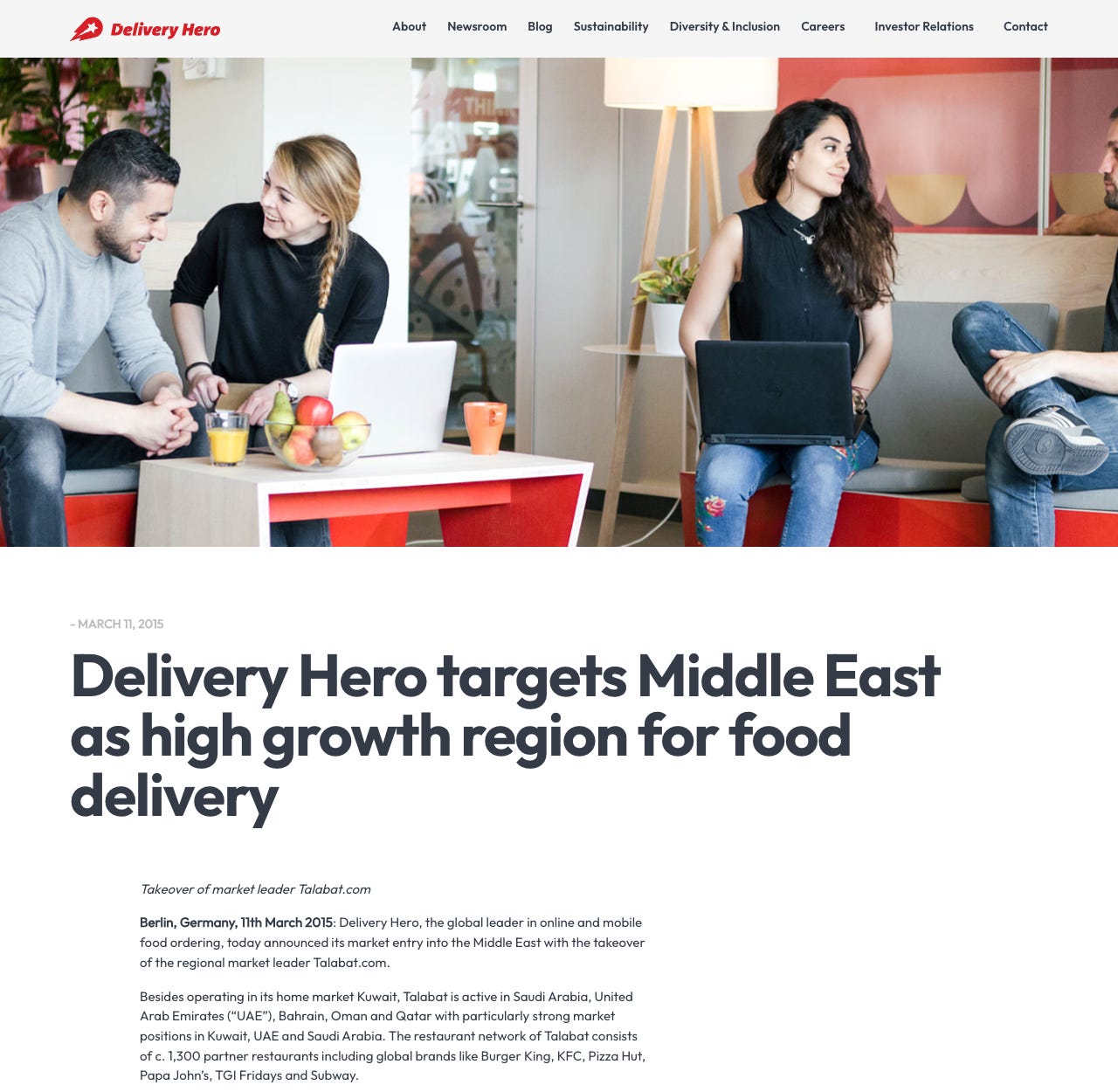
It changed hands at least once while it stayed Kuwaiti. Then, in February 2015, it left the region entirely. Rocket Internet, the Berlin startup factory, bought Talabat for about 170 million dollars. At the time that was the largest technology exit the Middle East had seen since Yahoo bought Maktoob. Weeks later Rocket folded Talabat into Delivery Hero, the German delivery group it was backing, and Delivery Hero has owned it ever since. What Delivery Hero itself paid was never disclosed, because it was not really a purchase. It was one Rocket company being moved inside another.
From there, Delivery Hero did something deliberate.
It made Talabat the master brand for the whole region and fed its other Middle East businesses into it. It bought Carriage, a Kuwaiti rival, in 2017 for around 100 million dollars, ran it on Talabat’s system, and let the Carriage name fade. It folded in Otlob, its Egyptian brand. In 2019 it bought Zomato’s business in the United Arab Emirates for 172 million dollars and put that under Talabat too. In 2020 it paid 360 million dollars for InstaShop, a Dubai grocery marketplace, though that one it kept running on its own. One market sits outside the umbrella: Saudi Arabia, the largest economy in the Gulf. Talabat was there once. It sold food in Saudi Arabia in its early years, and Delivery Hero’s 2015 takeover announcement still counted Saudi Arabia among its strongest markets. But Delivery Hero also owned a Saudi delivery brand of its own, HungerStation, and in the consolidation that followed, Saudi Arabia became HungerStation’s territory. Today Talabat does not operate there at all, and its executives describe staying out as a choice about where the money earns more, not a door that is closed. Worth remembering the next time you hear it called the leader of the region.
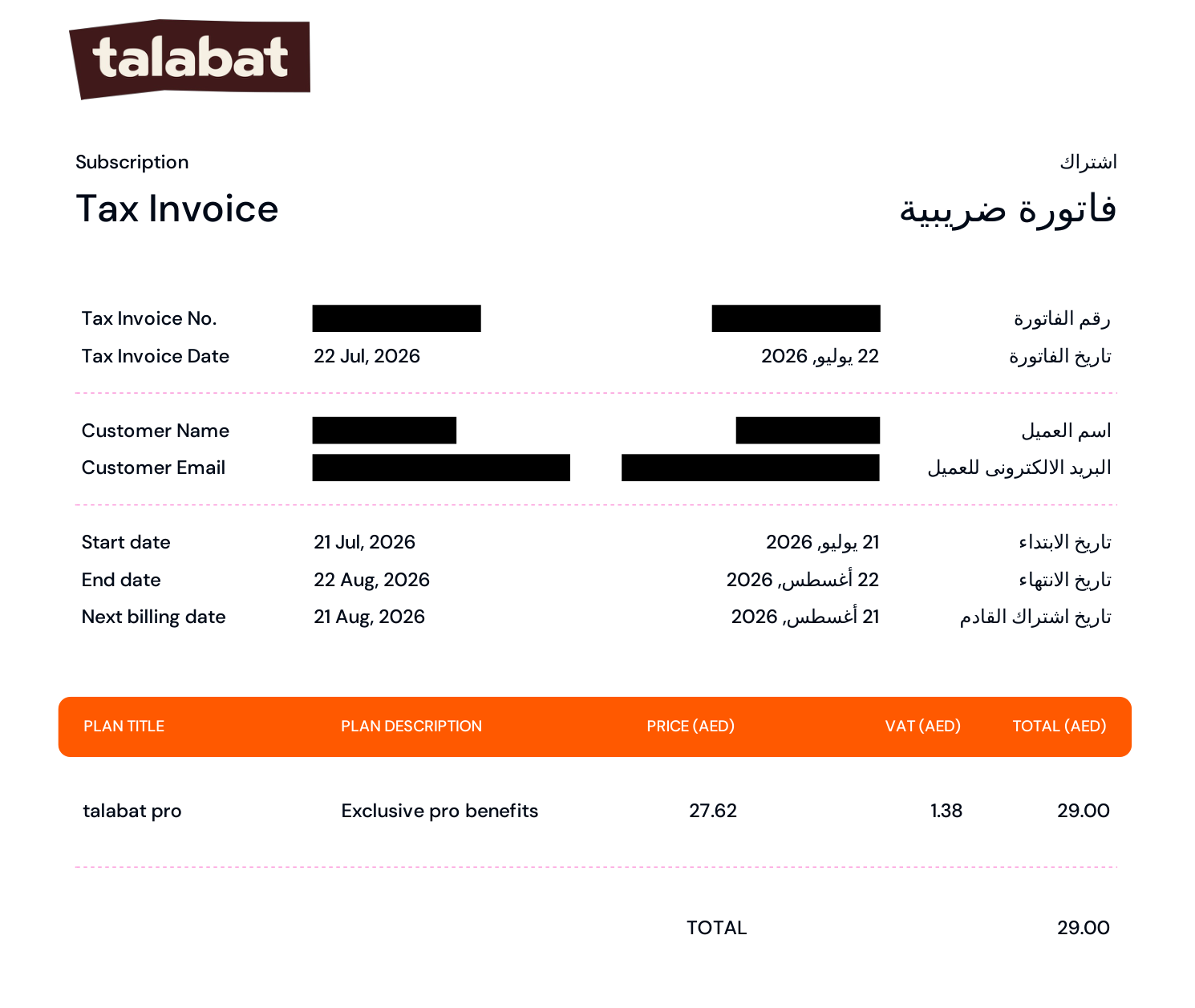
While the ownership was being reshuffled at the top, the business itself grew into something wider than food. Talabat spread across the Gulf from 2011 and into Egypt and Jordan soon after, settling at the eight countries it covers today. During the pandemic in 2020 it launched talabat mart, its own grocery service that promises delivery in about half an hour from small local warehouses the industry calls dark stores (an unglamorous name for a shop with no shopfront, built only to be picked from). From 2023 it began selling a paid membership, talabat pro, that bundles free delivery and discounts. The price is AED 29 a month including tax, about 8 dollars, and in Dubai a single delivered meal often costs more than that. So the fee is not the business. The behaviour is. A customer who pays even a small monthly charge for free delivery has less reason to open four rival apps to compare, because an order placed anywhere else forgoes something already paid for. The membership turns an open contest into a default, and it hands Talabat a piece of revenue that repeats every month whether or not you order that day. The company discloses enough to show how far this has gone. At the IPO, about 8 percent of its customers held a subscription. By the middle of 2026, subscribers accounted for 51 percent of everything ordered on the platform by value, up from 37 percent a year earlier. The whole strategy has a name inside the company: the everyday app. The idea is to stop being the thing you use when you want a takeaway and become the thing you open for groceries, pharmacy, and the rest, several times a week instead of once.
For most of the run-up to the listing, Talabat was run by Tomaso Rodriguez, chief executive from 2019 to 2025, who oversaw the consolidation and took the company public. In October 2025 the company said he would hand over to Toon Gyssels, who took the job on the 21st of November 2025. Gyssels is a returnee, back after earlier stints at Talabat, and he has framed his tenure around leaning harder on AI. A change at the top is not, on its own, a warning sign. It is worth noting all the same that the person who built the story now sits on the board, and someone new owns the results.
Which brings us to the part that actually put Talabat in front of you. On the 10th of December 2024, Delivery Hero listed it on the Dubai Financial Market under the ticker TALABAT. By the money it raised, it was the largest technology IPO in the world that year, though 2024 was a thin year for big technology listings, so the label flatters it a little. The offer price was 1.60 dirhams a share, which valued the whole company at roughly 10.1 billion dollars. Demand was strong enough that Delivery Hero raised the size of the sale from 15 percent of the company to around 20 percent, and took in about 2 billion dollars.
Here is the detail that tells you whose deal this was. Every one of those dollars went to Delivery Hero, not to Talabat. It was what the market calls a secondary offering (the existing owner selling its own shares, rather than the company issuing new ones to raise money for itself). Talabat received nothing beyond its expenses. Delivery Hero cashed in part of its most valuable asset, kept about 80 percent, and kept control. And there is one more piece of the structure that matters a great deal later, so it is worth slowing down for. The shares you buy trade on the Dubai Financial Market, the stock exchange in Dubai. The company itself, though, is not registered in Dubai. It is registered in the Abu Dhabi Global Market, which is not a stock exchange at all. It is a financial free zone in a different emirate, Abu Dhabi, that runs on English-style common law, with its own courts and its own company law. So you trade the stock under Dubai’s exchange, while your rights as a part-owner, how you vote and whether you can be forced to sell your shares, are set by Abu Dhabi’s rules. Two emirates, two different jobs. Hold that. It becomes the whole question near the end.
The listing itself was not a triumph on day one. The stock opened above the offer price, then reversed, and closed its first session at 1.49 dirhams, nearly 7 percent below where it had been sold. A great business, a record IPO, and a market that was not quite sure what to make of it from the very first afternoon.


How Big Is Gulf Food Delivery, and Why Is It the Most Profitable in the World?
That is the company’s story. The market it lives in has one too, and it starts with a number that does not exist.
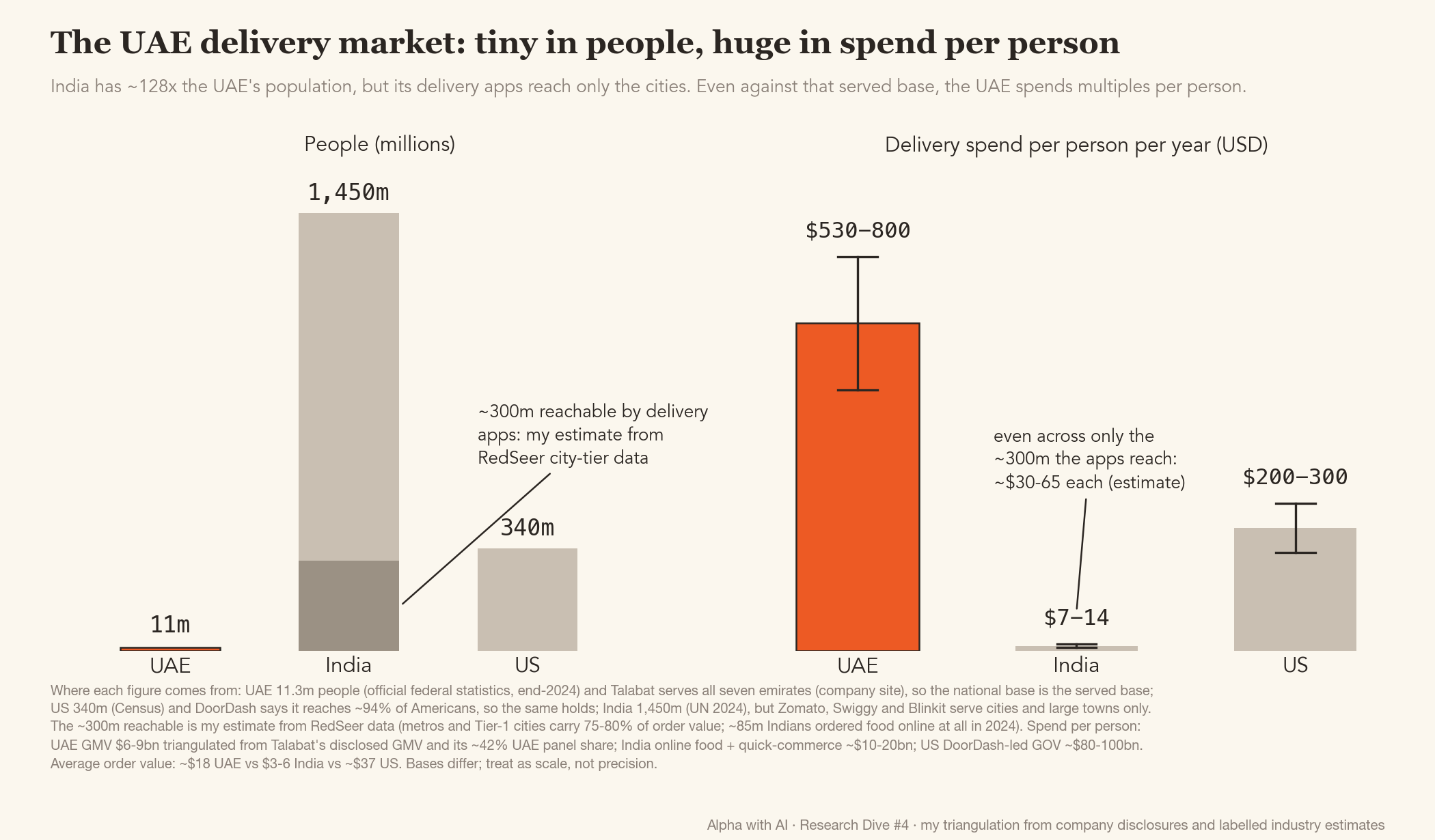
No one publishes the size of the UAE food-delivery market. Not the government, not the exchange, not Talabat. The private research firms that estimate it do not agree, and their numbers run from about 700 million dollars to more than 9 billion for the same year. That range is not a real disagreement. It is that they count different things. The low numbers count only the fees the platforms keep. The high numbers count the full price of every order, the food and the fees together.
Since there is no official figure, I estimated it from Talabat’s own numbers, and the steps are simple enough to check. Talabat processed about 9.4 billion dollars of orders across its eight countries in 2025. Assume the UAE, its largest single market, is somewhere between 28 and 35 percent of that, which is what the disclosures hint at without stating: call it 2.6 to 3.3 billion dollars of UAE orders. Outside estimates put Talabat’s share of the UAE market near 42 percent, so divide, and the market comes out at roughly 6 to 8 billion dollars a year counting the full value of orders, stretching toward 9 if either assumption is loosened, or 0.7 to 2.5 billion if you count only the platforms’ fees. It is growing at a high single-digit to low double-digit rate. Three things to be honest about with that estimate. The 42 percent share comes from an unaudited restaurant-industry panel. The UAE slice of Talabat’s own business is my assumption, not a company disclosure. And the 9.4 billion I started from is everything ordered through Talabat, groceries included, while the 42 percent share was measured on restaurant orders alone, so the honest label for my range is delivered food and groceries, not food by itself. Treat it as a careful estimate, not a hard fact.
Here is the part that matters more than the size. Judged by what its biggest player earns, I cannot find a more profitable food-delivery market anywhere.
Talabat keeps about six and a half cents of profit out of every dollar ordered. DoorDash, in the United States, keeps under three. The reason is a gap the Gulf has and almost nowhere else does. On one side, the baskets are large: an affluent, convenience-first population orders expensive food. On the other, the cost of carrying it is low, because a deep pool of migrant labour drives the bikes. High value per order, low cost per order, and the space between the two is the margin. Then stack on the physical setup. This is the densest high-rise living in the region, so a rider drops five orders in one tower instead of driving between five houses. And the heat runs extreme for close to five months a year; for three of them, mid June to mid September, the government bans outdoor work in the early afternoon. All of it pushes people indoors and onto the app. Wealth, density, cheap delivery labour, and heat that keeps people indoors and ordering. That is why an eleven-million-person country supports a multi-billion-dollar delivery market and the highest margins in the business.
It is worth being just as clear about the other side of that, because it sets the ceiling on everything that follows. The UAE is small. India, where Zomato and its rivals operate, has about 128 times as many people. The five Gulf countries Talabat serves hold about 26 million people between them, fewer than greater Delhi. So Talabat cannot grow the way an Indian platform grows, by adding a hundred million users a year. It is already the largest player in every market it operates in. Its growth has to come from somewhere narrower: defending and taking share from new entrants, selling more than restaurant meals through the same app, getting the customers it already has to order more often, and leaning on its faster-growing smaller markets in Egypt, Jordan, and Iraq. This is a business that wins on the value of each order, not the number of new mouths. And that is exactly why it out-earns India on margin. A Gulf order is worth several times an Indian one while costing about the same to carry to the door, so more of each order survives as profit. That is why its food-delivery margin sits just above Zomato’s, even though Zomato serves a market more than a hundred times larger.
Who Competes With Talabat in the UAE, and Who Owns Them Now?
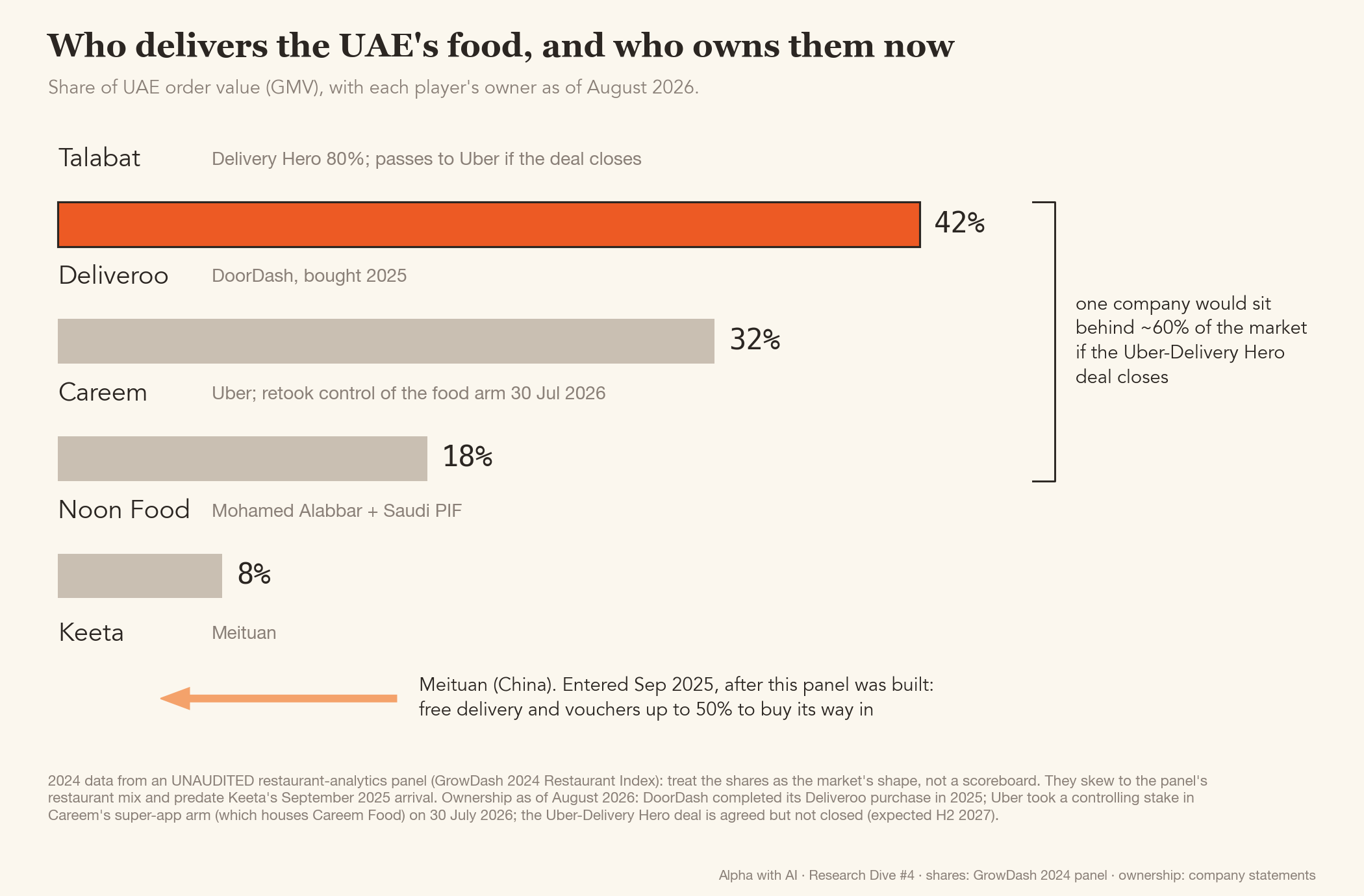
For years the UAE was a race between a few familiar names, and Talabat led it. On the most-cited panel it holds about 42 percent of the market by order value. Behind it sit Deliveroo, the British premium brand, at around 32 percent; Careem, the Gulf super-app, at about 18; and Noon Food, backed by a local billionaire and Saudi Arabia’s sovereign wealth fund, at about 8. The shares come from the same unaudited industry panel as the market estimate above; read them as the market’s shape, not a precise scoreboard.
Two of those names should make you look twice, because of who owns them now.
Deliveroo, the number two, was bought by DoorDash in 2025. Careem, the number three, belongs to Uber, the same Uber that is now buying Talabat’s parent. Uber bought Careem in 2019, ran the super-app arm that houses Careem’s food business as a joint venture with e&, the Abu Dhabi telecom group, and then took back control of that arm on the 30th of July 2026, two weeks after agreeing to buy Delivery Hero. So if the bigger deal closes, one company would sit behind both Careem and Talabat, roughly 60 percent of the UAE market on that panel. That is either the single biggest prize in the thesis or its single biggest regulatory problem, and it is why Gulf competition authorities are looking hard at the deal.
Then there is the newcomer that does not play by the old rules.
In late 2025 a fifth player arrived: Keeta, the international arm of Meituan, the Chinese delivery giant. It entered the way Chinese platforms enter, with a war chest and a tolerance for losing money. Free delivery, half off the first order, low commissions for restaurants, and no demand that they sign up exclusively. It reached Dubai in September 2025 and the rest of the country by the end of the year.
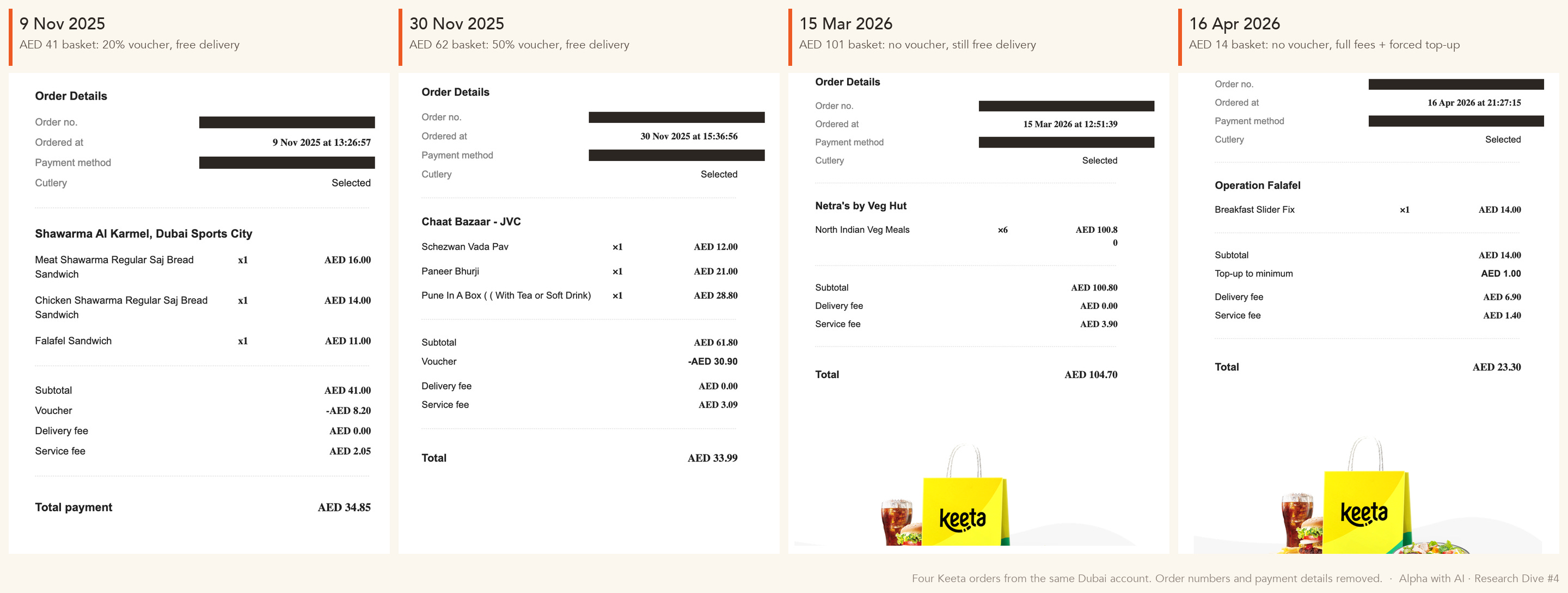
I saw what that looks like on actual bills, and, more useful, on bills six months apart. Five Keeta orders from the same Dubai account run from November 2025 to April 2026. The three November orders, placed within weeks of the launch, carry vouchers of 20, 35, and 50 percent off the food, and delivery is free on two of them; the third paid 1.90 dirhams. On one of those orders Keeta paid half the bill. The 2026 orders look different. In March, a 101-dirham order got no voucher at all, though delivery was still free. In April, a 14-dirham order got no voucher either, plus a forced 1-dirham top-up to reach the order minimum, plus 8.30 dirhams of delivery and service fees. The fees came to more than half the price of the meal.
I want to be careful with this, because five orders from one account prove nothing on their own. The November vouchers were probably partly new-customer offers, and those run out for any user. The April delivery fee may just be a small-order rule, since there is no 2026 order in this sample at the size of the November ones to settle it. What the bills do show, cleanly, is that the free-delivery-and-big-voucher experience this account got at launch is not the experience it gets now. If Keeta is starting to charge like a business rather than a land grab, this is what that would look like from the customer’s side.
The reason to take Keeta seriously is not the launch offers. It is what the same playbook already did next door. In Saudi Arabia, by one industry count, Keeta went from nothing to roughly the number two position, about a third of orders, in around fourteen months, by out-discounting rather than out-building. Other counts put its share lower, but none dispute the speed or the direction. It did most of its damage to the smaller players first, while the two leaders held on through sheer scale and bigger baskets. That is the live question hanging over Talabat’s richest markets. Not whether it keeps its lead, but whether Keeta pushes the cost of competing high enough to dent the margins that make this business special in the first place. Its funding is real but not endless. Meituan is losing money in a price war back home, and the thinning vouchers on these bills may be one small, local sign of that pressure.
How Do Delivery Apps Fight for UAE Customers? Subscriptions, Super-Apps, and Bank-Funded Discounts
Keeta’s vouchers are one part of a wider fight, and I did not have to guess at the rest of it. The friend’s(Dubai) account that this dive’s orders ran through also collects the competitors’ marketing, so I could sit and read how each player actually pitches a UAE customer.
What struck me, reading the pile, is that none of them is really pitching food delivery. Noon folds its food arm into noon One, a single subscription across everything the group runs: marketplace shopping, groceries, quick delivery, home services, free delivery on all of it. That is a direct answer to talabat pro, from the player with the deepest local backing. Careem, Uber’s super-app, pushes its dine-in arm with restaurant discounts of 15 to 25 percent, and it brings banks into the fight: one Al Hilal Bank card promotion ran 20 percent off Careem’s food, groceries, shopping, and dine-in bookings in a single month.
Then there is a layer under the platforms that I had not thought of as part of a delivery war until I saw it in the inbox: payments. Tabby, a buy-now-pay-later card (you split the bill into instalments), stacks its own money on top of whatever the platforms offer. Fifty dirhams off a Careem restaurant bill. A grocery programme whose partner list includes talabat mart and noon Food side by side, which tells you Tabby does not care who wins the delivery race. It is paying to own the payment underneath all of them.
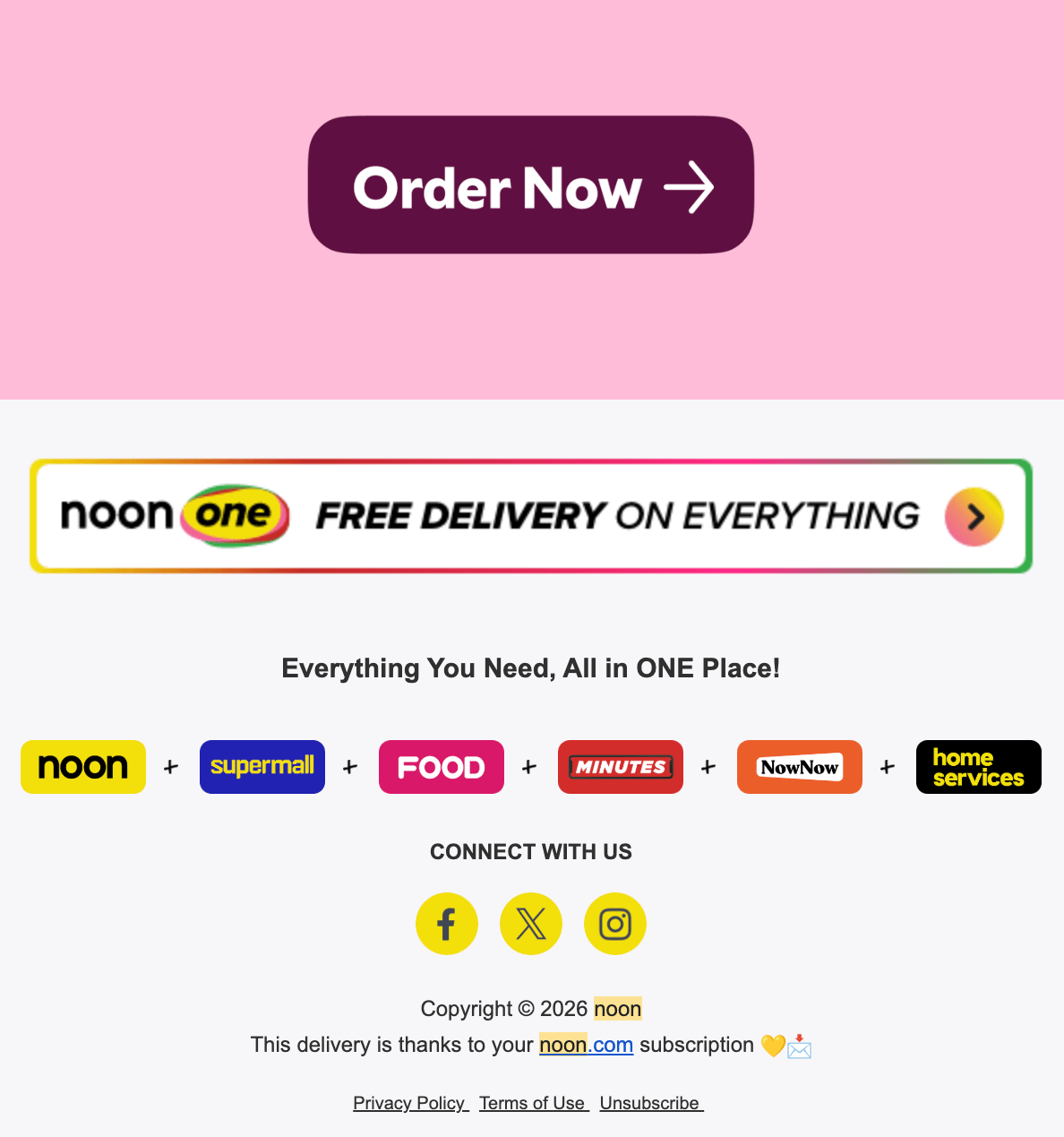
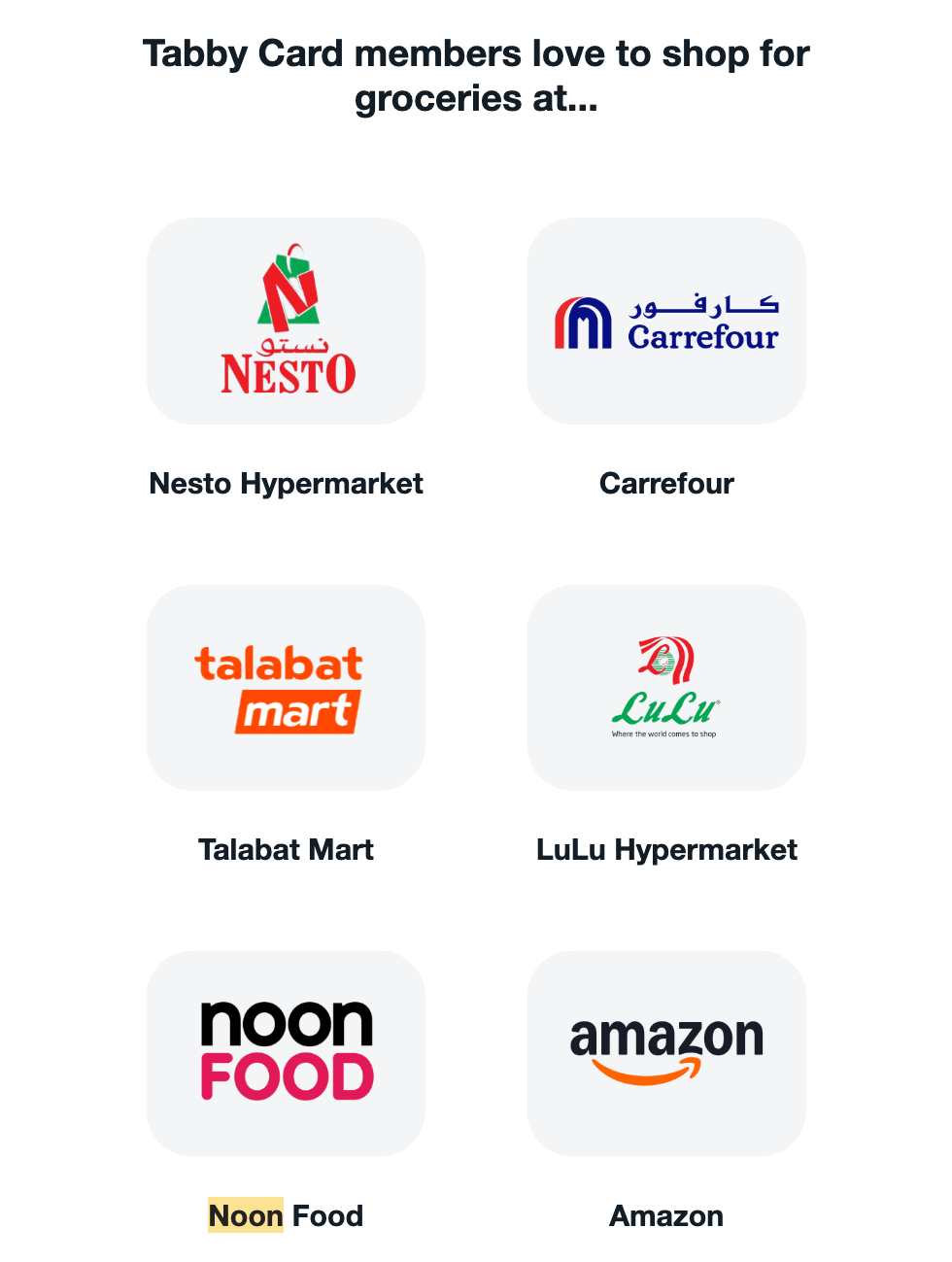
For a Talabat thesis this changes two things. The everyday-app strategy Talabat is spending its margin on is not a private insight; Noon and Careem are chasing the same prize, which tells you how valuable it is and how crowded and the discount a UAE customer sees is not all platform money. Some of it comes from banks and card companies chasing payment volume, and a price war that other people help fund can run longer than any single platform’s losses suggest.
Is Gulf Food Delivery Regulated? Commission Caps, Exclusivity, and the UAE’s Middle Path
There is a common worry about this business: that governments across the Gulf are about to cap delivery commissions and crush the margins. It is worth checking against what the regulations actually say, because a cap on commissions is the one regulatory move that could break the economics I just described.
Here is what has actually happened, moving across the Gulf.
Saudi Arabia went first, in early 2025, with rules against predatory pricing, aimed squarely at the discounter cutting delivery fees to buy share. Qatar has been the enforcer. In 2025 it fined Talabat about 313,000 dollars and briefly suspended it for misrepresenting prices, and in 2026 it issued a formal code: every commission and fee disclosed in writing, pricing registered with the ministry. Years earlier it had even capped commissions outright after restaurant complaints, so the region’s platforms know Qatar will act. The UAE landed in the middle. It limited how long a restaurant can be locked into an exclusive deal to twelve months, and it made platforms disclose their commissions and how their apps rank restaurants. What the UAE did not do is cap the commission itself. The one hard cap in the Gulf today is Kuwait’s: in early 2026 it fixed delivery commissions and fees outright for three years. It is the outlier, and it is a smaller market.
So the honest read is calmer than the worry. The UAE has no commission cap. The regulation that does exist is mildly unhelpful to Talabat, because the thing being unwound, restaurant exclusivity, was one of the tools an incumbent uses to keep a discounter like Keeta out. But that is a long way from a margin-crushing cap. The pricing power that earns those six and a half cents on the dollar is, in Talabat’s biggest market, still intact.
Where Does Talabat’s Money Actually Come From, and Where Does It Go?
By now you have seen the app list: restaurant delivery, groceries in half an hour, a pharmacy, flowers, dine-in discounts, a paid membership, advertising space sold to restaurants. A list that long does not explain anything by itself. So strip it away, because underneath the list this company has one shape.
Talabat is a dominant, high-margin food-delivery engine in the Gulf, and everything else on the list is a use of that engine’s cash.
The engine first. In 2025, about 9.4 billion dollars of orders flowed across Talabat’s platforms, and 82 percent of that value came from the five Gulf countries. Of every dollar ordered, about 39 cents became Talabat’s revenue (that figure includes the groceries it sells directly, so it is not a pure commission rate), and 6.5 cents survived as operating profit. The engine carries no bank debt and sat on about 808 million dollars of net cash at the end of June 2026. That is the machine. The interesting part is where the money goes next.
A clarification before anything gets built on those numbers, because this piece says food delivery a lot. The 6.5 cents is the whole company’s profit rate, groceries and every other category included. Talabat reports its results by geography, not by business line, so nobody outside the company knows what the grocery arm alone earns or loses. Two things follow from that. Groceries and retail are already large: about a third of everything ordered on the platform by the end of 2025, by value and the company has said plainly that the build costs money right now, a cost the blended figure already absorbs, so the mature food business on its own earns more than those 6.5 cents, not less.
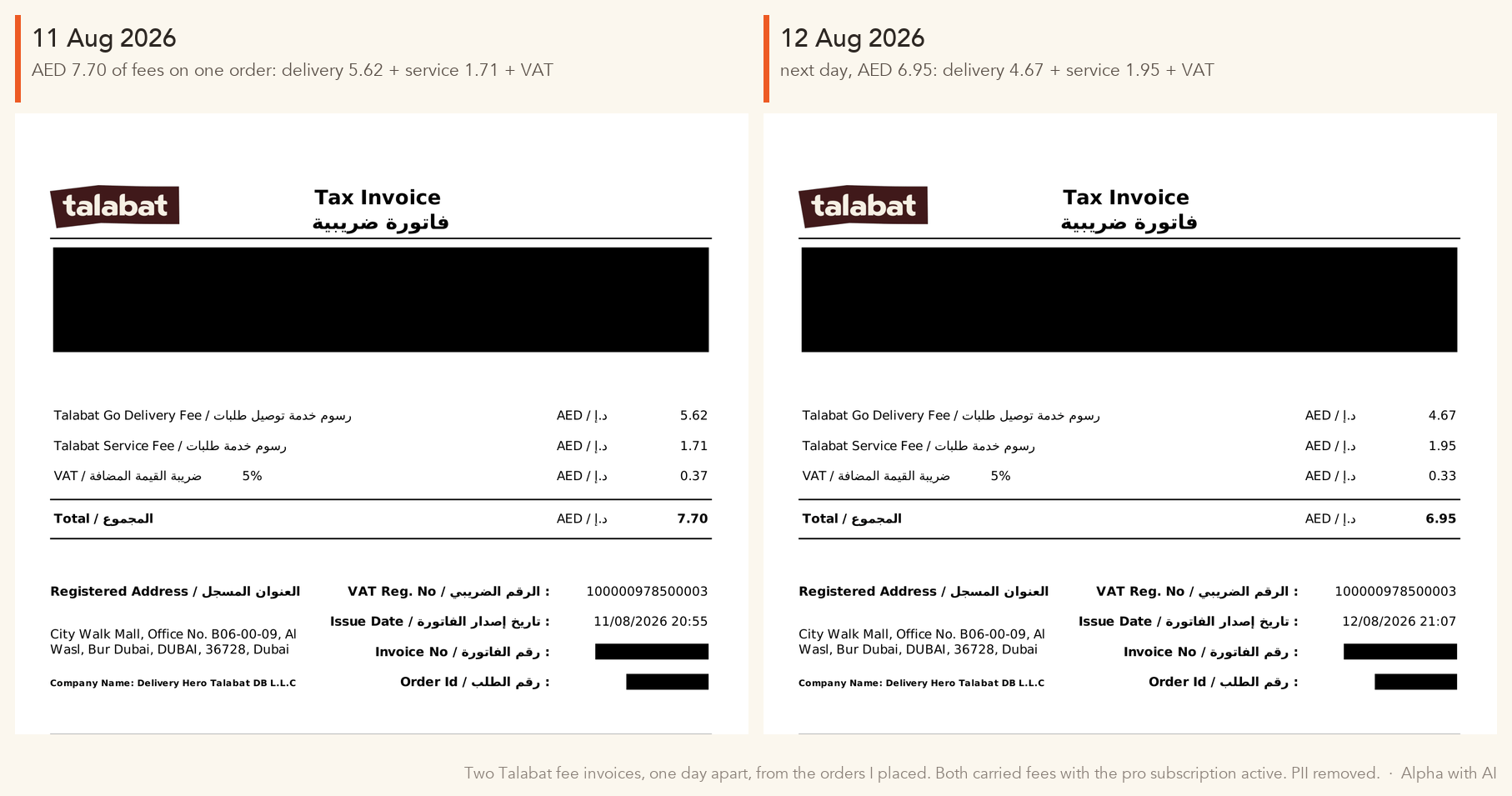
You can see the engine’s take on a customer bill first. The two orders I placed in August each came with a separate fee invoice: a delivery fee, a service fee, and VAT, adding up to AED 7.70 of fees one day and 6.95 the next. Both were charged even though the pro subscription was active on the account. To be fair to the product, talabat pro’s free delivery applies to eligible orders: above a minimum basket, from participating restaurants. These two evidently did not qualify. The point is not that the benefit is fake. It is that even a subscriber’s order can still carry seven dirhams of fees, and the engine collects them. And the customer’s fees are only part of the take. The commission the restaurant pays on the same order never appears on a customer invoice at all, because it is billed to the restaurant. Between the customer’s fees and the restaurant’s commission sits most of that 39 cents. Put these invoices next to the Keeta bills from the industry section and the difference in posture is the whole competitive story: the challenger opened by paying you to order. The incumbent charges you, twice, and still gets the order.
The first use is the dividend. On 2025’s profit, 421 million dollars went out to shareholders, 90.7 percent of what the company earned, and the stated policy is to keep paying out 90 percent. For a small shareholder, that payment, the roughly 5 percent a year from the summary at the top, is the visible return while everything else plays out.
The second use is the build. Talabat is spending part of the engine’s margin to become the everyday app you read about in the company’s story. talabat mart and its roughly 160 dark stores, the groceries, the pharmacy, the dine-in arm, the advertising business: each exists to raise how often you open the app. This build is exactly why the 2026 profit margin is guided down to roughly 4.7 to 5 percent of order value, from 6.5: management called 2026 a deliberate investment year of about 120 million dollars when it set the guidance in February. The profit decline you see in the 2026 numbers is that spending showing up in the accounts. Second-quarter profit fell 18 percent from a year earlier while order value grew 12 percent, and the gap between those two numbers is, mostly, the price of the build. On the company’s own disclosed measures, the build is working: three quarters of order value now comes from customers who use more than one vertical (a vertical is just a category: food, groceries, pharmacy), and over half comes from paying subscribers.
For scale on the ambition, I had Claude Code build a category-by-category grid of what Talabat, DoorDash, Delivery Hero, and the big Indian platforms each sell, from their own disclosures. Talabat’s list came out the broadest. It runs dine-in discounts and flowers that DoorDash does not, and it matches the Indian platforms category for category. The same grid also shows the gap: Blinkit, the grocery arm of the Indian group Eternal(Zomato parent) from the margin comparison earlier, runs around 2,400 dark stores to talabat mart’s 160. Talabat has the widest menu of services; it does not yet have the deepest operation behind each one. On quick groceries in particular, the Indian platforms are years further into the build. Their accounts also show what the build costs while it runs. Even at fifteen times talabat mart’s store count, the Indian group’s grocery arm still earns a fraction of what its food-delivery arm earns. A young grocery operation loses money for years before it makes any, and Talabat’s 2026 investment year is that same cost showing up earlier in the build.
The third use is the growth tail. Egypt, Jordan, and Iraq are about 22 percent of revenue and grew 46 percent in the first half of 2026. The Gulf engine barely grows in volume, around 5 percent a year, because nearly everyone who would order already does. The tail is where new users still exist. And, for now, it is also where Keeta is not.
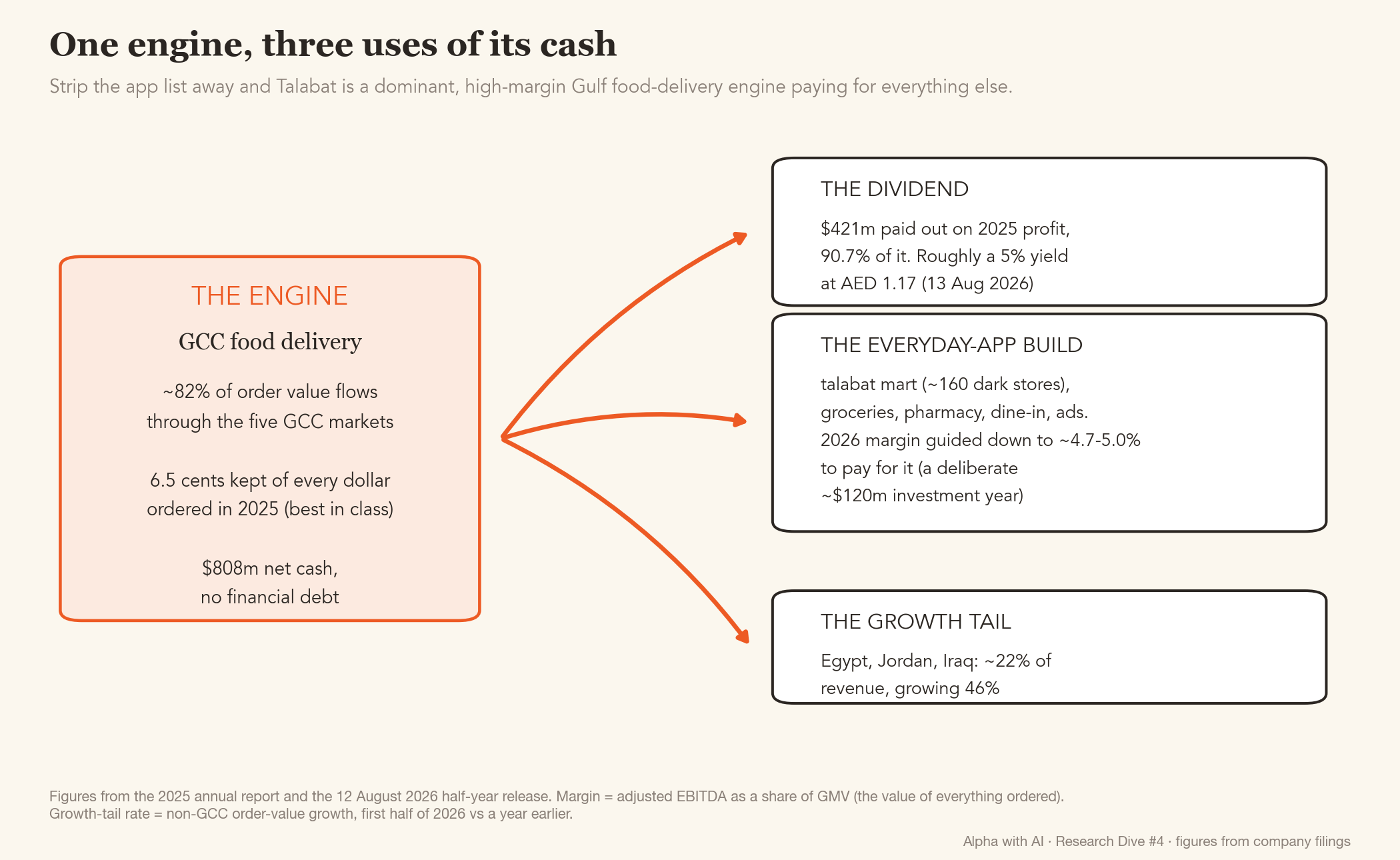
Here is what seeing the company as one engine clarifies about the fight in the last section. Everyone in the UAE is building some version of the everyday app. The difference is the funding. Talabat pays for its build out of the engine’s own profit and still hands 90 percent of earnings to shareholders. Noon’s build is funded by its billionaire and sovereign backers, Keeta’s by a parent losing money at home, Careem’s by Uber and a telecom group, Deliveroo’s by DoorDash. Talabat is the only one whose war chest is the business itself. That self-funding is the strength of the model. It is also the exposure, because the build and the dividend are both paid out of the same six and a half cents that Keeta’s vouchers are aimed at.
One last piece of texture from the research account, offered as exactly what it is: a single customer, not a survey. The friend whose Dubai account this dive’s orders ran through tried Keeta through its launch months and has since settled on Talabat as the default, keeping Keeta for the occasional big group order, where a discount on a large basket bites hardest. One person proves nothing. But it is the pattern the subscription logic predicts: a discount wins single orders, while a membership decides where the everyday order goes without a thought. Talabat is betting the second is worth more, and on this one account, so far, it is right.
Why Is Talabat Stock Down 27 Percent From Its IPO Price?
Here is the uncomfortable arithmetic. Talabat sold at 1.60 dirhams a share in December 2024. It trades at 1.17 today, 27 percent lower, and in between the business grew its order value, grew its revenue, paid two dividends, and raised its 2026 guidance twice. A business this good does not usually sit this far below its offer price without reasons, and Talabat collected a full set: a rich starting price, a price war, a management change, a guidance cut, and an actual war. They arrived in that order.
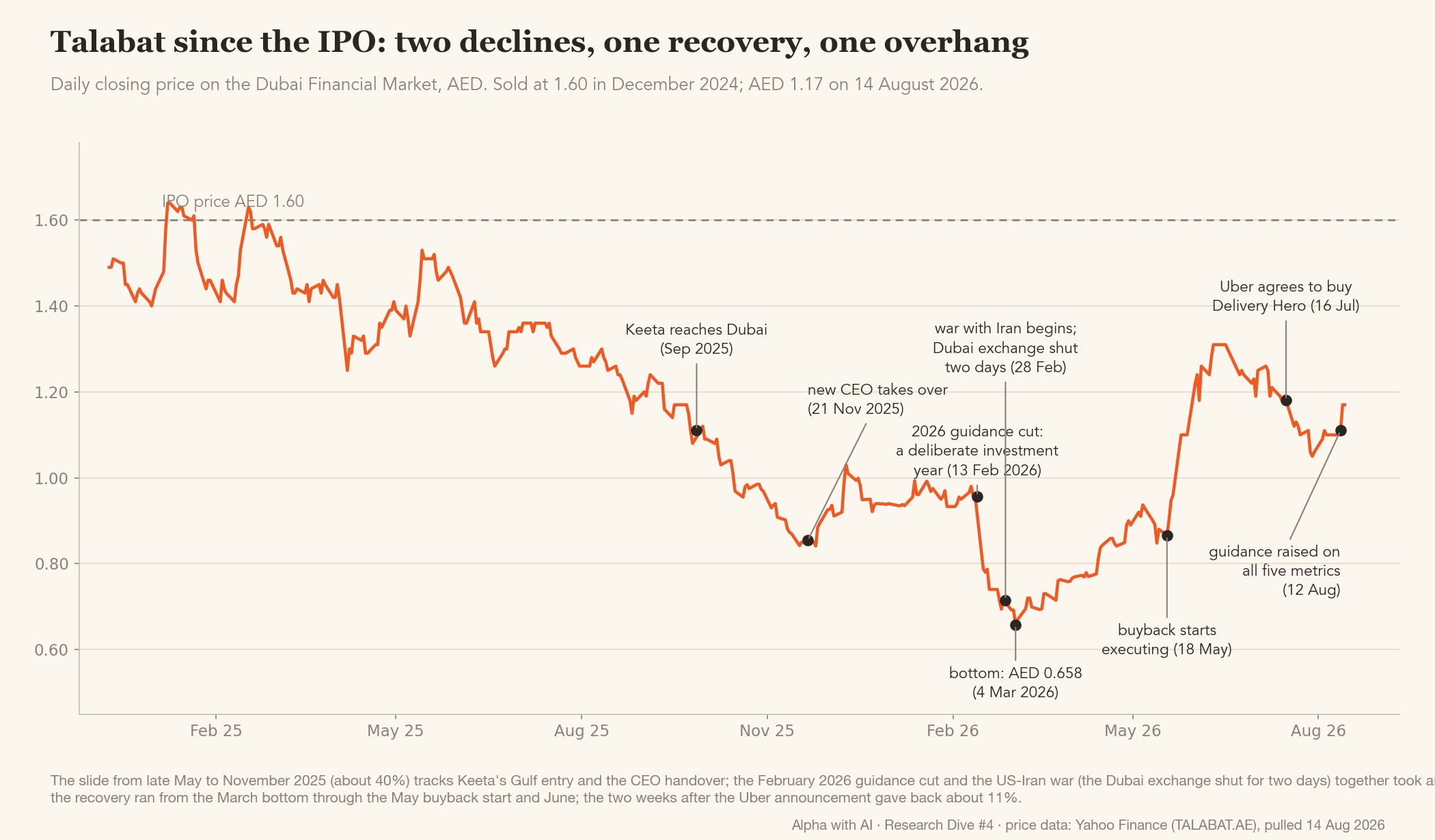
The first reason is the price it started at. The offer was upsized on demand and priced at the top of its range, valuing the company at about 10.1 billion dollars, and the very first session told you how full that was: the stock closed its opening day at 1.49, 7 percent under the offer. It closed at 1.64 in January 2025, and that is still the high of its listed life. Anyone who bought in the first few months paid for a story that had no room to disappoint.
Then it disappointed twice, and neither time was really about demand. Between the end of May and the end of November 2025 the stock fell about 40 percent. The chart shows what walked in during those months. Keeta arrived in the Gulf: Qatar in August 2025, Kuwait in September, Dubai on the 27th of September, the rest of the UAE by the end of the year. The question it planted has hung over the stock ever since: what does a Chinese-funded price war do to the best margins in the industry? And in the middle of that, in October, the company said the chief executive who had run it since 2019 would hand over to a new one in November. Nothing broke in the numbers. The market just stopped paying a full price while it waited to see what Keeta and a new chief executive would mean.
The third blow was self-inflicted, and I covered its substance in the last section. In February 2026, off a year that delivered 615 million dollars of operating profit at a 6.5 percent margin, management guided 2026 profit down to 510 to 540 million, a margin near 4.7 to 5 percent, and called it a deliberate investment year. The market heard that margins were going down and sold first. By the 26th of February the stock had fallen 25 percent, to 0.715.
Then the region itself blew up. On the 28th of February the United States and Israel went to war with Iran, and this time the Gulf was not a spectator: Iranian missiles and drones struck targets on UAE soil, and the regulator shut the Dubai exchange entirely for two days in early March. When trading resumed, the whole market convulsed. Dubai’s index lost roughly 16 percent, around 45 billion dollars of value, inside a month. Talabat’s bottom, 0.658 on the 4th of March, 59 percent below the IPO price, printed in the middle of that panic. That low was not a judgment on the company alone. The guidance cut had already taken the stock from 0.956 to 0.715. The war panic pushed it the rest of the way, to 0.658, and that last leg had nothing to do with Talabat’s business.
Which also explains why the recovery came so fast. As the initial war shock faded from Gulf prices, a stock that had been hit twice got repriced twice. And the war itself, grim as it was, did not hurt this particular business: people who stay indoors still eat, and the half-year numbers Talabat delivered through those months came in ahead of its own plan. On the 12th of May the company raised its profit guidance with its first-quarter results, and the stock barely reacted; it actually slipped over the next session. Then the share buyback began executing on the 18th of May, and over the following two weeks the price rose about 30 percent. I am careful about drawing a straight line there, because the buyback’s actual purchases were small, about 35 million dollars in total, less than half a percent of the company. Whatever mix of fading war fear, bargain hunting, and improving numbers did it, by the end of June the stock had recovered to 1.23, above where it stood before the guidance cut. Worth knowing all the same: that supportive buyback has been idle since mid July, with barely a tenth of its authorization used, on no stated schedule.
The last reason is the one that does not show up in any income statement, and unlike the war, it has not faded. On the 16th of July, Uber agreed to buy Delivery Hero. Talabat’s own operations changed not at all that day, and the stock closed flat. Over the next two weeks it drifted down 11 percent. Then on the 12th of August the company raised all five of its guidance metrics, and the stock rose 5 percent the following day on about three times its usual volume, back to 1.17. Read those three reactions together and you can hear what the market is actually worried about. Good operating news still moves this stock up. The prospect of a new controlling owner moved it down, quietly, for two weeks.
So the diagnosis is specific. The war discount has largely unwound. The operating scares, Keeta and the margin reset, are real, but they are known, priced, and partly answered by two guidance raises since. What the market has not made peace with sits outside the accounts: a global competitor about to become the controlling shareholder, a technology licence that runs through that controller, and a minority position with no guaranteed exit price. The discount is the market charging for those three things.
Free side so far: the company, the market, the engine economics, and the honest diagnosis of why the stock is down. Paid side from here: the Uber question, the ownership map, the valuation with the model, and the verdict.