


A reader messaged me last week and asked if I’d break down the SpaceX IPO.
I almost said no. Not because it isn’t interesting. Because I don’t write about whatever is trending that week. Trends rot. In AI especially, the hot thing today is stale in three days, and I’m not interested in teaching you something with a shelf life. I write about workflows that still matter a year from now, and I usually find them buried in messages like this one, from readers telling me what they’re actually stuck on.
This one was worth it. Because SpaceX isn’t really the lesson. The lesson is the document.
I’ve admired this company for years. Not Musk the personality. The work ethic, the engineering DNA. There’s a story about how that DNA works that has stuck with me for a long time.
An engineer comes to Musk and says he needs to buy a part. It costs $1,200. Musk doesn’t ask why they need it. He asks what it’s made of. Some kind of metal, they say. He asks what that metal costs. They check the London Metal Exchange. Fifty dollars a kilo. He just looks at them. And eventually the room works out what he already knows, that the $1,200 part is maybe $300 of raw material and they should build it themselves.
That’s the whole company in one scene. He refuses to accept the price he’s handed. He breaks it down to the raw inputs and rebuilds the real number from scratch.
Every competitor knows this story. None of them have the DNA to actually do it. That refusal is why these companies trade at a premium nobody else gets, and why Wall Street bends the knee.
So here is what I find funny.
The man who has never accepted a sticker price in his life just handed the public a 277-page sticker price. The SpaceX prospectus. Plus a hundred-page addendum. Dozens of photos of rockets going into orbit. A soaring story. And somewhere inside all of it, the five or six numbers that actually decide whether this is the business of a generation or the most expensive story ever sold to retail.
Twenty years ago a prospectus was short. You could read one in an evening and know what you owned. Today they run two to three times longer, and not because there is two to three times more worth knowing. The length is the point. Noise is a great place to hide signal.
I’m not going to read 277 pages to find five. Not in 2026. Time is the only thing I can’t get back, and there is no reason left to spend it this way.
So I did to the prospectus what Musk would do to that $1,200 part. I refused the price. I broke the document down to its raw inputs and rebuilt the real number myself.
This is how. And it works on any prospectus, any annual report, any 300-page document built to wear you down, whether you’ve been investing for years or you’re about to analyse your first IPO.
One thing before we start. The title says Claude Code, and if that sounds like a developer tool you’re about to be locked out of, relax. There’s a no-terminal version of this exact workflow, same power, no commands, and I’ll show you both. Nobody gets left at the door.
Almost everything I make ends up here, in the open, because a workflow you can’t see doesn’t make anyone a better investor. The paid tier exists for the readers who want the skills, the prompts, and the downloadable guides the moment they ship, and it’s quietly what keeps me doing this instead of something that pays better. If you’re one of them already, thank you. If you’re not, no wall here. This one’s yours, all of it.
DATA IS NOT INFORMATION
Aswath Damodaran has a framing in his recent SpaceX note I keep coming back to. He calls it data versus information. The way I've come to interpret it for myself is simpler. Data is not information.
A prospectus is full of data. Page after page of it. Numbers, disclosures, risk factors, diagrams. What it is short on is information, the small number of things that actually change what you believe about the business. Damodaran has even written a paper on this. Prospectuses today run two to three times longer than they did three or four decades ago, and not because companies have three times more worth telling you. The extra length is mostly defensive. Risk factors written to be unfalsifiable. Language vetted so nothing in it can be used against the company later.
So before I open any filing, I do something that sounds backwards. I read what other people wrote about it first.
Here is why. I love reading. I will happily spend an evening with a great piece of writing about a business. But there is a difference between reading an author and reading a document. An author I respect is accountable to their own reputation. They have a name on the page and a track record you can check. A prospectus is written by lawyers who are accountable to one thing, protecting the company that pays them. Given the choice, I will read the author first, every time. Not because the author is always right. Because the author is trying to inform me, and the document is trying to sell me.
So that is where I started with SpaceX.
READ THE AUTHORS BEFORE THE DOCUMENT
I started with Aswath Damodaran.
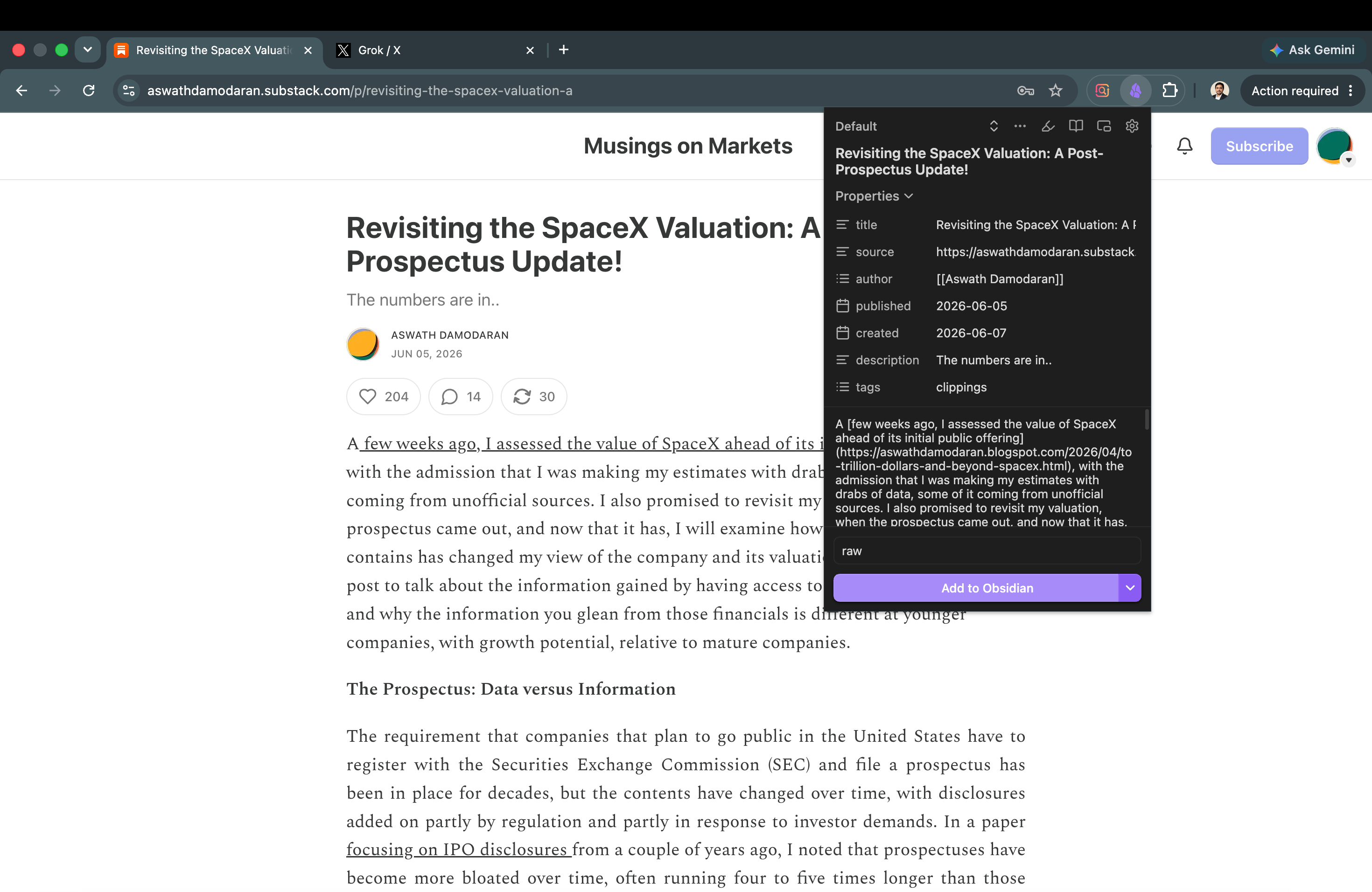
He had just published a post-prospectus update on SpaceX, revisiting a valuation he’d first attempted before the filing came out. This is exactly the kind of reading I trust. A man who has valued more companies than almost anyone alive, showing his work, telling you what he got wrong the first time and what the prospectus changed. I read it once for the story and once for the numbers. Then I clipped the whole thing into my Obsidian vault so it sits in my own research library, searchable, permanent, mine. If you want the setup that does this, I’ve written about how my research library works before which you can read here.
Then I went to X.
Not for hot takes. X has the largest live investing community on earth, and buried in the noise are people who have actually done the work and published their reasoning. I asked Grok to pull me the most substantive bull cases and, just as deliberately, the most substantive bear cases, with names and links so I could read the originals myself. I did not want a summary that hid the disagreement. I wanted the strongest version of both sides. I clipped the results into Obsidian alongside the Damodaran piece.
A note on this, because it matters. Everything I gathered at this stage is opinion. Smart opinion, sometimes. But opinion. None of it is a fact until I have checked it against the filing. A bull who tells you Starlink subscribers doubled is giving you a lead, not a number. The number lives in the prospectus, and that is the only place it counts.
Now I had a folder full of intelligent people arguing about SpaceX. And only then did I open the prospectus itself.
That is the order that matters. Authors first, to build the story and the questions. The document last, to settle them.
THEN I OPENED THE PROSPECTUS
So I opened it. Two hundred and seventy-seven pages, plus a hundred-page addendum. Dozens of photographs of rockets leaving the atmosphere. A story about humanity becoming multiplanetary, written to make you feel something before you’ve read a single financial statement.
I read enough to confirm what Damodaran already warned me about. The signal is in there. It is just buried under a great deal of material that exists to fill pages, not to inform a decision. Risk factors that could apply to any company on earth. Sentences engineered by lawyers to mean as little as possible while technically disclosing something.
And here is where I made my decision. I was not going to read all of it.
Not because I couldn’t. I’ve read plenty about this company over the years and enjoyed every word of it. But there is a difference between reading and grinding. Reading 277 pages of mostly noise to find five pages of signal is not analysis. It is a tax on my time, and time is the one input I never get back.
Think back to the engineer and the $1,200 part. Musk didn’t refuse to understand the part. He refused to overpay for it. He broke it down to the raw metal and rebuilt the real cost himself. That is exactly the move here. I’m not refusing to understand the prospectus. I’m refusing to overpay for it in hours. So I broke it down to its raw inputs and let a machine do the reading that a machine should do.
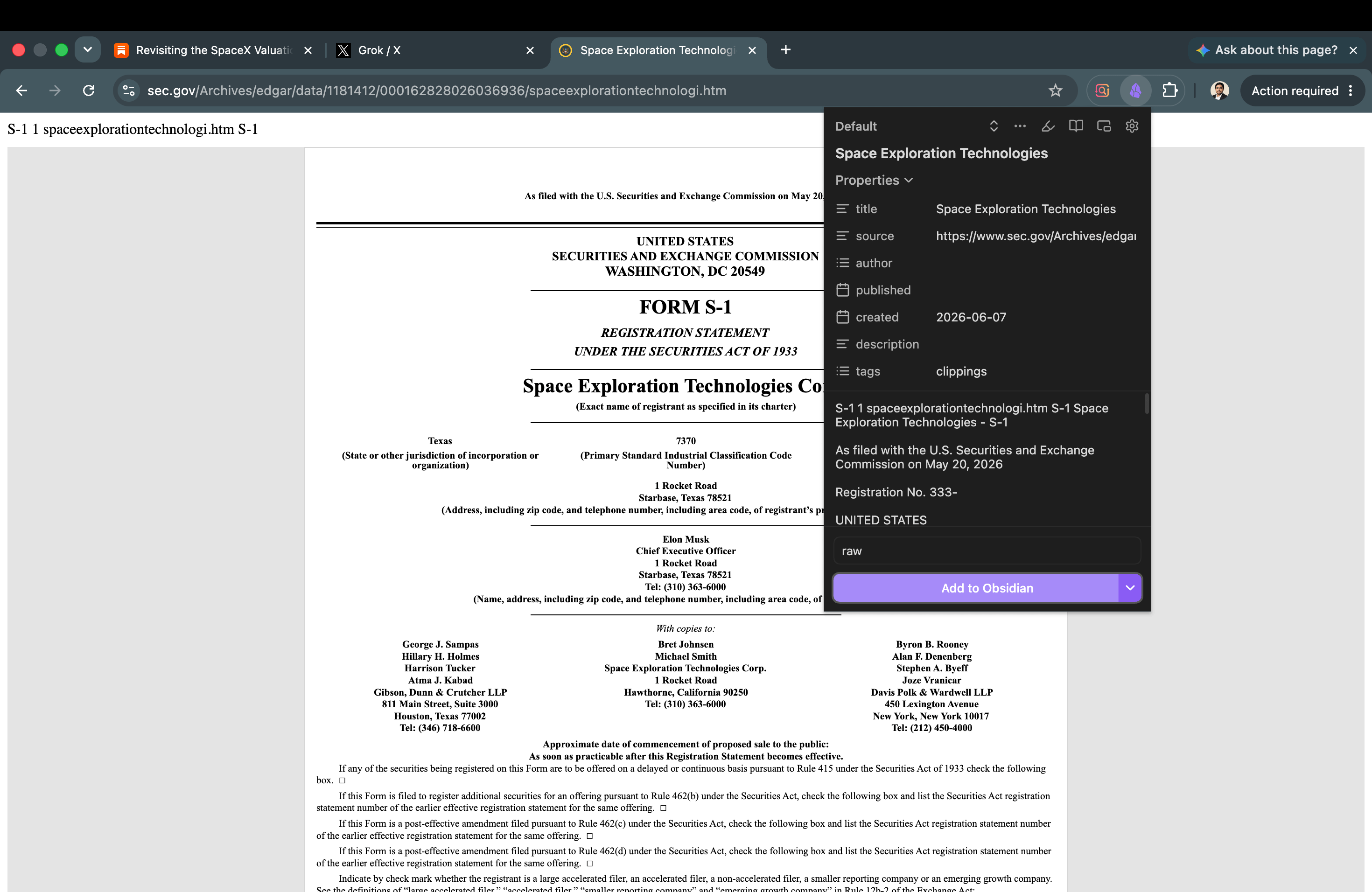
I clipped the entire prospectus into the same Obsidian vault that already held Damodaran’s piece and the bull and bear cases from X. Then I pointed Claude Code at the vault Or its no-code twin, if a terminal isn’t your thing. More on that in a second.
This is where the actual work begins. And this is the part that works on any document you ever have to analyse, not just this one.
THE WORKFLOW: REFUSE THE PRICE, REBUILD THE NUMBER
A quick word on setup, because I’ve covered it in full before and won’t repeat all of it here. Pick your path, then come back.
If you’re using Claude Code, it’s not a coding tool. It’s Claude with hands, the same Claude you talk to in the chat window, except this version can read the files on your computer. I run it inside Obsidian, pointed at the vault where I just clipped the prospectus. If you’ve never wired this up, I walked through the whole thing in how I set up Claude Code as my investment research analyst. Start there.
If a terminal isn’t your thing, use Claude Cowork instead. It’s the same agentic engine in a friendlier room, no commands, you just point it at a folder and ask in plain English. I’ve shown exactly how I use it for a full equity report before, in how I used Claude Cowork to write a full equity research report in 90 minutes. Same destination, gentler road.
Whichever path you’re on, the rest of this works identically. The prompts are the same. Only the room changes.
One caution for both. Give the tool a folder with a copy of the prospectus in it, not your entire vault, and never your whole drive. These agents can edit and delete files, so you fence them into a sandbox and let them work there.
Now the work. I don’t ask the prospectus open-ended questions. I run it through the same checklist I run on every idea, in the same order, because the order is the discipline. Skip ahead to valuation and you’ll talk yourself into anything.
STEP ZERO: THE FIVE-LINE TEST
Before any number, one human question. Can I explain this business in five lines to a ten-year-old? If I can’t, it’s outside my circle and no spreadsheet will save me.
Here’s the honest answer for SpaceX. It’s three businesses wearing one ticker. A rocket business that launches things into space cheaper than anyone else. A satellite internet business, Starlink, that beams broadband down from those rockets. And an AI business, xAI, that runs enormous computers. The first two I understand. The third is where it gets hard, and that’s worth admitting before I read a single figure.
That admission shapes everything. A company you can’t fully explain in five lines isn’t disqualified. But it raises the bar on what the filing has to prove.
Know someone about to buy into an IPO because the story sounded good? Send them this before they do. That’s who it’s for.
THE FRAMEWORK, AND WHY THE PROMPT IS NOT THE POINT
Here is the part most people get wrong. They go looking for the perfect prompt to paste. But a prompt you copy only works on the company it was written for. What you actually want is the thing underneath the prompt, the question, and the thing underneath the question, the principle. Get those right and you can write the prompt yourself, for any company, forever.
So here is the whole framework in one breath. Every step is a principle. Each principle becomes a single question. Each question becomes one tightly worded prompt that forbids the machine from guessing. The order is fixed on purpose. Growth first, then cash, then debt, then the quality of the profit, and valuation last, always last, because if you let yourself peek at the price before you’ve checked whether the profit is real, you will reverse-engineer a reason to like it.
Five principles, in order:
Is revenue genuinely growing, across years, not one good quarter dressed up as a trend.
Can the business fund its own growth from its own cash, or does it survive on outside money.
Is the debt load sane, or has the company handed control to its lenders.
Does the reported profit show up as real cash, or only on paper. This is the one that catches frauds.
And only now, after all of that, is the price sane?
The pattern of every prompt never changes: tell the machine exactly where to read, forbid it from estimating, demand a page citation for every number, and make it say “not disclosed” out loud when the filing stays silent. A filing’s silences are information too.