


Say the word timeshare and most people picture the 1980s version. A windowless conference room. A free breakfast that costs you a morning of your holiday. A salesman who keeps talking while a couple edges toward the door.
That version was real. In December 2016, Arizona’s attorney general announced an $800,000 settlement with a timeshare company called Diamond Resorts, after more than 500 complaints about what its salespeople had promised families in those rooms. The industry’s reputation got bad enough that a second industry grew up next to it: timeshare exit companies, which do nothing but help people get out of contracts they regret signing.
Hold that picture. Here is the same business in 2026.
Hilton Grand Vacations sells vacation packages from kiosks inside Bass Pro Shops and Cabela’s stores. 142 of them at last count, under a ten-year exclusive deal. You walk in for fishing gear, you walk out with a discounted trip to Orlando, and the trip includes a sales presentation.
The pitch also reaches you through Hilton Honors, the loyalty program you use for ordinary hotel stays. HGV’s license from Hilton requires it to take part in the program.
The product changed too. It is not a fixed week in a fixed room anymore. It is points in a members club, spendable across resorts and seasons. The newest tower is going up in Waikiki right now, and HGV was already selling it before the building was finished.
The buyer changed most of all. In the industry’s own 2026 owners survey, Millennials and Gen Z made 76% of recent purchases. The product your parents were warned about is now bought mostly by their children.
Hilton Grand Vacations, spun off from Hilton in January 2017, is the company this dive is about. It sells the new version of the product under the Hilton name. It also owns the old version: in 2021 it bought Diamond Resorts, the same company from that Arizona settlement. Both now sit inside one company, with about 722,000 members.
By HGV’s own numbers, the selling machine works. Tour flow, the count of families who actually sit through a sales presentation, has grown for four straight quarters. Tours are the raw material of this business. Get families into the room, and a predictable share of them buys.
On July 30, HGV reported its second quarter. Tour flow grew again. The sales those tours produced fell 2.9%. The stock fell 9.9% in one day.
Put those numbers next to each other. More families are touring than at any point in the last year, and they are buying less once they are in the room. Either something broke in how HGV sells, and that is fixable. Or the customers walking in can no longer afford to say yes, and that is a much bigger problem. The 9.9% fall says the market fears the second answer.
This dive is about finding out which one is true.
One housekeeping note before we start. This Research Dive is free from top to bottom, except the model portfolio action at the very end. That is deliberate: I would rather show you what a paid Research Dive looks like than describe it. If you want every future dive plus the model portfolio, the launch offer here is 35% off, forever.
Make sure you are signed in to Substack when you use it, or the discount will not apply.
The 60-Second Thesis on Hilton Grand Vacations (HGV)
What they do. Hilton Grand Vacations sells vacation ownership, the modern form of the timeshare. A member pays upfront for points (a reusable currency for booking resort stays), then pays maintenance fees every year after that. HGV sells the memberships, manages the resorts and clubs for fees, and lends most of its customers the purchase money: 67% of buyers finance through HGV itself. So this is two businesses in one: a vacation seller with the Hilton name on the door, and a consumer lender with a $5.0 billion loan book.
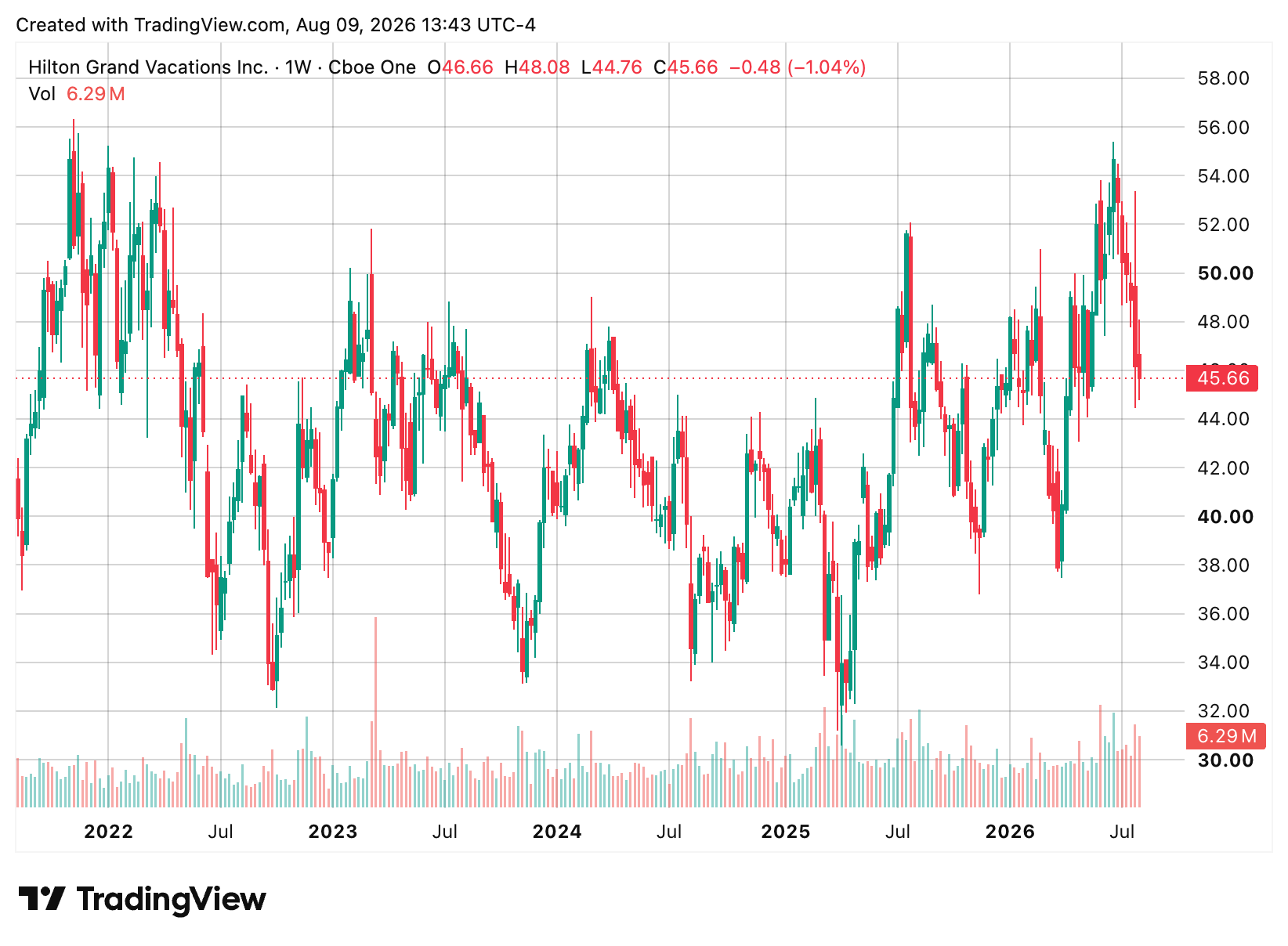
Why the stock is down. On July 30, HGV reported its second quarter. Contract sales fell 2.9%. VPG, volume per guest (revenue per sales tour, the industry’s productivity number), fell 8.6%. The stock fell 9.9% in one day and sits at $45.66 as I write. The bigger problem is in the loan book. Loans more than 120 days late are 14.0% of the book, up from 12.6% six months earlier. The quarterly charge for expected loan losses reached $122 million, up 28% in a year, while sales shrank. The two closest peers, Marriott Vacations Worldwide (VAC) and Travel + Leisure (TNL), reported improving credit numbers over the same period. The deterioration is specific to HGV’s book.
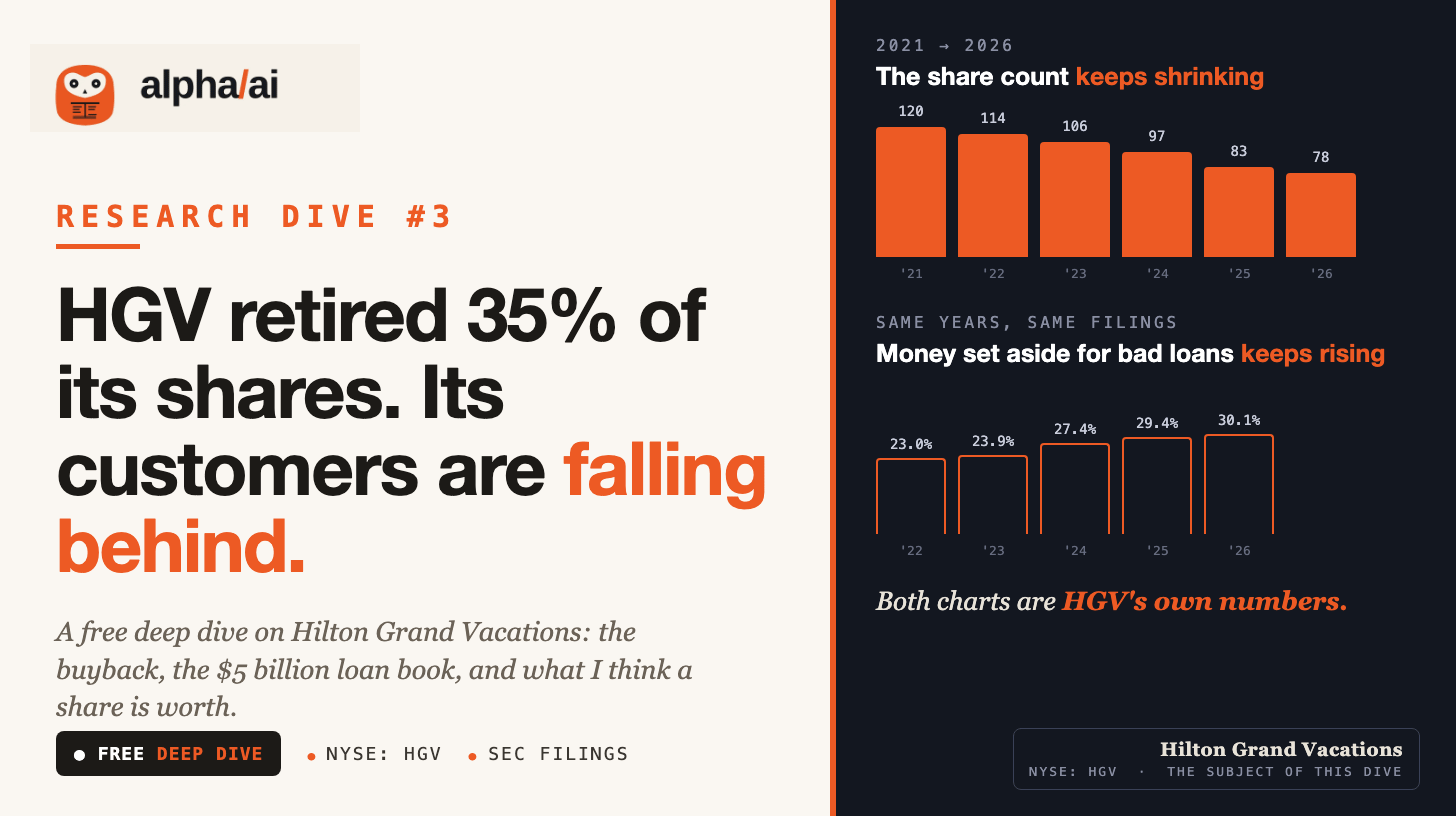
Why it might be cheap. The share count. HGV bought back 35% of its own shares between the end of 2021 and July 2026, from 119.9 million to 77.7 million. Management raised its full-year EBITDA guidance in April and held it in July despite the weak quarter. Tour flow grew 6.1%, the fourth straight quarter of growth. By my math, the market prices the whole company, debt included, at about 6.6 times this year’s guided EBITDA (operating earnings before interest, taxes, and depreciation). VAC trades near 9.7 times and TNL near 8.3 times.
What could turn it. Three dated things. First, a new buyback authorization: $103 million remained as of July 23, and at the roughly $150 million a quarter pace of the past year that is about two more months, so the Q3 print is the test. The board has re-upped every year since 2022. Second, the Q3 credit numbers: if delinquencies flatten while peers hold steady, the bear case loses its best evidence. Third, Hawaii: sales at the unfinished Waikiki tower are deferred (booked as revenue only once the building is complete), so rooms already sold flip into reported earnings as construction finishes.
One honest caveat before we go further. If the loan book keeps deteriorating, the low multiple is deserved. The rest of this dive works that question out.
How Hilton Grand Vacations Was Built: the 2017 Hilton Spin-Off and Three Acquisitions
On January 3, 2017, Hilton split itself into three listed companies. Hilton kept the hotel brands. Park Hotels & Resorts took the owned hotel real estate. And the timeshare business became Hilton Grand Vacations, its own stock, its own board, ticker HGV.
Hilton kept zero ownership. What it kept instead is a license. HGV pays Hilton 5% of its gross revenues for the right to sell under the Hilton name, a fee that reached $192 million in 2025. The exclusive right to the name runs to 2051. And the license has teeth: HGV cannot even go through a change of control without Hilton’s consent. So HGV is independent, but only up to a point. The brand that makes its product sellable is rented.
Here is what the customer actually buys. A member pays upfront for points, then uses those points to book stays across the network, this year and every year after. On top of the purchase price come annual club dues and maintenance fees. And since two thirds of buyers finance the purchase through HGV, there is usually a third payment stream: interest, at an average rate of 14.4% across HGV’s loan book. That is one customer paying three ways: the purchase, the fees, and the interest.
Then HGV went shopping, three deals in five years.
August 2021: Diamond Resorts. Paid for with 33.9 million newly issued HGV shares. This deal did two things that matter to this story. It moved the old version of the industry, including the company from that Arizona settlement, inside HGV. And it handed the seller, the private equity firm Apollo, just over 30 million HGV shares, making it the largest shareholder. Hold the Apollo detail. It comes back when we get to why the stock is down.
January 2024: Bluegreen Vacations. All cash this time, about $1.6 billion including debt, at $75.00 per share, not one new HGV share issued. This is where the Bass Pro channel comes from: HGV signed the ten-year kiosk agreement in November 2023 while the deal was underway, and the acquisition brought a joint venture with Bass Pro that runs four wilderness resorts under the Big Cedar Lodge brand.

April 2026: Elara. HGV bought the 75% of its Elara joint venture in Las Vegas that it did not own from its partner Blackstone, for $131 million. Along with the tower came $411 million of customer loans and $310 million of debt attached to them.
Add it up and today’s HGV is the product of a five-year consolidation: about 722,000 members, $5.0 billion of revenue in 2025, and enough resort inventory to support $14.7 billion of future sales at current prices, by the company’s own measure. The industry spent four decades earning a bad name. HGV spent the last five years buying most of it.
The US Timeshare Industry in 2026: a $10.7 Billion Business With a Reputation Problem
Start with the numbers the industry publishes about itself. ARDA, the timeshare trade association, puts US timeshare sales at $10.7 billion for 2025, higher every year since 2022. About 10 million American households own one. And the resorts run full: close to 80% occupancy for two straight years, against roughly 62% for US hotels. Read those numbers knowing who published them, a lobby reporting on its own industry. But the direction matches what the public companies report: people keep buying this product.

The money is made in four layers, and they behave differently. A developer builds or buys resort inventory. Sales teams sell it as points or weeks, and selling is the expensive part of the model: the discounted packages, the kiosks, and the tours all sit in the cost line. The financing layer lends buyers most of the purchase price at mid-teens interest rates. And the management layer collects club dues and maintenance fees every year, under contracts that renew. That last layer is the closest thing this industry has to subscription revenue.
The product also has a structural reputation problem, and it shows up in a strange place: the escape route. Getting out of a timeshare contract is hard enough that a whole industry of exit companies exists to sell escape. That industry then produced its own scandal. Washington State’s attorney general sued the largest exit firm, Reed Hein, known as Timeshare Exit Team, in February 2020. The September 2021 settlement cost the firm $2.61 million plus a $22 million suspended judgment (a penalty collected only if the settlement terms are broken), mandatory customer refunds, and a public apology. Even leaving this product safely required a regulator.
The modern industry consolidated behind hotel names. Marriott spun off its timeshare arm in 2011; that company, Marriott Vacations Worldwide (VAC), bought ILG, another timeshare and exchange operator, for $4.6 billion in 2018. Wyndham split itself in 2018 too, and its timeshare half bought the Travel + Leisure brand in 2021 and took the name, Travel + Leisure Co. (TNL). Hilton’s arm became HGV in 2017, then bought Diamond and Bluegreen. Three hotel-heritage companies now front the US industry. That is not an accident: after decades of reputation damage, the industry’s fix was to sell under hotel brands people already trust. Remember VAC and TNL. They are the two comparison companies this dive keeps returning to.
Where the cycle sits in mid-2026: mixed. US air passenger volumes fell 1.3% year over year in July, a second straight monthly decline, per the US Travel Association. Resort hotels grew RevPAR (revenue per available room, the hotel industry’s core sales measure) by 4.6% against 13.7% for urban hotels, and the association notes that travel spending growth is now mostly higher prices, not more travelers. PwC projects 2026 hotel RevPAR up 2.9%. Inside timeshare, ARDA’s own reports show the average transaction price fell to $23,160 in 2024 from $24,170 in 2023. The customer is still traveling and still paying more. Volumes are flat to down; prices are doing the work.
One fact from this section matters more than the rest. Industry sales rose in 2023, 2024, and 2025. HGV’s contract sales fell 2.9% in the June quarter. A company shrinking inside a growing industry is losing share. Keep that in mind when management explains the weak quarter as an execution problem. We get there in three sections.
How HGV Actually Makes Money: a Vacation Seller With a Lender Behind It
The way to see this company clearly is to split it in two.
Company one sells vacations. It builds or buys the towers, runs the kiosks and the tours, and closes the sale. This is the loud, expensive half. In 2025 the selling activity made $453 million of profit at a 21.2% margin, down from 24.1% a year earlier. Attached to it is a rental business that lost $39 million renting out unsold rooms, mostly because HGV pays the maintenance fees on inventory it has not sold yet.
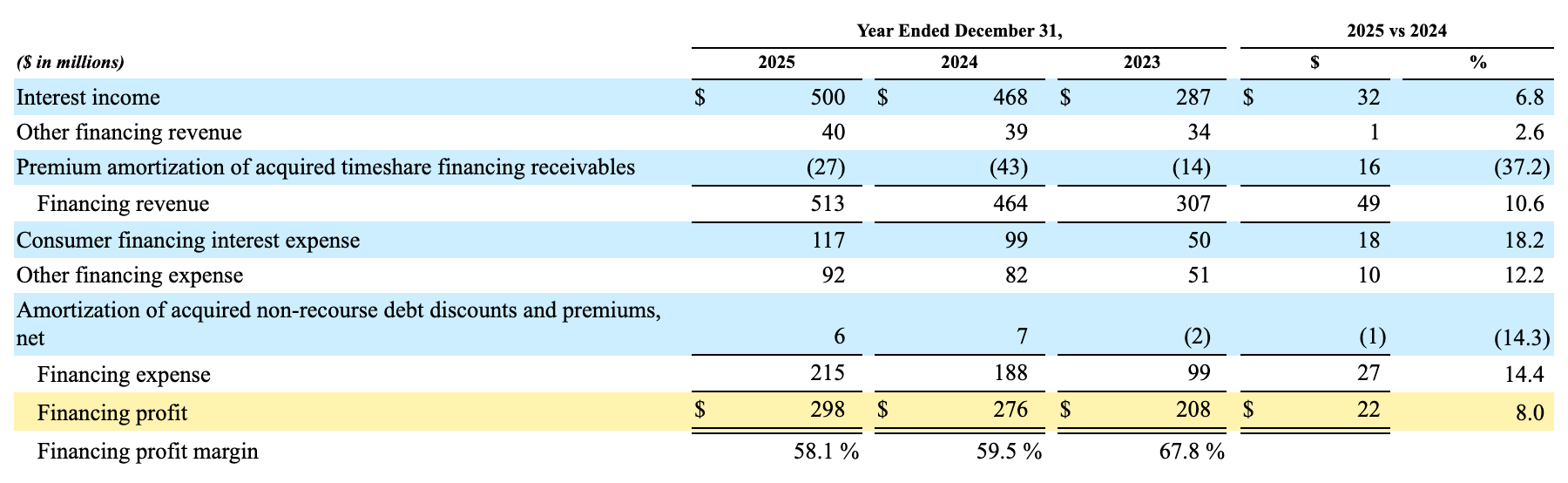
Company two starts earning the moment a sale closes, and does not stop. It lends buyers the purchase money: $5.0 billion of loans outstanding at a 14.4% average interest rate. And it manages the resorts and clubs for fees that come back every year. In 2025, financing made $298 million of profit at a 58% margin. Resort and club management made $551 million at 71%.
Add up each half. The after-sale streams made $849 million of profit in 2025. Selling, including that rental loss, made $414 million. Two thirds of HGV’s profit comes from financing and managing people who already own, not from selling to new ones (by my math, from the profit lines in the 10-K).
Two consequences follow, and they drive the rest of this dive.
First, the fee-and-interest machine only grows if the selling machine keeps feeding it new members. That feed has stopped: 721,896 members at June 30, slightly fewer than a year earlier. Growth right now comes from selling more to the people already inside, and 74% of 2025 contract sales came from existing owners.
Second, the profit engine is a lender, so it is only as healthy as its borrowers. HGV lends at 14.4% and funds those loans by borrowing against them at about 5% (and on most of that debt, lenders can only claim the loans themselves, not HGV’s other assets: it is non-recourse). That spread is the best business inside the company. But when borrowers stop paying, the expected loss is charged against sales revenue, and that charge reached $122 million in the June quarter alone. The lender’s health is the thread the rest of this dive pulls.
The balance sheet in one line: $4.9 billion of corporate debt at a 5.6% average rate, another $2.9 billion borrowed against the loan book without recourse to HGV, and about $272 million of cash.
And capital allocation in one line: nearly every spare dollar goes to buying back HGV’s own shares. That arithmetic is unusual enough to get the next section to itself.
Share Buybacks Explained: AutoZone, Bed Bath & Beyond, and HGV’s Disappearing Share Count
HGV has retired 35% of its own shares in four and a half years. Before deciding whether that is good news, it helps to know when a buyback creates value and when it destroys value, because the same act sits behind a stock that rose roughly 95x in 27 years and behind a company that went bankrupt.
The mechanics are simple. Picture the company as a pie, cut into one slice per share. In a buyback, the company uses its own cash to buy slices back and remove them from the pie plate. The pie itself stays the same size; it is just cut into fewer slices now, so every remaining slice is bigger. That is all a buyback does.
The common belief is that this automatically creates value. It does not. A buyback is an investment like any other, and it depends on the price paid: pay less for a slice than the slice is actually worth, and everyone still holding a slice comes out ahead. Pay more, and the company has overpaid for its own stock and made the remaining owners poorer.
The second thing that decides the outcome is where the cash comes from. Buy back stock with genuine spare cash, and the worst case is a wasted opportunity. Buy it with borrowed money while the business weakens, and the company reaches the downturn with the debt still there and the cash gone.
Here are both outcomes, from real filings.
AutoZone is the success case. From 1998 to 2025 the car-parts retailer cut its share count from 150.4 million to 16.6 million, an 89% reduction, spending about $38.6 billion on it (by my math: $39.2 billion authorized over the years, minus the $632 million still unused). Here is the important part. The business grew well but not spectacularly: net income rose about 11x over those 27 years. Earnings per share rose about 98x over the same period. The difference between 11x and 98x came entirely from the shrinking share count. The stock went from $32.94 at the end of 1998 to about $3,127 this month, roughly 95x, with no stock splits.
NVR did the same thing. The homebuilder cut its share count 62.6% between 2001 and 2025 and is still buying today ($1.82 billion of buybacks in 2025 alone). Its stock went from $204 to about $6,390 over that period, roughly 31x.
Bed Bath & Beyond did the same thing and went bankrupt. It repurchased $10.5 billion of its own stock from 2004 through fiscal 2017. Then its retail business declined, and the losses arrived after the cash had already been spent. In fiscal 2022 it lost $36.03 per share. To keep operating it had to sell new shares at very low prices, and by May 2023, two weeks after its Chapter 11 bankruptcy filing, the share count stood at 739 million, up from about 97 million a year earlier. The stock closed at $0.29 on the last Friday before the filing. The buybacks did not cause the decline of the business. They spent the $10.5 billion the company could have used to survive it.
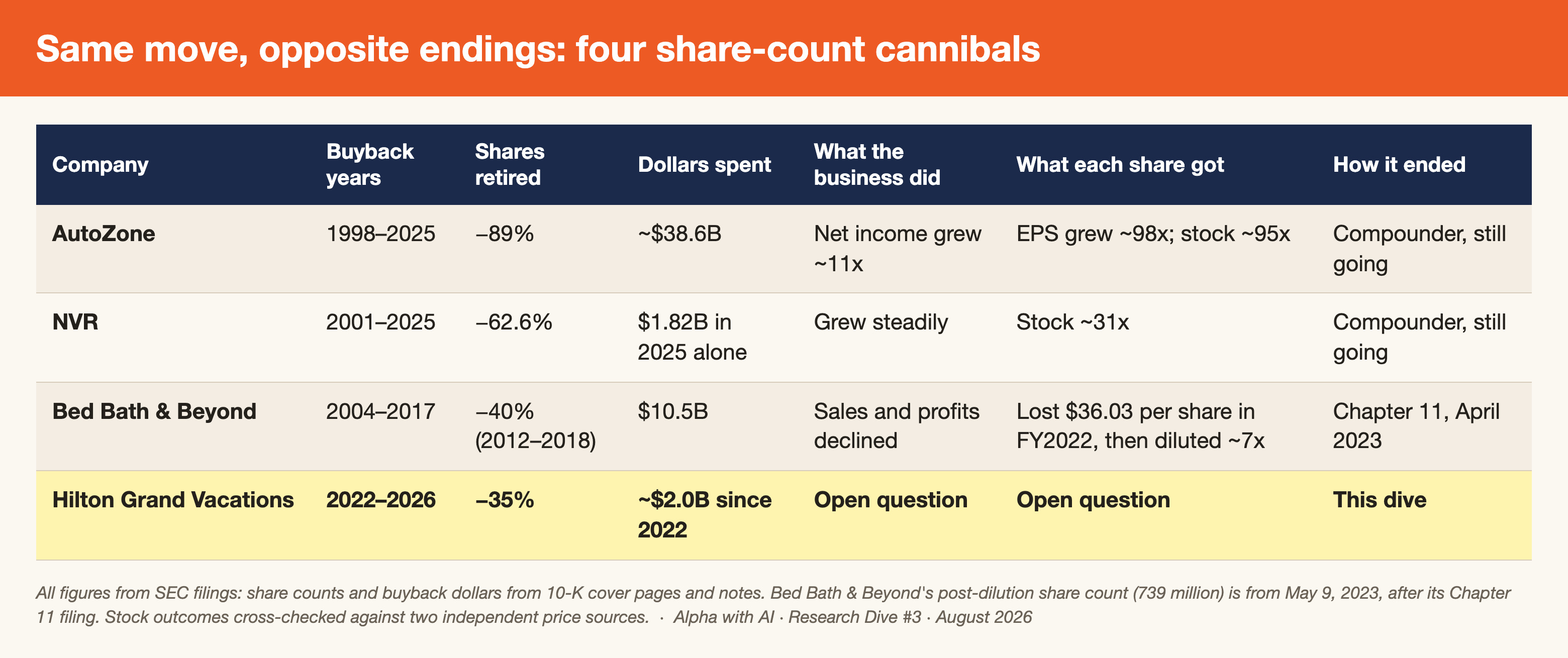
So the outcome is not decided by the buyback itself. Three checks separate AutoZone from Bed Bath & Beyond: was the price paid below per-share value, was the cash genuinely spare, and was the underlying business growing or declining.
Run the checks on HGV. The scale is real: $272 million of buybacks in 2022, $368 million in 2023, $432 million in 2024, $600 million in 2025, and $325 million so far this year through July 23, at an average of $48.19 per share last quarter. By my math, each remaining HGV share now represents 54% more of the company than it did at the end of 2021.
But all three checks are still open, and the rest of this dive works through them. Is the price paid below what the business is worth per share? That is the valuation section. Is the cash genuinely spare? HGV’s own headline cash-flow measure counts money borrowed against its loan book as cash flow, and separating real cash from borrowed cash is also the valuation section’s job. Is the underlying business growing or weakening? That is the question the next two sections answer.
One more number before moving on. The buyback authorization has $103 million left. At the recent pace of roughly $150 million a quarter, that is about two more months of buying. The board has approved a new authorization every year since 2022. Whether it does so again at the Q3 report is the nearest-term test of the whole HGV story.
Why HGV Stock Fell 9.9%: the Weak Quarter, the Loan Book, and the Apollo Overhang
Four things are weighing on the stock. Here they are, one at a time.
The quarter itself. Contract sales (the total value of new vacation-ownership purchases signed in the quarter) came in at $810 million, down 2.9% from a year earlier. VPG (volume per guest: the average sales value each tour produces) fell 8.6% to $3,372, while tour flow (the number of people who sat through a sales presentation) rose 6.1%, the fourth straight quarterly increase. On the earnings call, management gave two explanations. Bluegreen resorts were comparing against a quarter last year when buying jumped after the launch of HGV Max, the combined membership program. And a handful of Bluegreen sites in Orlando and Myrtle Beach had what management called execution challenges, where new sales leadership has been installed. Management also said it expects third-quarter contract sales to fall by a mid single digit percentage. One more item sat in the quarter: a $48 million loss on the disposal of certain resort properties. HGV has not disclosed the buyer or the terms of that sale.
The loan book. This is the part the market is most afraid of. Remember how this business works: HGV lends most of its customers the money for the purchase. Some of those customers will eventually stop paying, and accounting rules require HGV to estimate those future losses in advance, at the moment of sale, and subtract the estimate from revenue. That estimate is called the provision (the charge for expected loan losses).
The provision reached $122 million in the June quarter, up 28% from a year earlier, even though the sales that create the loans fell. Measured against contract sales, the provision was 15.1%, up from 11.4% a year before. In plain terms: for every $100 of vacations HGV sold in the quarter, it set aside about $15 for customers it expects to stop paying, up from about $11 a year ago.
The other loan-book numbers point the same way. Loans more than 120 days late grew to 14.0% of the loan book at June 30, from 12.6% six months earlier. The allowance (the total pool of money already set aside for expected losses on the loans HGV made itself) has risen every reporting period since the end of 2022, from 23.0% of those loans to 30.1%. And in the first half of 2026, HGV gave up on and wrote off $107 million of loans, about the same as in all of 2024.
One possible explanation is that American consumers are stretched everywhere. The filings of the two closest competitors do not support it. Over the same period, Marriott Vacations reported delinquencies (payments running late) improving by about one percentage point from a year earlier, and Travel + Leisure reported its share of past-due loans falling. Whatever is happening to HGV’s borrowers is not happening across the industry.

The Apollo overhang. Apollo, the private equity firm, received just over 30 million HGV shares when it sold Diamond Resorts to HGV in 2021, which made it the largest shareholder. It has been selling in blocks: 8.05 million shares at $42.85 in August 2025, then 5.75 million at $50.00 in June 2026. HGV used its own buyback to purchase part of each block, 933,488 shares the first time and 750,000 the second. Apollo still holds about 12.5 million shares, 15.9% of the company, and HGV’s own annual report now states that Apollo may continue to sell. Buyers know more shares are likely to be sold, and that knowledge holds the price down. Two related details: one of Apollo’s two board seats went away on July 2 when its designee resigned under the shareholders agreement, and if Apollo sells about another 528,000 shares, its board representation ends entirely.
The insider tape. Since the July 30 report, no HGV insider has bought shares in the open market. One has sold: the general counsel sold 20,691 shares on August 6 at an average price of $46.90, about $970,000, roughly 30% of the shares held directly before the sale (unvested stock awards sit on top of that, so the share of the total stake is smaller). The filing shows the sale was not made under a pre-arranged trading plan (a 10b5-1 plan, which schedules insider sales in advance). One sale by one executive proves nothing; people sell for taxes and personal reasons. The plain fact is this: a week after a 9.9% fall, the insiders’ combined open-market activity was one sale and zero buys.
Weigh the four parts. The Apollo shares will be sold and absorbed eventually. A badly run quarter can be fixed with better selling. The loan book is the part that decides everything, because if HGV’s customers are running out of ability to pay, then the falling VPG is not an execution problem, the loss charge keeps growing, and the earnings that fund the buyback shrink. The whole thesis now hangs on one question: is this a selling problem or a customer problem? The next section takes both sides of it seriously.
The One Question That Decides HGV: a Selling Problem or a Customer Problem?
This whole dive comes down to one question. The number of people taking HGV’s sales tours is growing. The amount those people buy is falling. Why?
There are two possible answers. Answer one: HGV’s sales teams are doing a bad job of selling. That can be fixed within a few quarters. Answer two: HGV’s customers can no longer afford the product. That is a much bigger problem. Below is the strongest honest case for each answer, and then my own conclusion.
The case that the customer is the problem.
The strongest evidence is in the loan numbers. In April 2026, HGV acquired Elara, and Elara’s customer loans came with it. So you could ask: maybe the loan book only looks worse because of these newly added loans? The filings answer that question. Remove the Elara loans completely and look only at the loans HGV already had: loans more than 120 days late still rose from 12.6% of that book to 14.1% in six months. So it is not the newly acquired customers making the numbers worse. HGV’s existing borrowers are paying worse than they did six months ago.
The second piece of evidence is history. HGV’s annual reports disclose what percentage of its loans defaulted each year (a default means the customer stopped paying and the loan was declared a loss). In 2019, before the pandemic, that rate was 5.14%. In 2024 it was 10.77%. In 2025 it was 9.86%. Defaults today run at about twice the pre-pandemic level. And HGV did not loosen its lending rules to cause this: the filings have described the same minimum 10% down payment since 2021. The rules for getting a loan stayed the same. The customers passing those rules got weaker. One more sign points the same way: the average new loan has been getting longer, from 8.2 years remaining in 2022 to 8.9 years in 2025. Lenders usually stretch loans out longer when buyers need smaller monthly payments.

The third piece of evidence is about future tours. Customers pay in advance for discounted vacation packages, and those packages are what bring them to sales presentations later. So the balance of these advance payments tells you how many future tours are already paid for. That balance was $226 million at the end of 2024 and $228 million at June 30, 2026. It has not grown in a year and a half, even though tours grew 6.1%. In other words, HGV is using up its supply of already-sold packages, and it is not selling enough new ones to replace them.
Now add what the last section showed. The two closest competitors reported improving loan numbers over the same period. And no HGV insider has bought a single share since the stock fell on July 30. If this case is right, then the 8.6% fall in VPG is not a sales-team problem. It means the customers themselves are running out of money, and next year’s earnings will come in lower than this year’s, whatever the guidance says today.
The case that the selling is the problem.
The first fact: tours keep growing. Tour flow has now grown for four straight quarters. Families are still buying the discounted packages, still getting on planes, still sitting through the presentations. People who could not afford the product would eventually stop showing up. They have not stopped.
The second fact: last year’s comparison was unusually hard to beat. On the earnings call, management explained that Bluegreen resorts were being measured against the June 2025 quarter, when buying per tour jumped about 45% after the launch of HGV Max, the combined membership program. When you compare a normal quarter against an unusually strong one, the normal quarter looks weak even if nothing is wrong. Management also named the exact places where selling went badly, Orlando and Myrtle Beach, and replaced the sales leadership there. That explanation is specific enough to be checked: within two quarters, either those markets recover or they do not.
The third fact: management did not cut its profit guidance. The full-year guidance for Adjusted EBITDA (operating earnings before interest, taxes, and depreciation, on the company’s own adjusted definition) was raised in April and kept unchanged in the same July release that reported the weak quarter. A management team watching its customers run out of money would normally cut that number. This one did not.
On the loan numbers, this case has three answers. First, high defaults are normal in this industry. Marriott Vacations’ own filings assume that 13.05% of its loan balances will eventually default. Travel + Leisure sets aside 20.8% of its sales for expected losses. HGV’s loss levels are inside the industry’s normal range. What is unusual at HGV is the direction of change, not the level. Second, the provision is an estimate made in advance, not cash actually leaving the company that quarter. HGV books the full expected lifetime loss on a loan on the day of the sale. So a cautious estimate lowers reported profit today, while the real cash losses arrive slowly, over years. Third, Fitch and trade press reports through 2025 said that timeshare loans were performing worse across the whole industry, especially loans made in 2025. So part of HGV’s bad trend may be an industry problem, not an HGV problem.
And one thing makes the reported quarter look worse than the real quarter: Hawaii. Sales at the unfinished Waikiki tower are deferred (booked as revenue only once the building is complete). So the reported earnings exclude selling that has already happened.
If this case is right, then the weak quarter was a hard comparison plus two badly run sales markets. The guidance holds, the Hawaii sales get added to reported earnings as construction finishes, and the buyback keeps retiring shares in a business the market just marked down 9.9%.
Before I give you my read, make your own call.
My read. The two cases are actually answering two different questions. Once you see that, most of the confusion clears up.
Question one: why did VPG fall 8.6% this quarter? Here the selling explanation mostly convinces me. The Bluegreen comparison problem was real, the problem markets are named, and the fix can be checked within two quarters.
Question two: why does the loan book keep getting worse? Here the selling explanation cannot help at all. How well a sales team performs this quarter has no effect on whether people who bought in 2023 keep paying their loans in 2026. And the loan book is getting worse on its own: excluding Elara, late loans rose from 12.6% to 14.1% in six months, while both competitors improved.
So my answer is split, and I mean the split precisely: the weak quarter is mostly a selling problem, but the loan book shows a real weakening of HGV’s financially weakest customers, and that part is specific to HGV. The loan book matters more for the stock. Worsening loans feed the provision, the provision reduces profit, and profit is what pays for the buyback.
Here is what would prove me wrong. I am writing it down now, with dates, so that neither you nor I can reinterpret it later. Management itself guided third-quarter contract sales down by a mid single digit percentage. If the actual fall is worse than that, or if VPG falls anywhere near 8% again after the Bluegreen comparison has passed, then the selling explanation is dead and the customer explanation wins both questions. And if the third-quarter loan numbers worsen again while Marriott Vacations and Travel + Leisure hold steady, my split answer gets worse, not better.
One more thing about the loan book belongs in this dive before the valuation. The cleanest loan numbers HGV shows the market are not what they appear to be. That is the next section.
Why HGV’s Loan Bundles Look Perfect: the Company Buys the Bad Loans Back at Full Price
One argument comes up in every bullish discussion of HGV, and it sounds strong. It goes like this: if HGV’s customer loans were really going bad, the bond market would notice, because the bond market lends against those exact loans. And the bond market keeps lending to HGV, cheaply and eagerly. In June 2026, HGV sold a $300 million bundle of customer loans to bond investors. Investors wanted about nine times more than was available, and HGV’s CFO said the deal priced at the tightest spread (the extra interest cost above benchmark rates) in timeshare since January 2022. How can the bond market be that calm if the loans are going bad?
That argument is wrong, and the proof is in HGV’s own filings. To understand the proof, you first need to see how HGV turns its customer loans into cash. Here is the whole process, step by step.
HGV does not keep its customer loans and wait ten years to collect the monthly payments. Instead, it does what banks do with home mortgages. It gathers thousands of customer loans into one large bundle. Then it sells that bundle to bond investors. The investors pay HGV cash immediately, about 98 cents for every dollar of loans in the bundle. In exchange, the investors receive the customers’ monthly payments as those payments come in. This is called securitization (turning a pool of loans into bonds that investors can buy), and it is normal practice across finance. Home mortgages, car loans, and credit card balances are funded the same way. Marriott Vacations and Travel + Leisure fund their timeshare loans the same way too.
Why does HGV do this? Because it gets its cash back on day one instead of over ten years, and it can immediately lend that cash to the next customer. The bond investors are, in effect, funding HGV’s lending business year after year. HGV needs them to stay comfortable.
With that background, look at what HGV’s latest quarterly filing discloses. The filing reports how many loans are more than 120 days late, and it reports this separately for loans inside the bundles and loans outside them. Of the loans HGV made itself and has NOT put into bundles, 25.2% are more than 120 days late. Of the loans HGV made itself that sit INSIDE the bundles sold to bond investors, 0.7% are more than 120 days late. Same company, same product, same kind of customer: 25.2% late outside the bundles, 0.7% late inside them.
I found this split by having Claude Code read the loan footnotes of every HGV filing back to 2021 and separate every late-loan number into two piles: loans inside the bundles and loans outside them. The 0.7% against 25.2% gap is what came out of that sorting.
Part of the gap is screening: only healthy loans are allowed into a bundle in the first place. But loans go bad after they enter bundles too, and the bundles still show 0.7%. How? HGV’s own filings give the answer, in one sentence: “we often replace or repurchase timeshare financing receivables that are in default at their outstanding principal amounts.” In plain English: when a loan inside a bundle goes bad, HGV often buys it back at full face value (at par, meaning 100 cents on the dollar), or swaps a healthy loan in. The bad loan moves back onto HGV’s own books. The bundle stays clean, the bond investors stay happy, and the bad loan joins the group of loans outside the bundles. That is part of why the outside group shows 25.2% late.

How much does this support cost? The filings never say. Nowhere does HGV disclose how many dollars of defaulted loans it buys back from the bundles each year. The cost sits inside the overall loan-loss numbers you have already seen, without its own line. The only outside estimate comes from Fitch, the rating agency that grades these bonds. According to Fitch’s surveillance reports, on HGV’s older bundles from 2018 through 2020, defaults equal to roughly 2.4% to 3.5% of the original bundle size were bought out or swapped out by HGV. Fitch also states the consequence: none of these deals has ever produced a loss for bond investors, and Fitch credits the repurchases and substitutions for that record. The bond investors have never lost a dollar on HGV’s loan bundles, partly because HGV keeps paying to make sure they never do.
Two more outside observations point the same way. In October 2025, Fitch raised its lifetime default expectations on HGV’s 2024 bundles, meaning those loans are performing worse than Fitch originally assumed. And the average credit score (FICO, the standard US credit score) of the loans in HGV’s newest bundle, sold in December 2025, was 727, which Moody’s called one of the lowest in the history of HGV’s deals, down from 745 in a bundle sold in early 2025.
So the bullish argument gets the direction wrong. The bond market’s calm is not independent proof that HGV’s loans are healthy. The bond market stays calm partly because HGV spends its own money to keep the bundles clean.
Three disclosure changes, all in the same direction. While the loan numbers worsened, three things also changed in what HGV shows the public.
First, the default-rate table. HGV’s quarterly reports used to include the annual default rates you saw in the last section. Both 2026 quarterly reports dropped that table. The numbers still appear once a year in the annual report, but the quarterly view of defaults is gone.
Second, the credit-score method. In the first quarter of 2026, HGV changed how it calculates the borrower credit scores it discloses, from an average of the available scores to a single score. The new method produces higher numbers. On the old method, the disclosed score had peaked at 741 in 2024 and fallen to 734 in 2025. The new method shows numbers around 747 to 751. Even on the new method, the score fell from 751 to 747 year over year.
Third, the Manhattan Club case. HGV inherited an arbitration case (a private court proceeding) with its Bluegreen acquisition, and in 2024 the arbitration panel ruled against HGV’s subsidiary. The 2025 annual report describes what HGV had to do: take on a $47.5 million note payable and make forced inventory purchases of $7.5 million every quarter, with the damages phase still unresolved. Then both 2026 quarterly reports stopped mentioning the case entirely, while the accrued legal liabilities line went from $8 million to $19 million in a single quarter, with no explanation given.
I want to be careful here. There may be an innocent explanation for each change on its own. Companies drop tables they decide are immaterial. A methodology change can be a genuine improvement. Legal disclosures come and go as lawyers judge what is material. And I am not claiming anyone at HGV intends to hide anything. I cannot know that, and the filings do not say it. What I can say is simpler: three disclosures changed in the same year, all three in the direction of showing less about a loan book that was getting worse. I weigh that as a pattern.
The catch. The repurchases themselves are not a scandal. They are optional, they are disclosed (in that one sentence), and they may simply be good business: the bundling channel gives HGV cheap funding at 98 cents lent per dollar of loans, and protecting that channel is worth real money. A rational finance chief might make the same choice with clean motives. The same sentence has also appeared in HGV’s filings since at least 2021, so this is not new behavior invented to hide this year’s problems. The reason it matters is narrower: you cannot use the bond market’s calm as proof that the loan book is fine. The loan book’s own numbers, the ones you saw in the last two sections, are the evidence that counts, and they are worse than the clean bundles suggest.
Two questions I could not answer from the filings. How many dollars per year do the repurchases consume? And when a customer who is behind on payments upgrades to a bigger package, which replaces the old loan with a new, larger one and resets its age, are late-paying customers allowed to do that? The filings do not say. I am sending both questions to HGV’s investor relations. If I get a reply, it will appear here as an edit at the end of this piece, or in a future update.
Now the valuation. Everything so far goes into it: the two businesses inside HGV, the buyback, the split answer at the hinge, and a loan book whose cleanest numbers I now trust less.
What I Think Hilton Grand Vacations Is Worth: My Bear, Base, and Bull Cases
Before the numbers, three warnings. A valuation is a set of assumptions multiplied together. Mine is sensitive to three of them: how much HGV earns in 2027, how much of that turns into real cash, and what price the market will pay for that cash. Change any one of the three and the answer moves a lot. Everything below is my opinion, with the method shown step by step, so you can disagree with a specific step instead of just the conclusion.
The first job is deciding what HGV actually earns, because HGV’s profit comes in three versions. Version one is reported Adjusted EBITDA (operating earnings before interest, taxes, and depreciation, on the company’s own adjusted definition): $950 million in 2025 for the portion belonging to HGV shareholders. Version two adds back the deferred sales (the Hawaii-style sales already made at unfinished buildings, not yet allowed to be counted as revenue): $1,152 million. This second version is the one HGV’s own bonus plan pays managers on, so I treat it as the honest measure of what the business earned. Version three is the guidance number for 2026, $1.225 to $1.265 billion, also calculated before deferrals. Three versions of profit, about $300 million apart. I build everything on version two.
The second job is turning earnings into cash. Here my method differs from the company’s own headline number, and the difference matters a lot. HGV publishes a measure it calls Adjusted Free Cash Flow. For 2025, that measure was $756 million. Here is what was inside it, from HGV’s own reconciliation table: $154 million of actual free cash flow, $404 million of new net borrowings against the loan book, and about $198 million of added-back costs. More than half of HGV’s 2025 “free cash flow” was borrowed money. One quarter, the fourth of 2024, showed $883 million on this measure, and $747 million of that was borrowings. In the first quarter of 2026, the same measure was negative $37 million. The reason for these wild swings is simple: the number rises and falls with how much HGV borrows in each quarter. So it cannot tell you how much the business actually earns.
So I built my own cash number. Start with the $1,152 million of version-two earnings. Subtract the interest HGV pays on its corporate debt. Subtract cash taxes. Subtract what HGV spends on property, software, and new resort inventory. Subtract the cash tied up in funding new customer loans. Do not count any borrowed money as income. What is left is cash that actually belongs to the shareholders. On 2025’s numbers this figure is much smaller than the company’s headline, and much steadier. All three cases below are built on it.
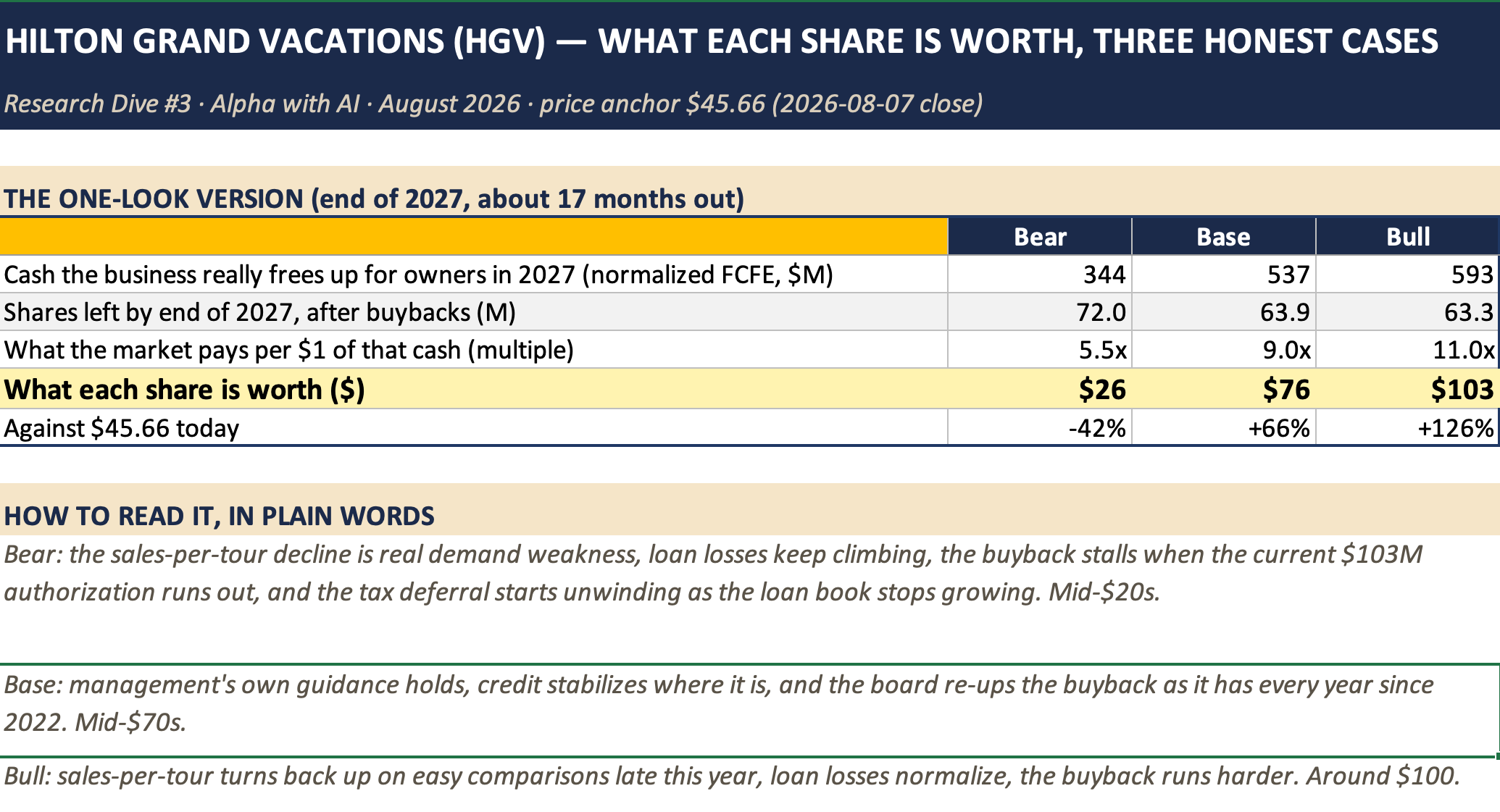
One more concept before the cases, because the cases depend on it: the multiple. When I say a share is worth nine times its yearly cash, I mean the buyer is paying today for nine years’ worth of the cash that one share produces. A growing, safe business deserves a high multiple, because its future years will probably arrive and will probably be bigger. A shrinking or risky business deserves a low multiple, because its future years may never arrive. So in each case below, I first work out the cash per share, and then decide how many years of that cash the business deserves to be priced at.
Now the three cases, all valued at the end of 2027.
My bear case: about $26 per share, roughly 42% below today’s $45.66. In this case, 2027 earnings (version two) fall to $1.0 billion: the fee HGV pays Hilton steps up as scheduled, loan-loss charges keep climbing at the current pace, and demand weakens. My cash number comes out near $344 million. That includes extra cash taxes, because HGV currently postpones tax on installment sales (sales paid over time), and that postponement unwinds when the loan book stops growing. The buyback stops when the current authorization runs out, leaving about 72 million shares. Divide $344 million of cash by 72 million shares: each share produces about $4.80 of cash a year. I price that at 5.5 times, a low multiple for a business in trouble, and get roughly $26 per share. This is what I think the stock is worth if the customer explanation is true and HGV’s borrowers really are running out of money.
My base case: about $76, roughly 66% above today. Earnings reach $1,275 million, a little above the top of this year’s guidance range, as the Hawaii sales enter the numbers and credit stabilizes without improving. Cash comes out near $537 million. The buyback continues and the share count falls to about 63.9 million, so each share produces about $8.40 of cash a year. I price that at nine times and get roughly $76.
My bull case: about $103, roughly 126% above today. Earnings reach $1.4 billion: Hawaii lands, the two problem sales markets recover, and credit actually turns. Cash comes out near $593 million across about 63.3 million shares, which is about $9.40 of cash per share. I price that at eleven times and get roughly $103.
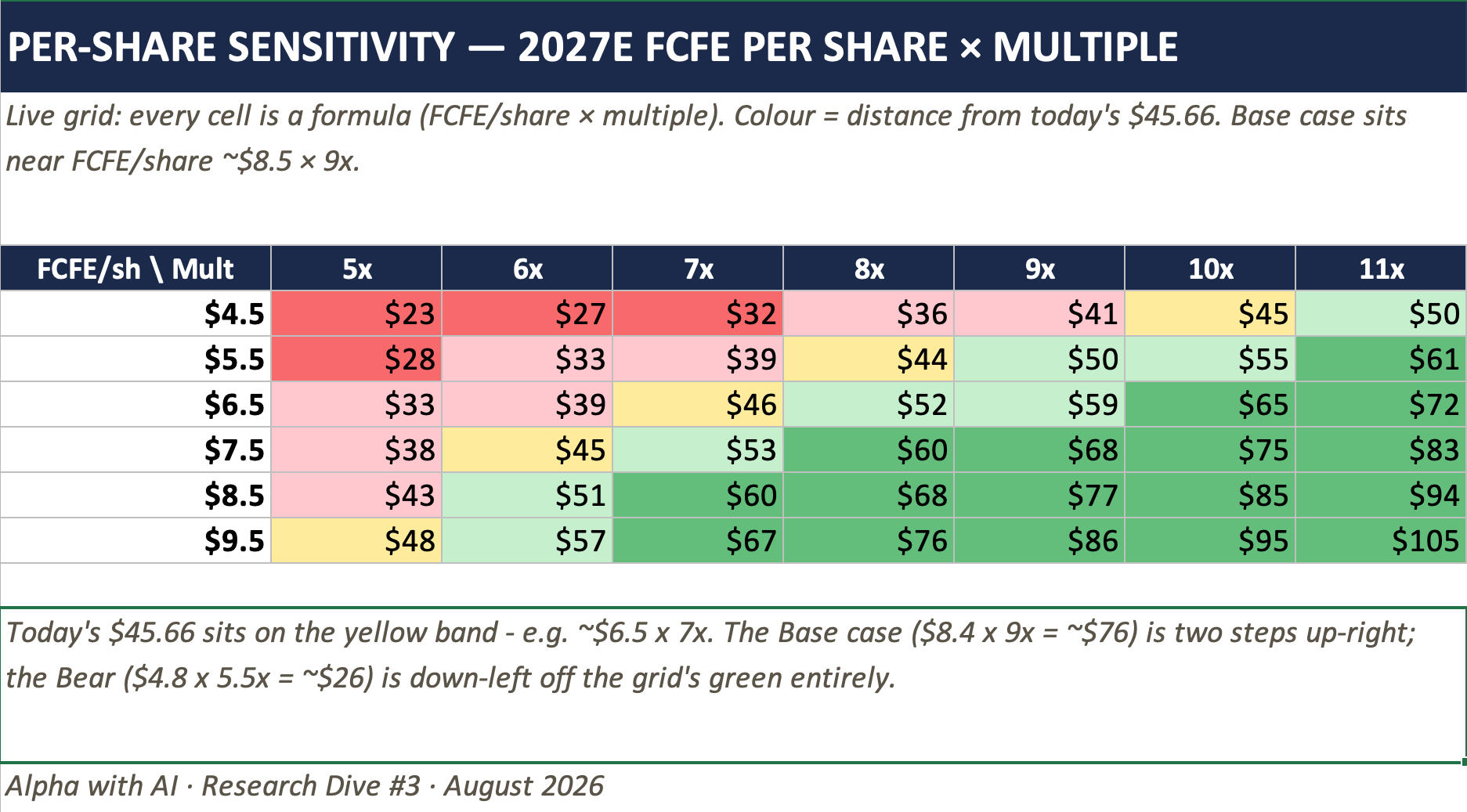
A second method as a sanity check. Value the whole company at seven times version-two earnings (this values the enterprise: the shares plus the debt together), subtract the roughly $4.6 billion of net corporate debt, and divide by the shares. The base case comes out near $70. The two methods land close together, which makes me trust the answer more.
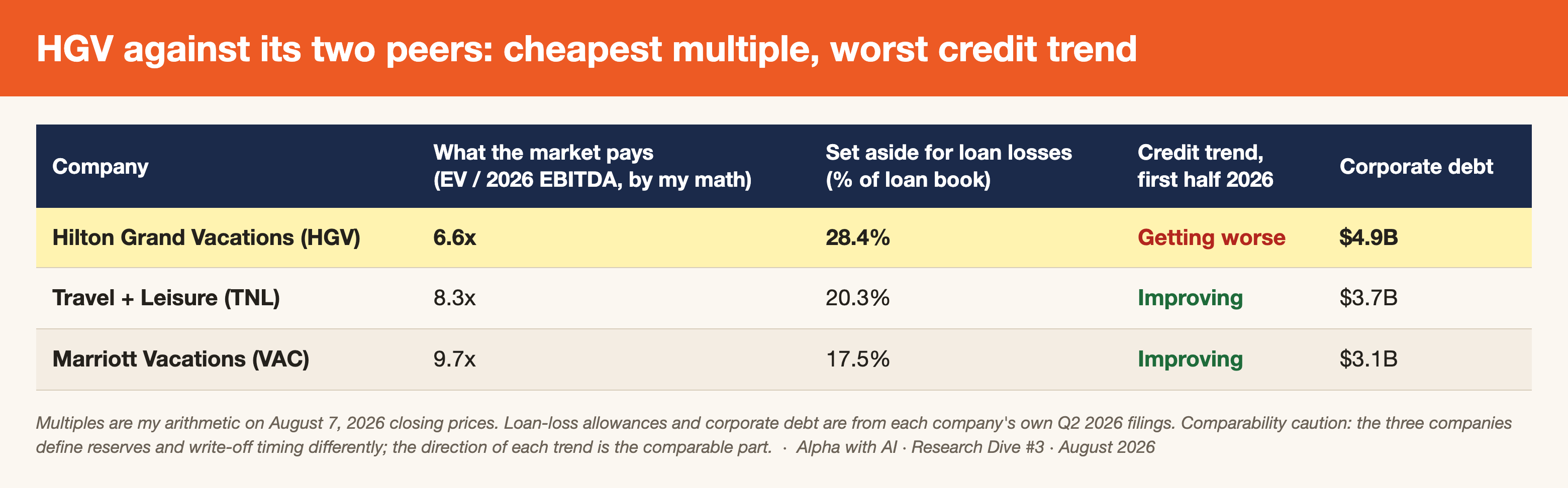
Now put HGV next to its two peers, because that comparison does two jobs at once: it checks whether my multiples are reasonable, and it shows what the market already charges for the risk. At the August 7 closing prices, by my math, the market values HGV at about 6.6 times this year’s guided earnings. Travel + Leisure trades near 8.3 times its earnings. Marriott Vacations trades near 9.7 times. HGV is the cheapest of the three, by a wide margin.
The discount has a reason, and you already know it: HGV is the only one of the three whose loan book is getting worse. Marriott Vacations and Travel + Leisure also carry billions in customer loans and also expect double-digit defaults, but their numbers improved this year while HGV’s worsened. The market is charging HGV for that difference. My cases simply price the two outcomes: the base case assumes HGV closes part of the gap to Travel + Leisure, not all of it, and the bear case assumes the gap gets wider.
You will see higher numbers than mine elsewhere. Some investors put a multiple of ten directly on the company’s own Adjusted Free Cash Flow measure, which produces values well above $100 per share. I do not, for the reason above: that measure counts borrowed money as cash flow. On the cash the shareholders actually receive, my base case is the mid-$70s. If you use that higher math, you should at least know that the number underneath it includes borrowed money.
One more piece of arithmetic, a discipline I run on every company I research. I ask: at what price would the upside to my base case be exactly twice the downside to my bear case? With a base of $76 and a bear of $26, that price is about $42.7. Today’s $45.66 sits about 7% above the point where my numbers say the reward is twice the risk. Close, but not there. That is a fact about my arithmetic, not an instruction to anyone.
My full Excel model comes attached with this piece, the same way as in the previous dives: my inputs in blue, so you can change any assumption and watch the answer move.
Those are my numbers. The next section lists the ways they could be wrong.
What Breaks the HGV Thesis: Five Risks and the Sign for Each
I tried to kill this thesis before publishing it. These are the five ways it dies, each with the sign that would tell me it is happening.
1. The board does not renew the buyback. About $103 million remains of the current authorization, roughly two more months at the recent pace. The board has approved a new authorization every year since 2022. If the Q3 report comes and goes without a new one, the shrinking share count that drives the whole per-share story stops. It would also be information in itself: boards pause buybacks when they see trouble coming or need the cash somewhere else. The sign: the Q3 report itself, and whether a new authorization comes with it.
2. The loan book keeps getting worse. Every quarter of rising late payments adds to the provision, and the provision comes straight out of profit. If the provision keeps climbing from the current 15.1% of contract sales, my base case earnings are wrong and the bear case is the honest map of where this goes. The sign: HGV’s Q3 credit numbers, read next to Marriott Vacations’ and Travel + Leisure’s.
3. A real consumer downturn arrives. Everything in this dive happened while US employment was healthy. HGV’s defaults already run at about twice their 2019 level in a decent economy. A recession hits the weakest borrowers first, and HGV’s problem is already concentrated in its weakest borrowers. A timeshare is also one of the first purchases a worried household delays. In that world, my bear case of $26 stops being the cautious scenario and becomes the likely one. The sign: US unemployment and consumer-credit data turning together.
4. The Hilton license terms turn against HGV. The fee HGV pays Hilton for the brand is stepping up on a schedule: the Diamond resorts reach the full 5% rate around August 2026 and the Bluegreen resorts by early 2028, a built-in cost increase of roughly $40 million a year by 2027, by my math. Two harder clauses sit behind it. If HGV misses its room-conversion targets badly enough, the fee escalates further, and Hilton gains the right to block future sales of HGV Max, the combined membership program. And any sale of HGV itself requires Hilton’s consent, which closes off the most common ending for a cheap stock, a takeover. The sign: any disclosure about missed conversion milestones.

5. The Manhattan Club case lands a big number. The damages phase of the arbitration is still unresolved, and HGV’s own history says these cases can be large: a different inherited case, from the Diamond acquisition, ended in early 2024 with a payment of about $104 million, of which HGV paid about $50 million in cash and insurance covered the rest. Meanwhile, accrued legal liabilities jumped from $8 million to $19 million in the June quarter with no explanation given. If the damages award lands anywhere near the earlier case’s scale, that is a direct cash hit in a year when only $103 million of buyback authorization remains. The sign: any 8-K or footnote resolving the damages phase.
That is the full list of what I think could break this thesis. Now the verdict.
Where I Land on HGV: My Verdict, Dated August 9, 2026
Time to land this.
Everything you have read so far is free, in full, on purpose. I would rather show you what a Research Dive is than describe one. What sits below is the part paid subscribers get with every dive: my model portfolio entry, its size, the reasoning behind that size, and the three tests that will decide what I do next.