


If you had put $100 into Boston Scientific five years ago, it would have been worth about $250 in September 2025, and it is worth about $106 today, while the same $100 in the S&P 500 is worth $168. Boston Scientific makes the devices heart doctors put inside patients, and its share price fell from $108.14 on 8 September 2025 to $45.69 on 23 October 2026, a fall of 57.7 percent, during a year when its sales still grew.
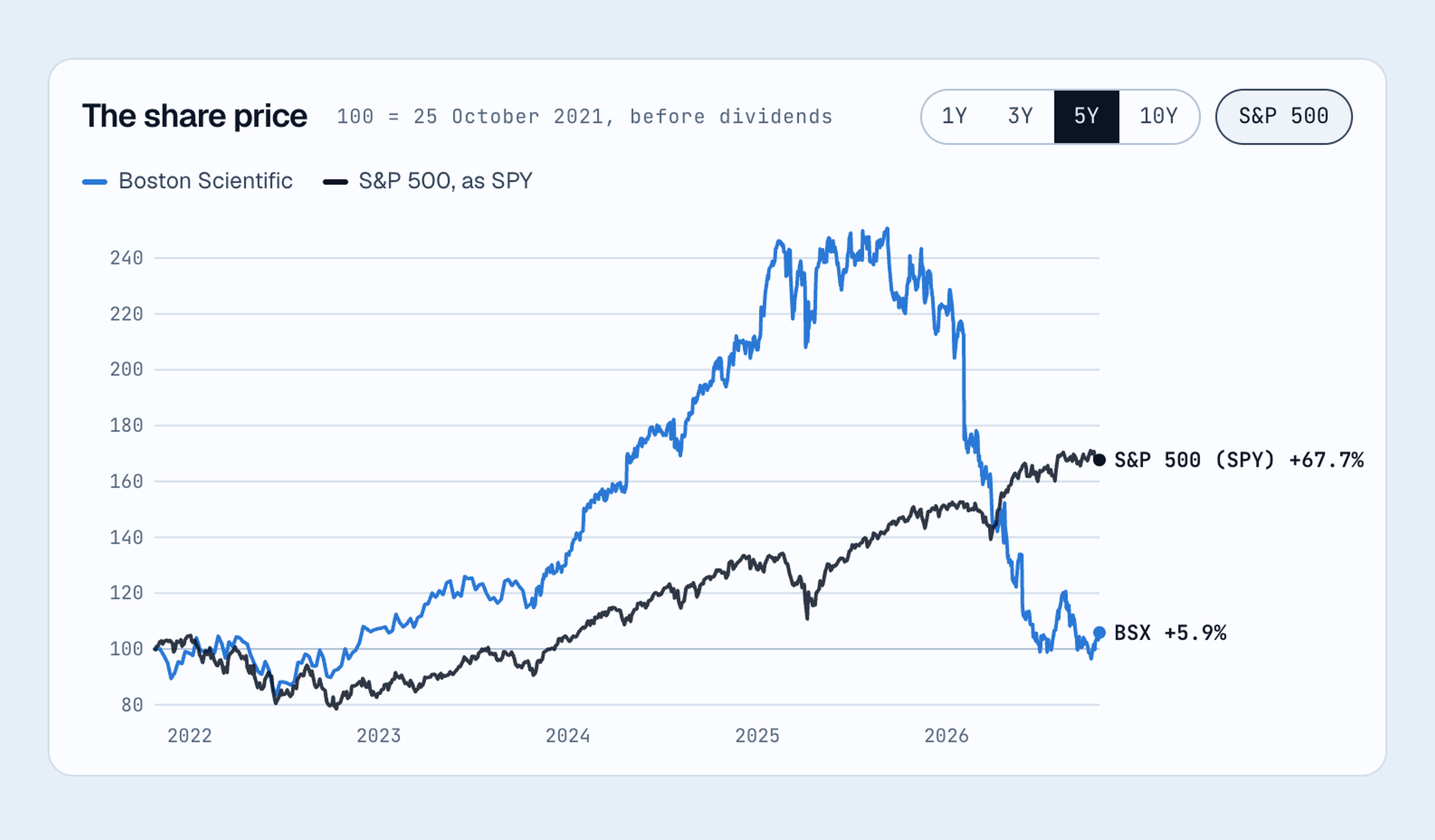
The market’s story is about the two products that made Boston Scientific a growth stock, Watchman, a small implant that closes off the pouch in the heart where clots form, and Farapulse, a catheter that treats an irregular heartbeat, and both of them have slowed down hard. Watchman grew 4 percent in the June quarter after growing 28 to 35 percent in every quarter of 2025, after a big trial in March made some doctors less sure about it, and three of the largest medical device companies now sell their own version of Farapulse.
So I went to the people who actually choose these devices. Heart-rhythm doctors argue about catheters in public on X every day, and when Grok read 176 of their posts from this year for us, it did not find a single one describing a hospital dropping Farapulse. That did not prove the market wrong, because doctors on X are not a sales report, but it was the first sign that the evidence might not match the story. And the two products in the story are only about a quarter of Boston Scientific’s sales. About half of the company, the stents, the tools for the stomach and the spine, the cancer treatments, grew between 8 and 15 percent in the first half of this year, and the share price fell as if all of it had stopped.
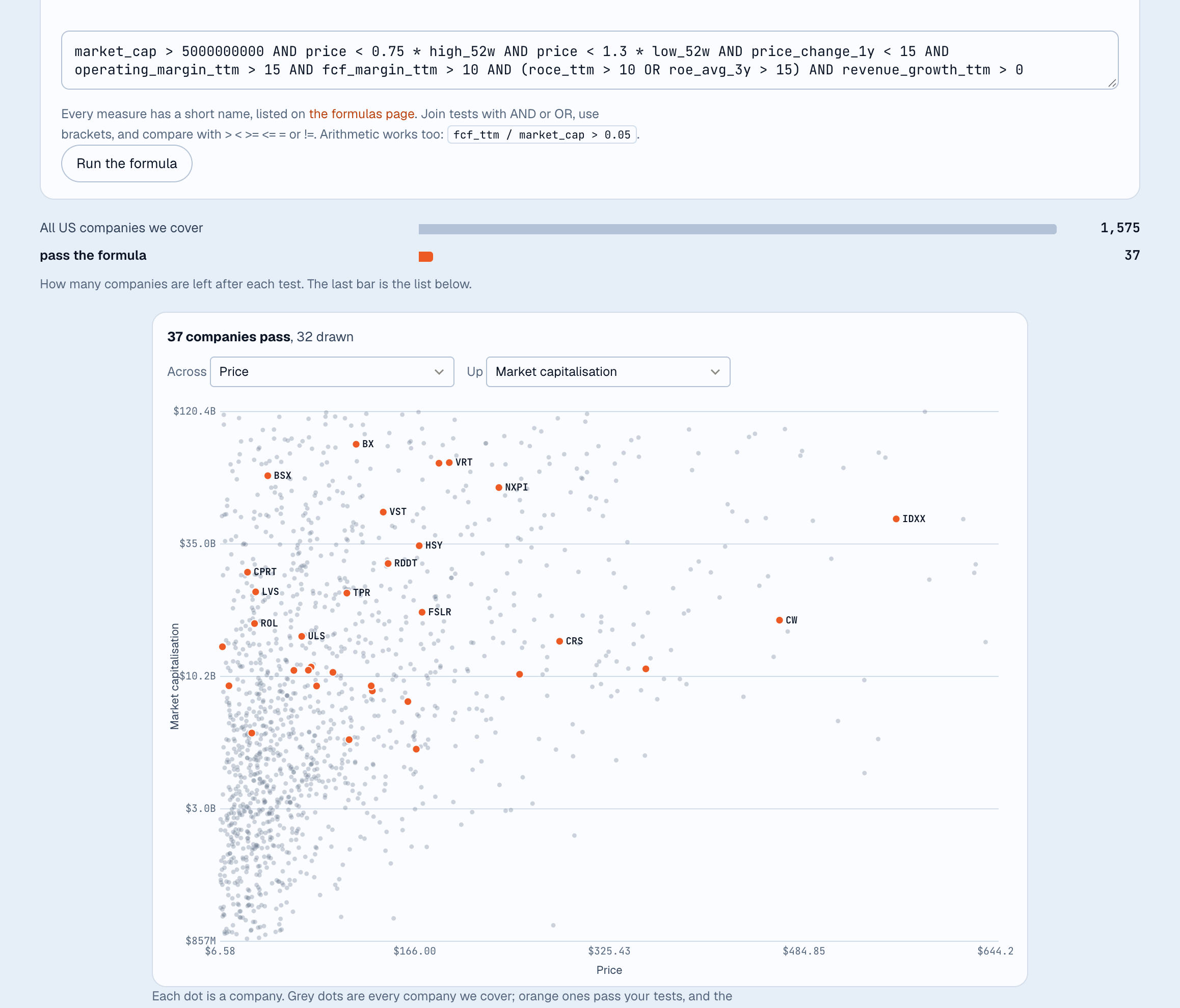
I did not pick this stock myself, because a few years of investing on my own ideas taught me that my brain falls in love with its own logic, so this time I let a screen find the names. On greeksoup.ai screener I asked for profitable American companies worth more than $5 billion that had fallen at least 25 percent from their high and were still close to their lows, and 37 companies out of 1,575 passed. I asked Claude Code to rank those 37, and its first choice was Copart. Boston Scientific came second, until two things moved it to the top: management had already told investors that 2027 would be a slow year, so the bad news was out in the open, and in August its chief executive bought $9 million of the stock with his own money.
A month ago we did the same kind of research on PTC, a software company sold on the fear that AI would take its customers, and there the people worth asking were the engineers who use its software. For a heart-device company the witnesses are doctors and patients, so Grok read X, Gemini read Reddit and the medical forums, where patients with an irregular heartbeat talk about choosing between a daily pill and an implant, and Claude Code read the filings, the earnings calls and the trials. Claude Code also checked everything the other two brought back, which mattered more than I expected, because Gemini gave us last year’s Medicare payment rate as if it were this year’s, and said hospitals can be paid for a Watchman as an outpatient procedure, which Medicare does not allow in 2026. Claude Code caught both before either reached this page.
Every chart in this dive comes from greeksoup.ai, our own research platform, and most of it is free to use. If you want to put Boston Scientific next to Medtronic, Abbott or your own stocks, the Compare page does it in a few clicks, and greeksoup.ai Premium is complimentary for Alpha with AI paid subscribers. This dive has no paywall, so you can follow how we research a company from the first screen to the last number, and from the next dive the full research goes to paid subscribers.
A small gimmick, and we are calling it one. Restacks are how Substack decides who gets to see a post, and our paid growth could use the help, so restack this post before 31 October and you are in the draw. On 1 November we pick three restackers at random, and each of you gets a year of paid Alpha with AI at half price. If you would rather not leave it to luck, paid has a special price until the end of the month.
How a stock screen found Boston Scientific, and why it beat Copart
The screen is the part of this you can copy, and you do not need to write a formula to do it. On the greeksoup.ai stock screener you pick a measure, choose above or below and type a number, and four simple tests already get you most of the way: a company worth more than $5 billion, a share price down more than 25 percent over the year, an operating margin above 15 percent and free cash flow above 10 percent of sales. Every test shows where all the companies sit, and the list narrows as you add each one.
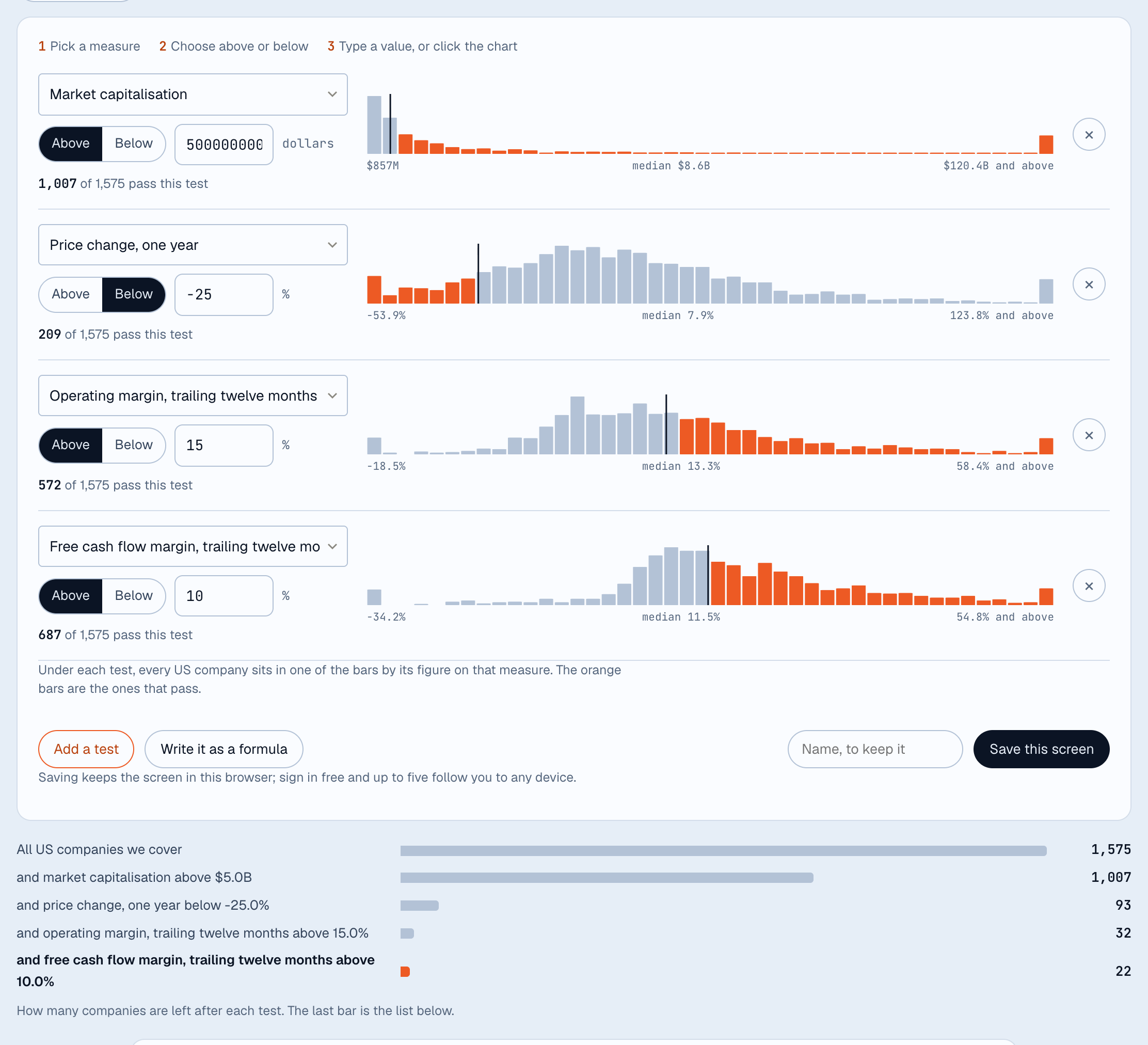
The full version I ran adds a few more rules, the price still close to its yearly low, a decent return on the money the business uses and sales that are still growing, and it is easier to type as one line. Out of thousands of American companies, 37 passed, and Boston Scientific and Copart were both among them.
My first instinct with a list like this was to say that the S&P 500 is near its high, so each of these stocks fell on its own story, and that turned out to be lazy, because an index can rise while a lot of the companies inside it fall. So I checked. The S&P 500 rose about 14 percent over the last year, and about a third of the 500 largest American companies still fell. Medical device makers were among them: the iShares U.S. Medical Devices ETF (IHI), a fund that holds them fell 11 percent over the year, while health care as a whole rose 25 percent. So part of Boston Scientific’s fall is a weak industry, and most of it, about 56 percent against the group’s 11, is its own. We built this check into the Claude Mythos edition, where it answers whether a falling stock is weak on its own, whether its sector is shifting, or whether the whole market is breaking.
Then Claude Code put all 37 through the four questions we ask of every fallen stock before we spend a day on it:
The shape of the price. How far has it fallen, and is it still falling?
What the company said about the fall. In its own filings and calls, not in the headlines.
How far it has fallen before. Its worst falls since 2015, so we know what normal looks like for this stock.
The balance sheet. Whether it can wait out a bad year without borrowing its way through it.
Its first choice was Copart, the company that sells wrecked cars for insurers. Copart had fallen 59 percent from its peak, had never fallen 50 percent before, carried no debt at all, had its founder back as chief executive and had bought back $1.63 billion of its own stock in a year, and on most of those four questions it looked like the cleaner company.
But Copart’s fall rests on a question nobody can answer yet. It lost a large insurance customer to its only big rival after refusing to cut its fee, and whether that was one account or the start of a price war will only show in its results in November and later. Boston Scientific’s bad news was already out in the open, from management itself, which had told investors in September that 2027 sales would grow only 2 to 4 percent with very little growth in earnings, and that the August cyberattack would make it miss its targets for 2026. Boston Scientific reports its next results on 28 October, three days after this post, which is an uncomfortable time to be making up my mind about any stock, and the reason I was willing to is that those results will mostly confirm numbers the market already has.
What settled it was one column on the screen, open-market purchases by insiders over twelve months, which showed 10 at Boston Scientific and none at Copart, where the company bought its own shares instead. On the greeksoup.ai insiders tab the reason is plain: in the four weeks after its second guidance cut in July, the chief executive, Mike Mahoney, bought 186,240 shares on 3 August at $48.33, about $9 million of his own money and not under a pre-set trading plan, and three directors bought too.
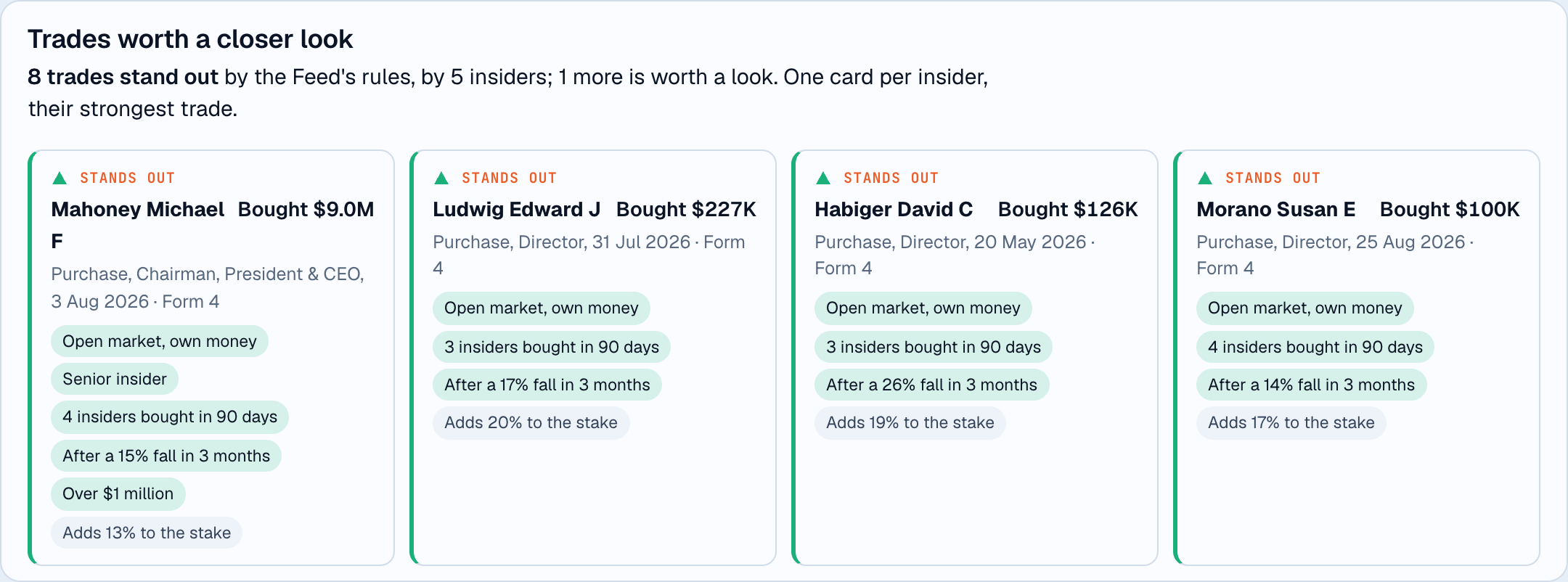
The Form 4 filings, the reports insiders must file within two days of a trade, showed more than the feed. The head of the cardiology business, the chief financial officer and the chief accounting officer, the people closest to the Watchman and Farapulse numbers, moved about $3.6 million of their retirement savings into Boston Scientific stock over the same weeks. That kind of buy goes through the company’s 401(k) plan, not the open market, so most insider feeds never show it, and we built a check for exactly that in an earlier edition. Mahoney had sold $15.0 million of stock in February, at about $93 a share, under a plan set months before, and in August, at half that price, he chose to buy. All of them paid between $45.48 and $51.19 a share, and the stock closed at $45.69 on Friday.
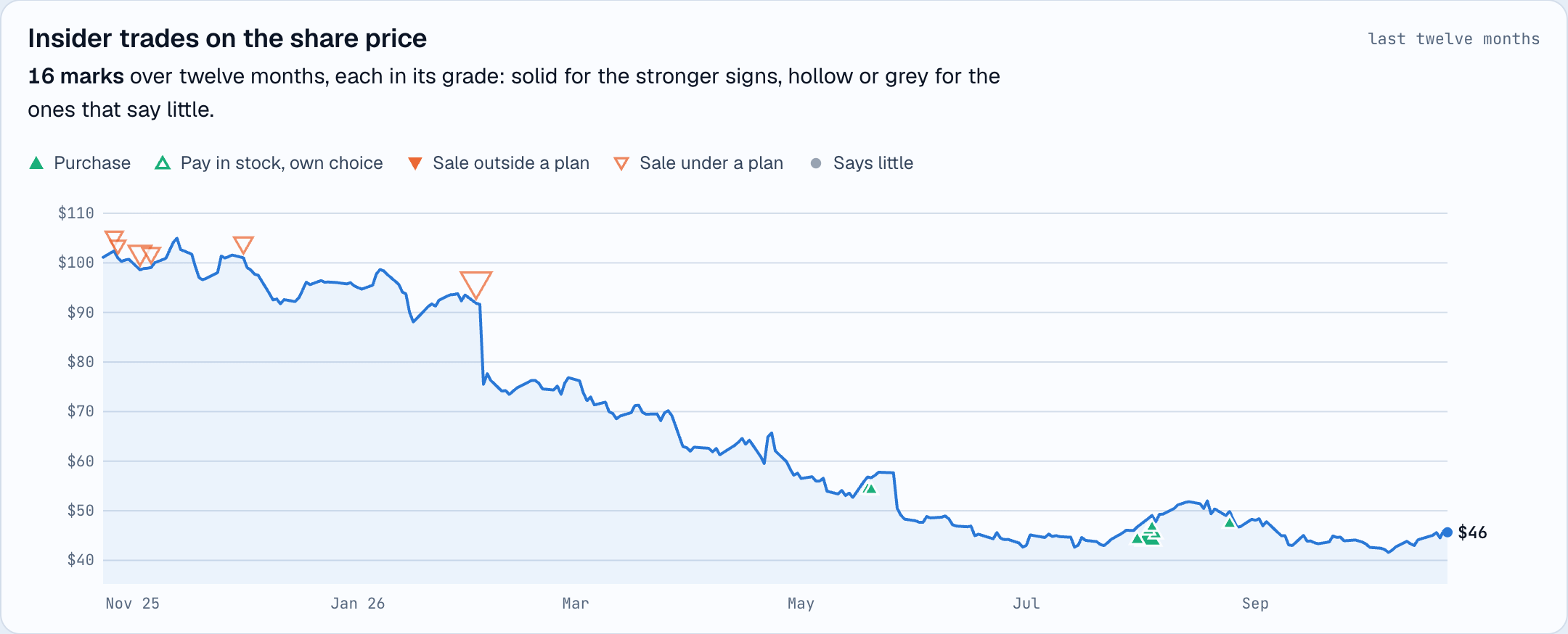
The insiders’ buying says the people closest to the numbers think the price is too low, and it still leaves the question of why the price fell 58 percent in the first place, so the next thing Claude Code did was go through the days it fell.
Why did Boston Scientific stock fall? Four bad days, four different stories
Medtronic and Abbott sell into the same hospitals as Boston Scientific, to many of the same heart doctors, and over the last year Medtronic’s shares rose 1.3 percent and Abbott’s fell 17.9 percent, while Boston Scientific’s fell 55.4 percent.
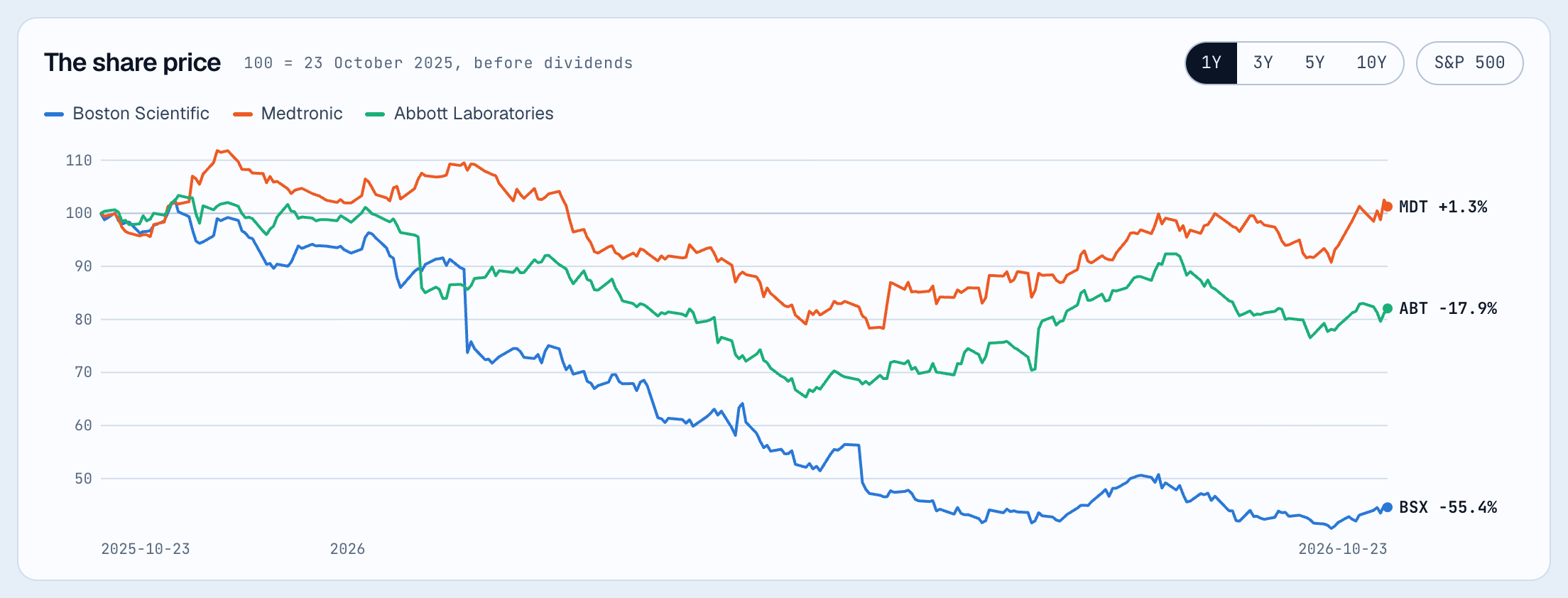
A fall that size feels like a long slide, so I asked Claude Code to go through every trading day since the peak on 8 September 2025 and set each one against Medtronic, Abbott, Stryker, Edwards, Intuitive Surgical and the same medical devices fund, IHI. The whole fall sits on twelve days, and on every other day put together the stock went nowhere, a net change of 0.1 percent. The four worst of those twelve days alone take about 38 percent off the price, and each of them had a different reason:
4 February, −17.6 percent. Boston Scientific beat its own forecast for the last quarter of 2025, and then guided 2026 to 10 to 11 percent growth, which the market read as the end of the 15 to 20 percent years. IHI fell 1.8 percent that day.
30 March, −9.0 percent. The first trading day after CHAMPION-AF, the big Watchman trial, was presented at the American College of Cardiology. The trial passed: Watchman was as good as blood thinners at preventing strokes and deaths, with far less bleeding. But a few more patients had the kind of stroke caused by a clot, 45 against 27, and the market read the result as good rather than great, so the trial that passed cost the stock 9 percent in a day.
27 May, −12.5 percent. The chief executive told an investor conference that morning that Watchman sales would be flat for two quarters, because fewer patients were getting it as a procedure on its own. The 2026 forecast did not change, and Wells Fargo downgraded the stock the same week.
8 and 10 September, −5.9 and −4.1 percent. The company filed that the August cyberattack would make it miss its 2026 targets, on a day when Stryker also warned and IHI fell 3.5 percent, and two days later management told a Wells Fargo conference that 2027 would grow more slowly than the market.
The other eight days were mostly bad days for the whole industry, with IHI down 2 to 4 percent, and Boston Scientific fell further than the group each time.
So the selling came in four waves, and three of them were about two products, Watchman and Farapulse, while the fourth was an eight-day outage. None of the days we could trace was about the stents, the stomach and spine tools or the cancer treatments, the half of the company that grew 8 to 15 percent this year. The market sold the whole company on two products, so the next question was whether those two products are really finished, and the people best placed to answer that are the doctors who choose them.
A small note, and the only sponsor here is me. I keep getting messages asking how I set up Claude Code for stock research, beyond what the editions can teach. So I am opening a small consulting program: I set your system up with you, then support sessions over the following months as your real problems show up. I am doing a lot of other things, so seats are very few. If that is you, the waitlist is on the website or reply to this email.
Grok and Gemini interviewing heart doctors and patients about Watchman and Farapulse
The market had decided that doctors were giving up on Boston Scientific’s two star products. That is something you can check, because heart doctors and their patients talk about these devices in public every day, so we went and listened to them, and we split the listening between our three AI tools by where each one reads best. Grok is built into X, where heart doctors argue about catheters, so Grok took X. Gemini reads Reddit well (Reddit licensed its posts to Google in 2024, in a deal reported at about $60 million a year), so Gemini took Reddit and the patient forums. Claude Code checked everything the other two brought back, because neither of them gets to put a number in this post on its own.
Before writing any prompt, I ask four simple questions about the product: who chooses it, who lives with it, who pays for it and who owns the stock. For a heart device the answers are the doctors, the patients, Medicare and the investors, so we wrote one prompt for each:
Grok, doctors on X: which catheter they use and why, and whether they now send fewer patients for a Watchman.
Grok, investors on X: the strongest case against the stock.
Gemini, patients on Reddit: why they chose the implant or stayed on a pill.
Gemini, the evidence: what the trials found, what Medicare covers and what hospitals are paid.
Every prompt asked for a link and a date behind each claim, and for the case against the company at full strength. The same four questions work on any company. For a software company the people to ask are the engineers who use it, and for Copart they are the insurers and the people who buy wrecked cars.
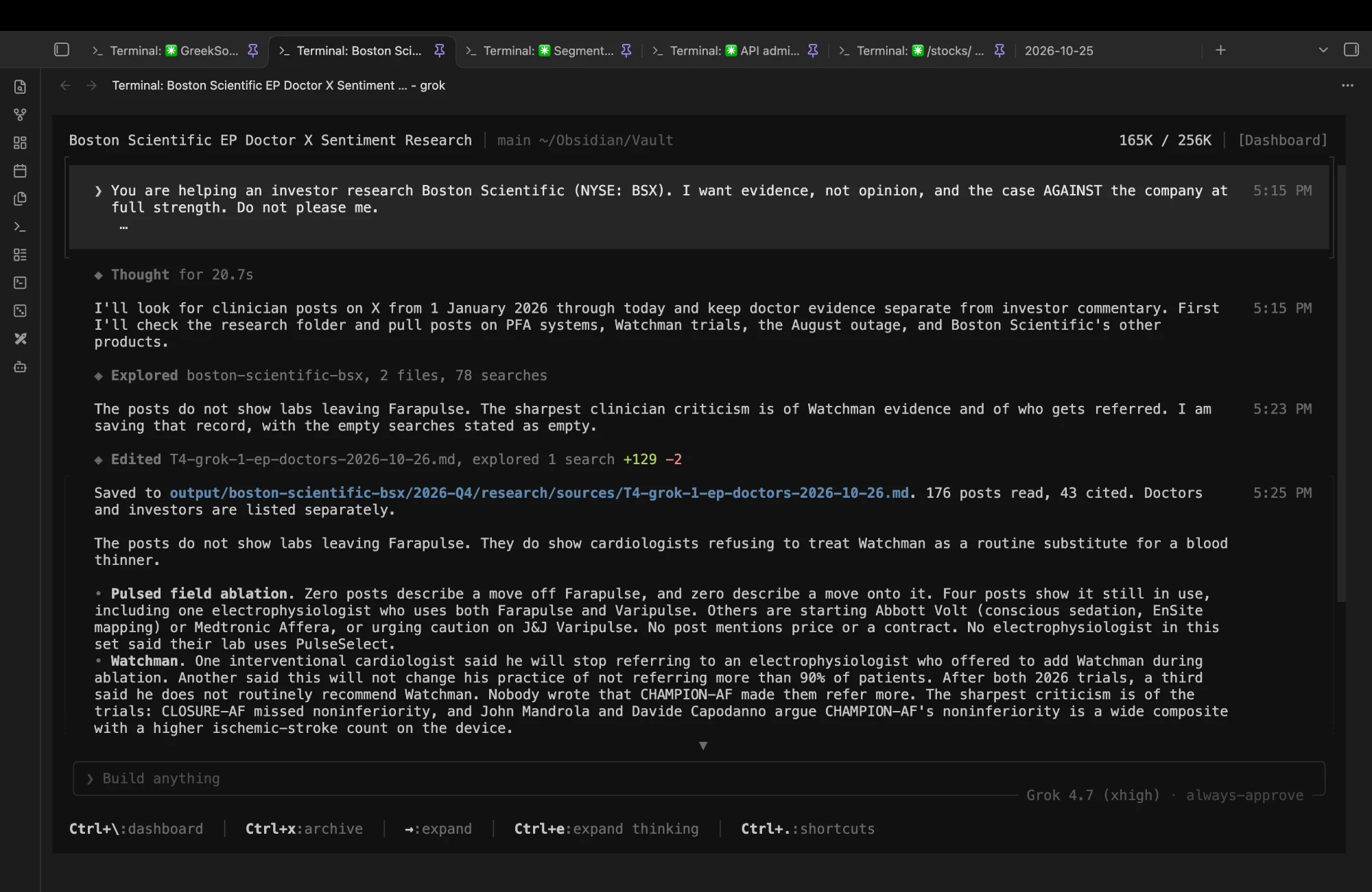
We started with Farapulse. If hospitals were dropping it, you would expect the doctors who use it to complain about it or to announce a switch, and Grok read 176 of their posts from this year without finding a single one. The doctors who named a catheter often used two or three brands side by side, and not one of them mentioned price or a hospital contract.
Watchman was a different story. Here the doubts came from the cardiologists who decide whether to send a patient for the implant in the first place, and what they doubted was the trials. A University of Maryland cardiologist summed up the mood two days ago: “Selected patients only. Not a DOAC replacement.” A DOAC is a modern blood thinner, such as Eliquis.
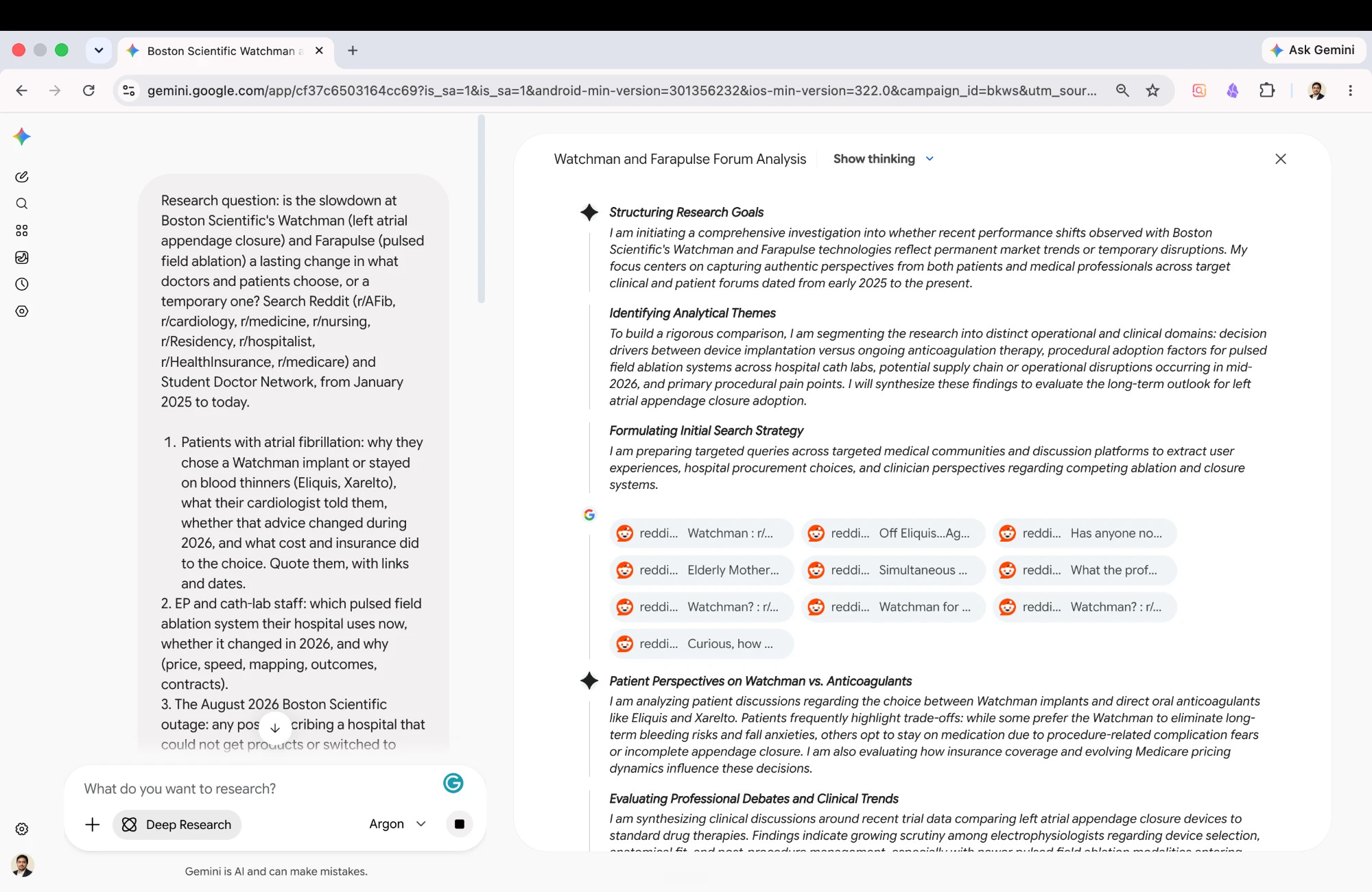
The patients on Reddit told the same story from the other side. Most of them stay on Eliquis unless they have a bleed or a fall. Gemini also found something our own research had missed: since January 2026, Medicare pays only $231 a month for Eliquis, so the cost of the pill, one old reason to want an implant instead, has become weaker. You can read Gemini's full report and the page it built from it.
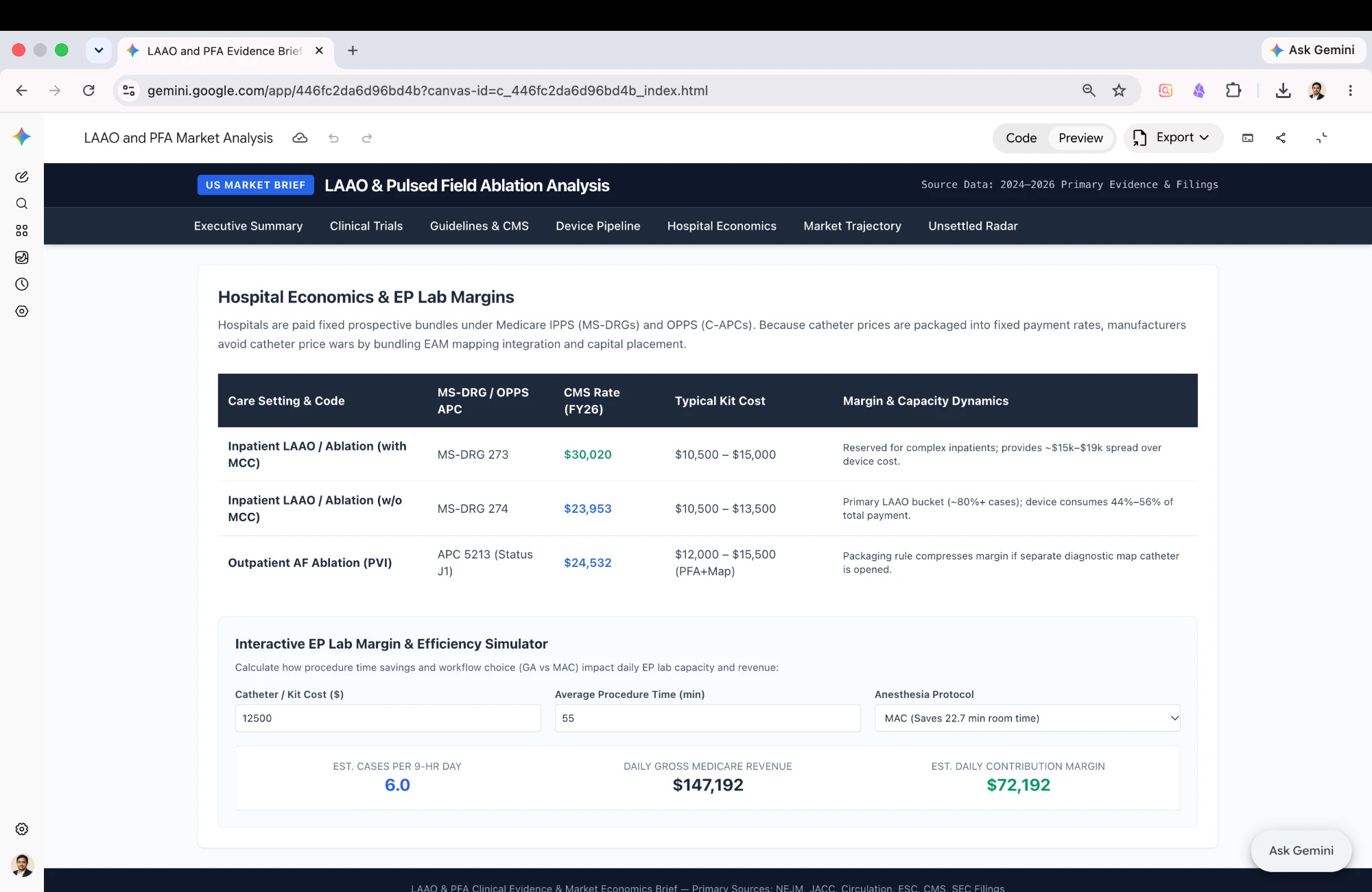
Gemini's evidence report was the most useful of the four runs, and it also needed the most checking. It gave us the fact the rest of this dive leans on: Medicare still pays for a Watchman only when a patient cannot take blood thinners for the long term, under a rule from 2016, and Claude Code confirmed that rule on Medicare's own website. The same report also used last year's Medicare rate as this year's, and said hospitals can do a Watchman as an outpatient procedure, which Medicare does not allow in 2026. Claude Code caught both. Gemini's evidence report and its web page are there if you want the raw output.
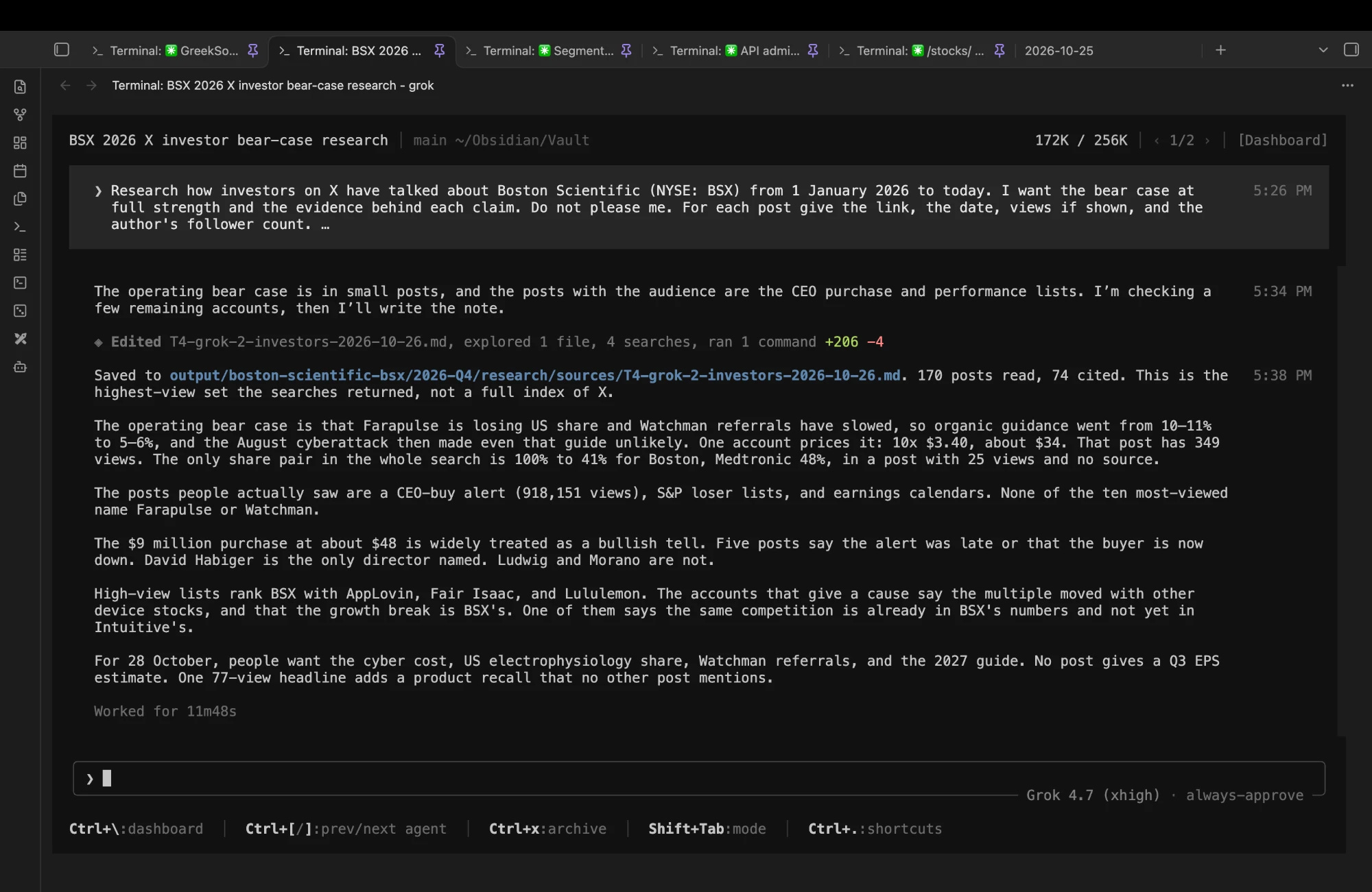
The investors on X were looking somewhere else entirely. The most-viewed post about Boston Scientific this year, seen 918,151 times, was about the chief executive buying $9 million of stock, and none of the ten most-viewed posts mentioned Watchman or Farapulse. So the doctors were not walking away from Farapulse, but the doctors who send patients for a Watchman had become more careful, and they blamed the trials, which sent us to the trials themselves.
Are Watchman and Farapulse finished? What the trials changed for Boston Scientific
Three of the four big selling days were about these two products, so they need a straight answer, and the short version is that neither one is finished, and neither one is coming back to its old growth soon.
Watchman first. In March two big trials tested it. In older, sicker patients it did worse than pills, and in younger, healthier patients it did about as well as pills with much less bleeding, but with a few more strokes. The American College of Cardiology called that second result “an uneasy win”. Doctors read both, and they became more careful about who they send for an implant. Medicare still pays for a Watchman only when a patient cannot take blood thinners for the long term, and until that rule changes, which nobody has asked Medicare to do yet, the Watchman cannot reach the bigger group of patients. Our base case is that Watchman sales stay flat until 2028.

“An Uneasy Win For Watchman Device”, the American College of Cardiology’s review of the second trial, 23 April 2026.
Farapulse is a different kind of problem. It was first to market with a new way of treating an irregular heartbeat, which now does close to 90 percent of these procedures in America, and for a while it had most of that market to itself. Today it has about half, because Medtronic, Abbott and Johnson & Johnson all sell their own versions. But the market is growing so fast that Boston Scientific’s ablation sales still grew 9 percent in the June quarter, even while it lost share, and its next catheter arrives in late 2027.
One more catch for Claude Code here. Gemini told us that Abbott’s rival Watchman trial would report by early 2027, which would have been a near-term worry. Claude Code checked the trial’s own registry, and its main results are not due until January 2029.
Together these two products are about a quarter of Boston Scientific’s sales, and the other three quarters is where the price fall makes the least sense.
Is the rest of Boston Scientific still growing? What the other three quarters of the company did in 2026
Boston Scientific reports its sales in eight businesses, and every three months its filing shows how each one did. Watchman and the ablation business that sells Farapulse are two of the eight, and in the first half of 2026 they brought in about 27 cents of every dollar of sales. The other 73 cents came from six businesses most investors never hear about, so here they are in plain words, with their share of sales and how much they grew in the first half of the year:
Stents and balloons that open blocked arteries (interventional cardiology and vascular): 24 percent of sales, up 12 percent.
Tools doctors use inside the stomach and gut (endoscopy): 14 percent, up 8 percent.
Implants that treat chronic pain and Parkinson’s disease (neuromodulation): 6 percent, up 15 percent.
Treatments delivered straight into liver tumors (interventional oncology): 5 percent, up 15 percent.
Tools for kidney stones and the prostate (urology): 12.5 percent, up 1.5 percent.
Pacemakers and defibrillators (cardiac rhythm management): 11 percent, flat.
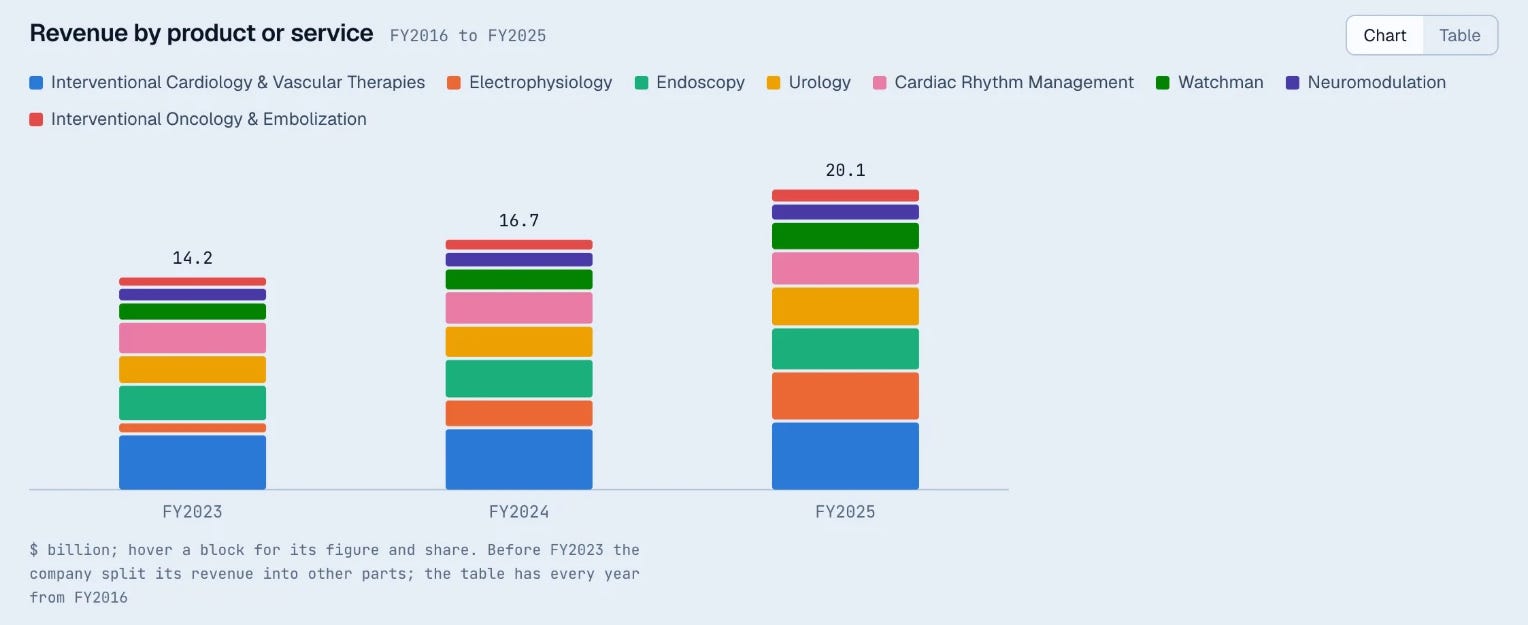
The first four of those are half the company, and they grew between 8 and 15 percent, faster than the market for medical devices as a whole. The last two, about a quarter of the company, did not grow at all. Even Watchman and the ablation business grew in the first half, 11 and 16 percent, although both slowed hard by June. Put together, the company’s sales grew 9.5 percent in the first half of 2026, and the June quarter, at $5.44 billion, was the biggest quarter of sales in its history. Boston Scientific is also buying Penumbra, a maker of devices that pull out blood clots, for about $14.5 billion, a deal it expects to close by the end of the year.
Anyone can read this table for any company, and it is usually the fastest way to see whether a bad headline is about one product or the whole business. In Boston Scientific’s case the headline was about a quarter of it. Management’s own forecast for this year’s earnings per share came down from $3.43 to $3.49 in February to $3.28 to $3.32 in July, about 5 percent lower, before the cyberattack in August took off a little more. So the forecast for this year's profit came down by about 5 percent, and the share price is 58 percent below its September 2025 peak. At the top, investors paid about 35 dollars for every dollar of a year's adjusted profit, management's own measure, and today they pay about 14.
That gap is either the market seeing something the filings do not show yet, or a story that went further than the numbers. The rest of this dive tests which one it is: whether the cash is as real as the profit, how management sounds when it talks, whether the books hold up, and what the company is worth in four different futures, including the bad one.
We research great companies the market has sold on a story, with AI reading every filing, call and results release. Paid subscribers get the rest of this post, the full Research Dives, the AI workflow library and both our books, greeksoup.ai premium, the model portfolio and the live one, with every trade as we make it. If you want them, upgrade.