


My understanding of the semiconductor industry is basic, and I am still fairly new to US companies, so some of what follows may be wrong or a little naive, but these are the thoughts I have from the tools I use every day and the things I read, and four trades came out of them this week. The letter has two parts, and you can read them in whichever order suits you. Part 1 is about AI: how fast AI use is growing, our own experience with the AI tools, what we use and what changed in our work. Part 2 is about the market: how I read this sell-off, and the reasoning behind each trade.
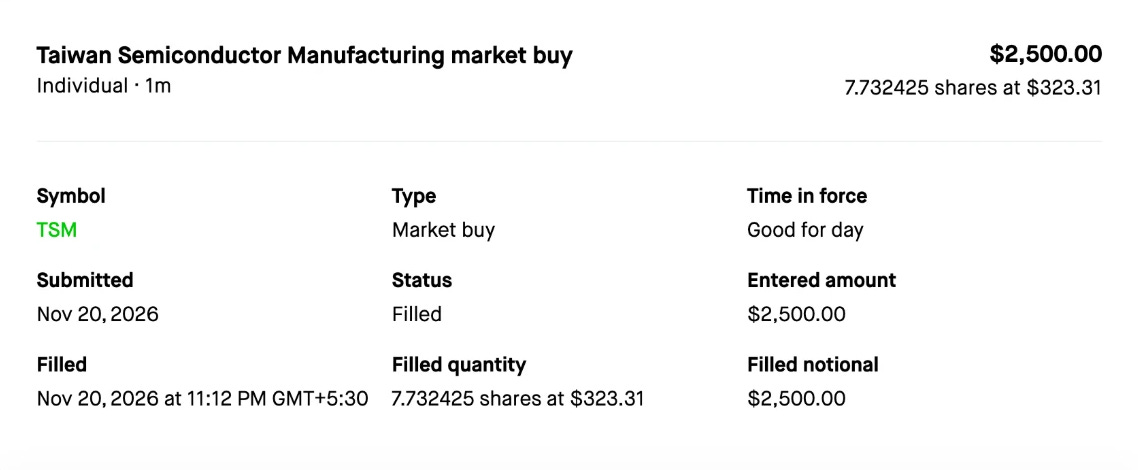
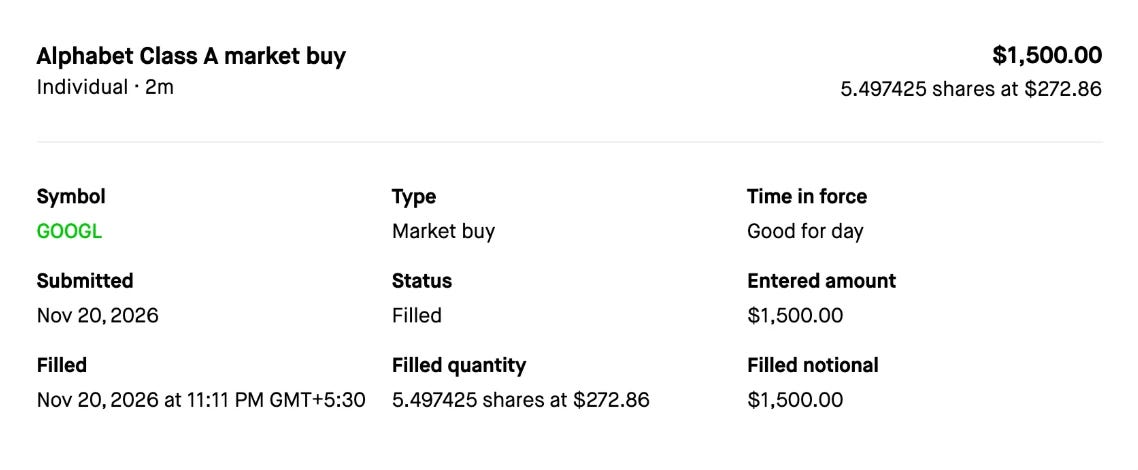
I bought TSMC and Alphabet during US market hours on Friday, 20 November, and told you in the subscriber chat right away, so the trades came before this letter. The Alpha with AI portfolio bought TSMC, ASML and Alphabet that afternoon, and Oracle a day later.
At Friday’s close the Alpha with AI portfolio was up 2.9% since it started on 8 July, while the S&P 500 was down 7.5%. The chart below updates after every US close, and the details are at the end.
The Alpha with AI portfolio against the S&P 500 since 8 July, updated after every US close.
Part 1: AI
How fast is AI use growing?
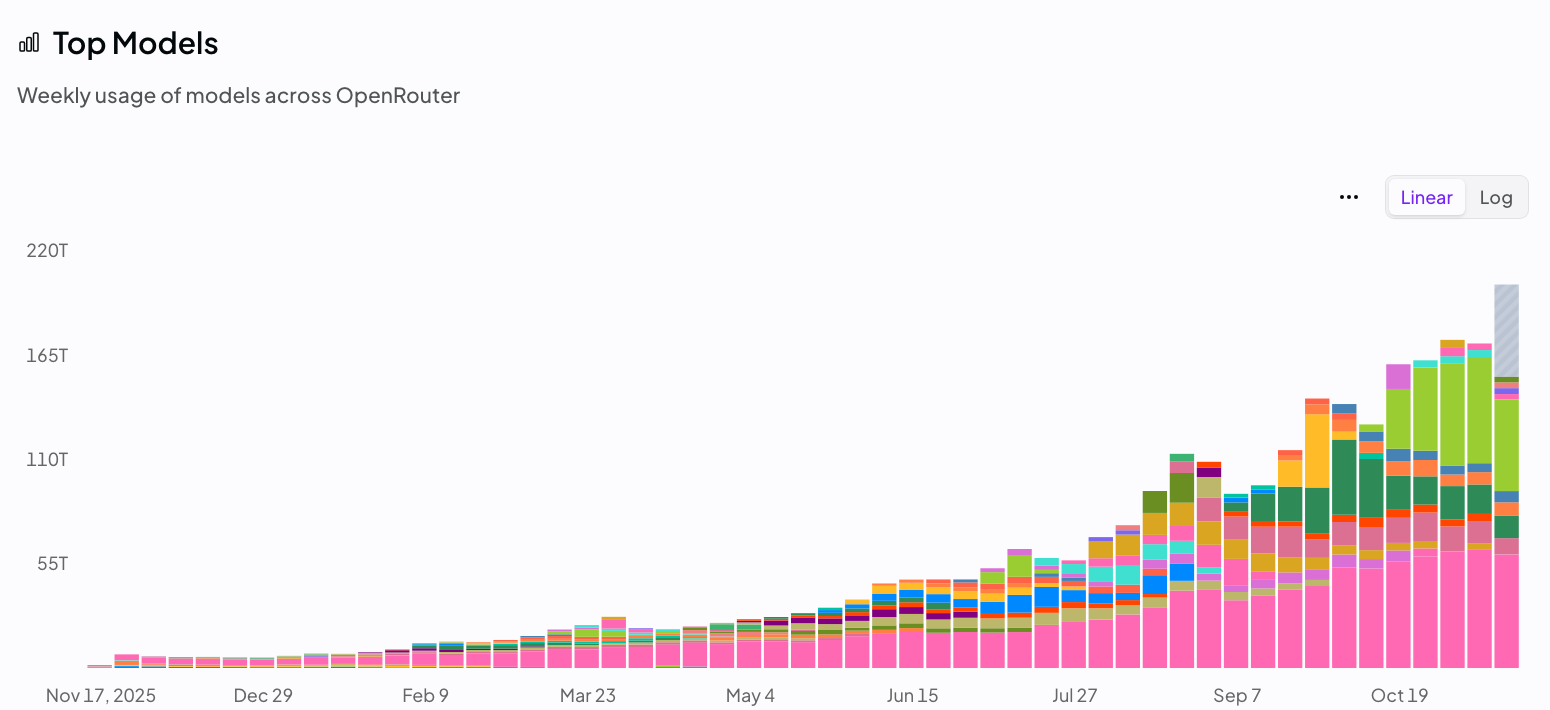
In the September letter I showed you OpenRouter, the service where developers pay for models from every lab through one key, and the tokens going through it every week, tokens being the unit the labs bill in, had just passed 100 trillion. In the latest full week it was about 170 trillion, against a few trillion a year ago, so whatever the chip shares did this month, the work running on those chips has not slowed down at all.
Why are cheap open models winning the volume?
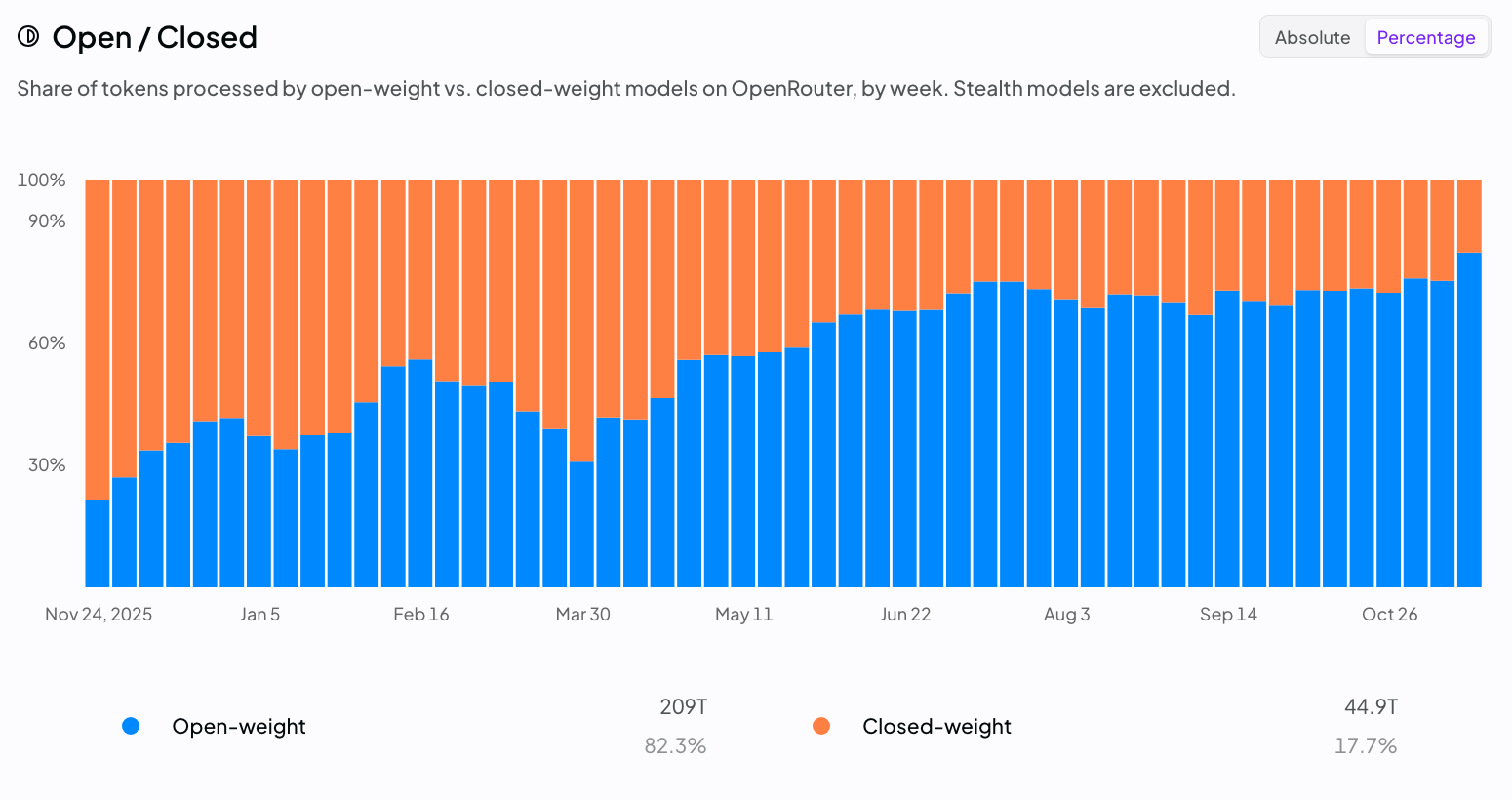
The bigger change since September is who gets that work. Models with open weights, which anyone can download and run on their own hardware, did about 21% of the tokens on OpenRouter a year ago, and this week they did 82%. DeepSeek alone had 31.8% of the week’s requests, against 24.6% in September, and Anthropic had 6.3%, against 3.0%.
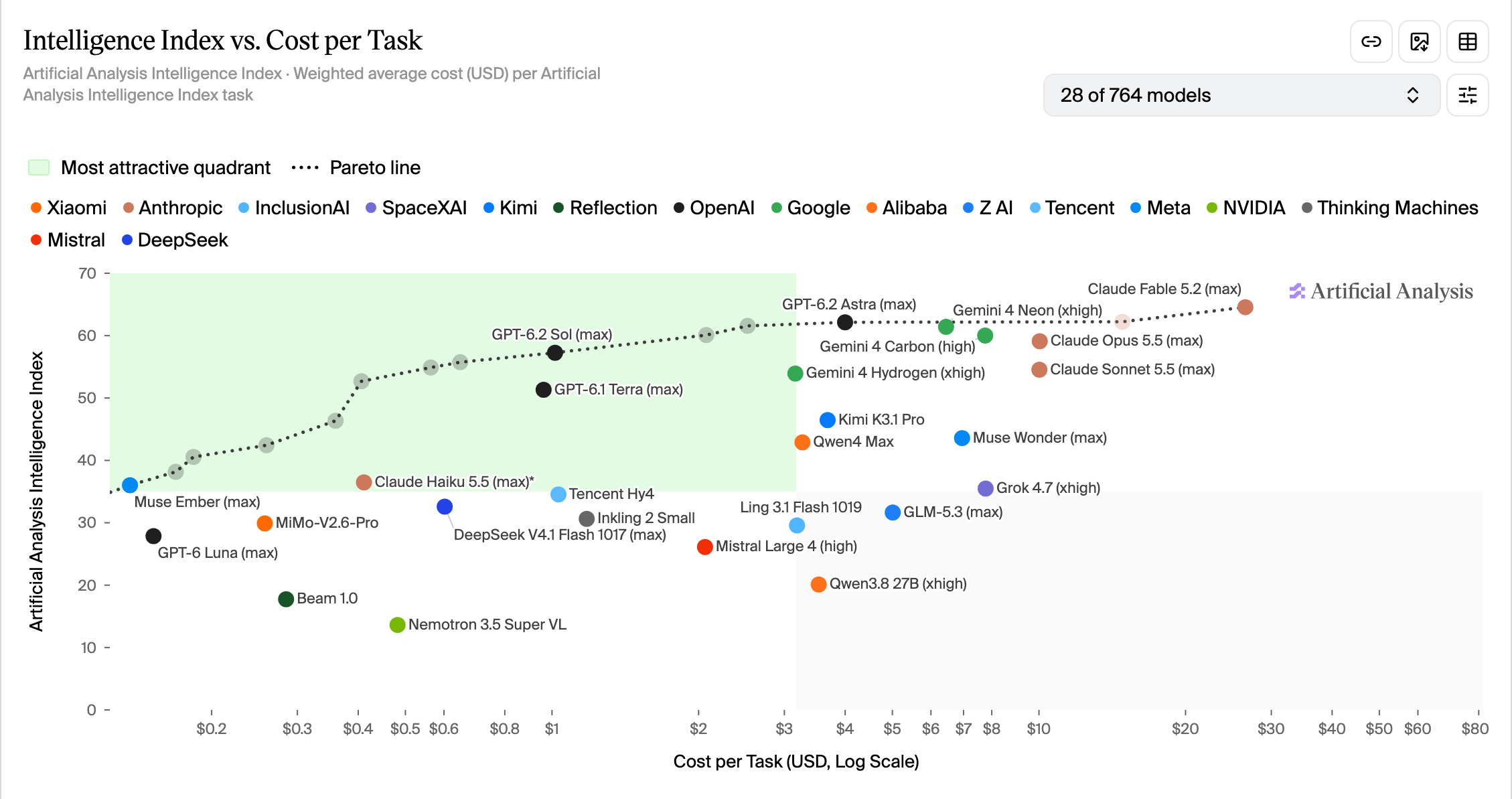
Price is most of the reason. On OpenRouter on 21 November, a million tokens of answer from DeepSeek’s newest fast model cost $0.60, and the same from Claude Opus 5.5, the model I use most, cost $20, about 33 times more. On Artificial Analysis, which runs the same set of tests on every model, that DeepSeek model scores 33 against 59 for Claude Opus 5.5, so it is clearly less capable, but a lot of everyday work does not need the best model. Say you run a support chatbot that answers a million customer questions a month: if the cheap model is good enough for that job, you are not going to pay 33 times more for the better one. A lab like Anthropic earns its money by selling the use of its models, to companies through its API and to people like me and you through monthly plans, so the more of the everyday work goes to cheap open models, the more the expensive ones have to stay clearly better at the hard work to keep earning. I may be reading too much into one service, because OpenRouter is where the most price-conscious developers shop, and large companies usually buy Claude directly from Anthropic or through Amazon and Google, which never shows up here. Still, on this service the number of tokens keeps rising while the price of each one keeps falling, and an open model can run on any chip, a Google TPU, a custom chip or an Nvidia one, which matters for the chip makers in Part 2.
What changed in our own AI work?
Our own work moved the same way. Earlier this year I wrote, a little proudly, about going through 100 million tokens and then 500 million on Claude skills, and looking back that was naive and nothing to boast about, because most of those tokens went into doing the same work again and again. Since October we have been asking a different question of every research job, how do we do this with less AI, and the answer kept coming out the same: spend the tokens once to build a program, and let the program do the repeated work for free. In October that was an earnings watcher that Claude Code built once and GitHub now runs twice every weekday, and on 10 November it was a program that reads a whole IPO prospectus, Anthropic’s, with no AI at all, and sends your AI only the few pages a question needs.
Claude Code or Codex: which one did I keep?
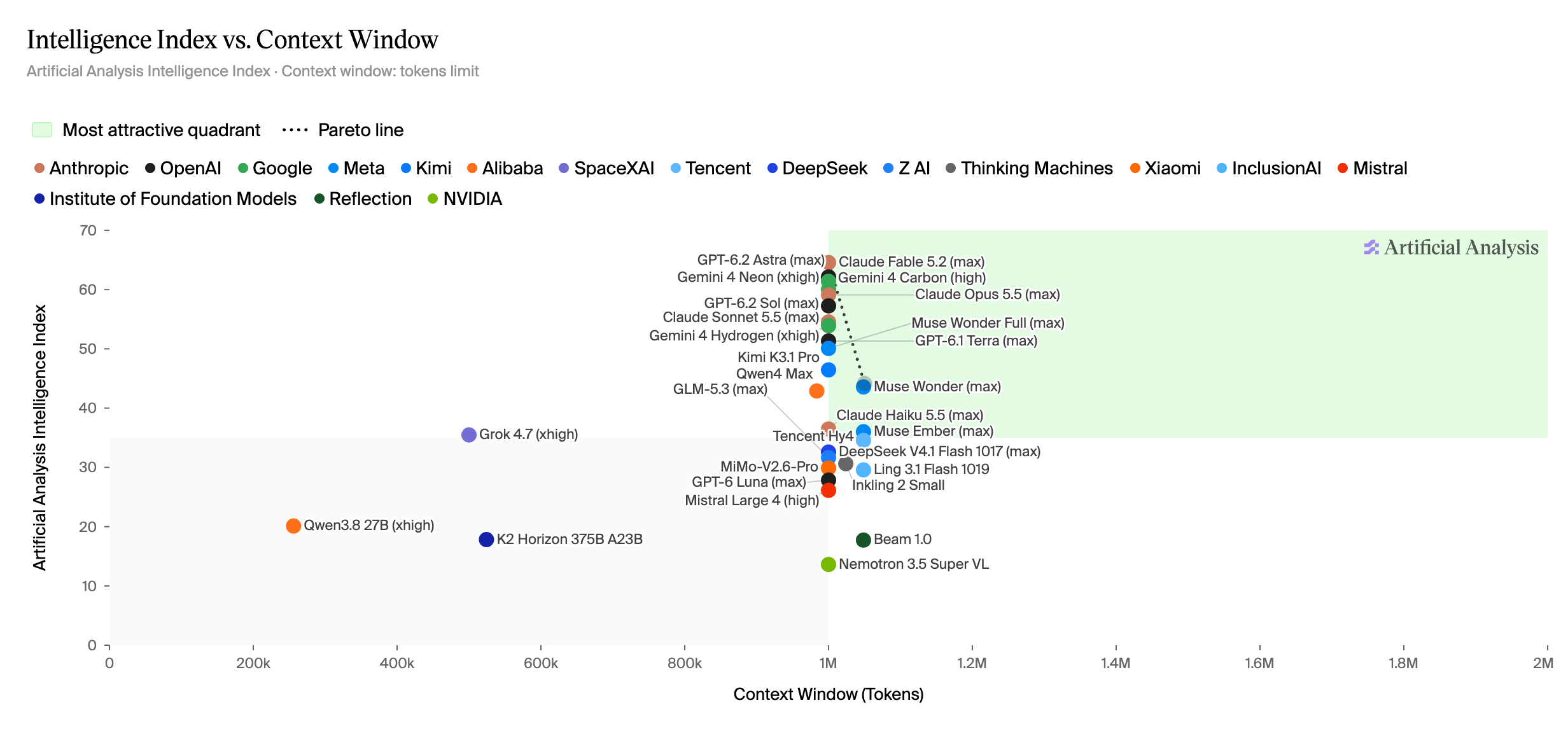
In the September letter I said I was moving ChatGPT from the $20 Plus plan to the $100 Pro plan for a month, to see which of Claude Code and Codex I would use more. Within two or three days I was back on Claude Code, using Codex in between only for some of the automated tasks. The reason has nothing to do with the model, because Codex is extremely, extremely good, and the gap between its models and Claude’s is like 19 against 20, and sometimes they do even better. What kept me on Claude Code is everything around the model, in the terminal as well as in the app. One example is the context window, which is how much the model can hold in front of it at one time. On size, the leading models are now level, and Claude’s models and the GPT models behind Codex can each hold about a million tokens, so what differs is how clearly the tool shows you what is filling that space. Claude Code breaks it down for you: how much your messages take, how much the tools you have connected take, the memory files, the system tools, the skills, the buffer it keeps free before it compacts the conversation, and how much space is left. Codex does not lay this out nearly as clearly. It sounds like a small thing, but how full that window is decides how accurate the answers stay and how many tokens you burn, whether you are writing code or running a research workflow, so for me it is a huge thing. Nothing in Codex was bad and it will get these features too, but it felt a month or two behind, and I was not comfortable giving up those few things again.
What is Shikshan Nivesh Data, and why did we build it?
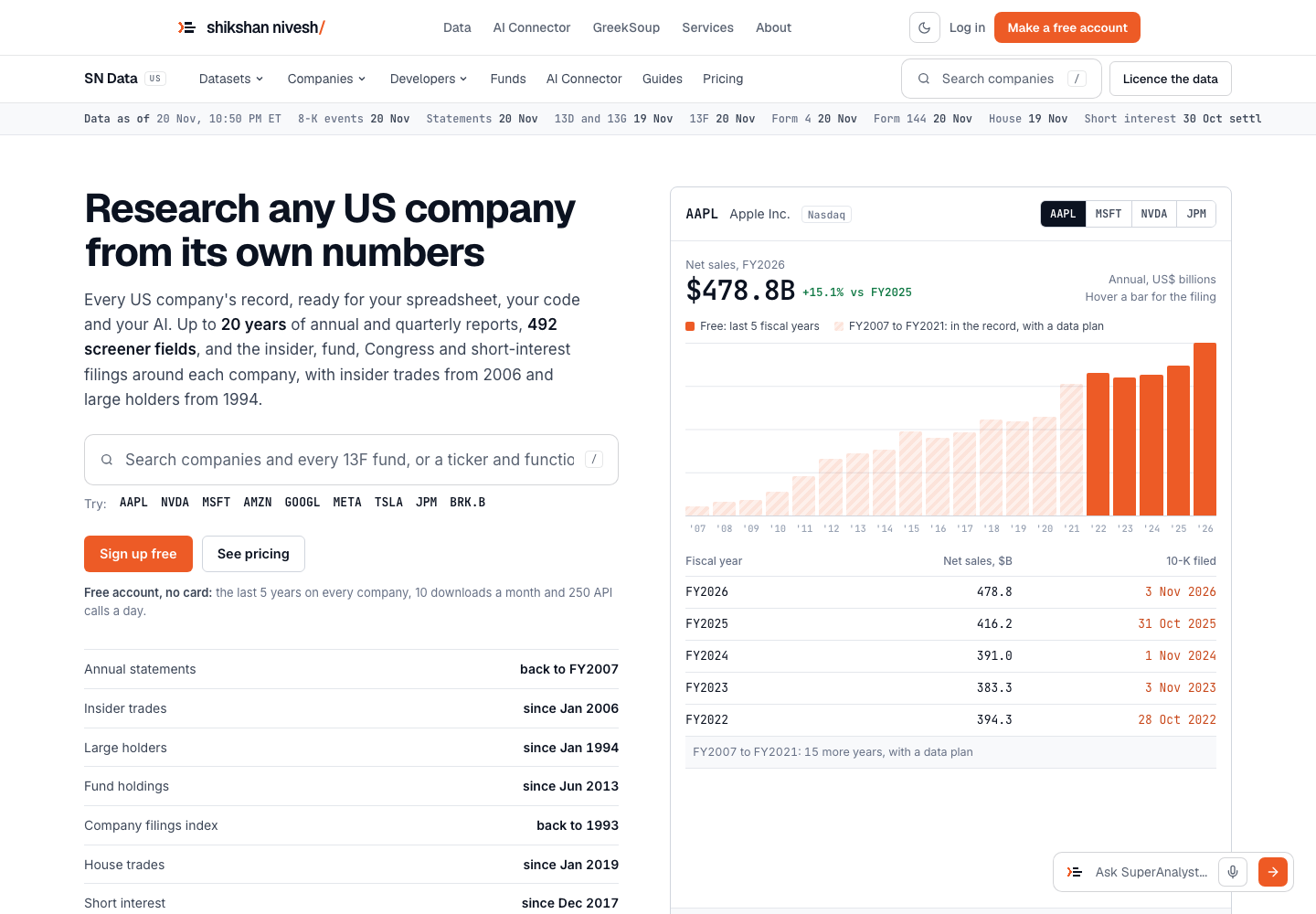
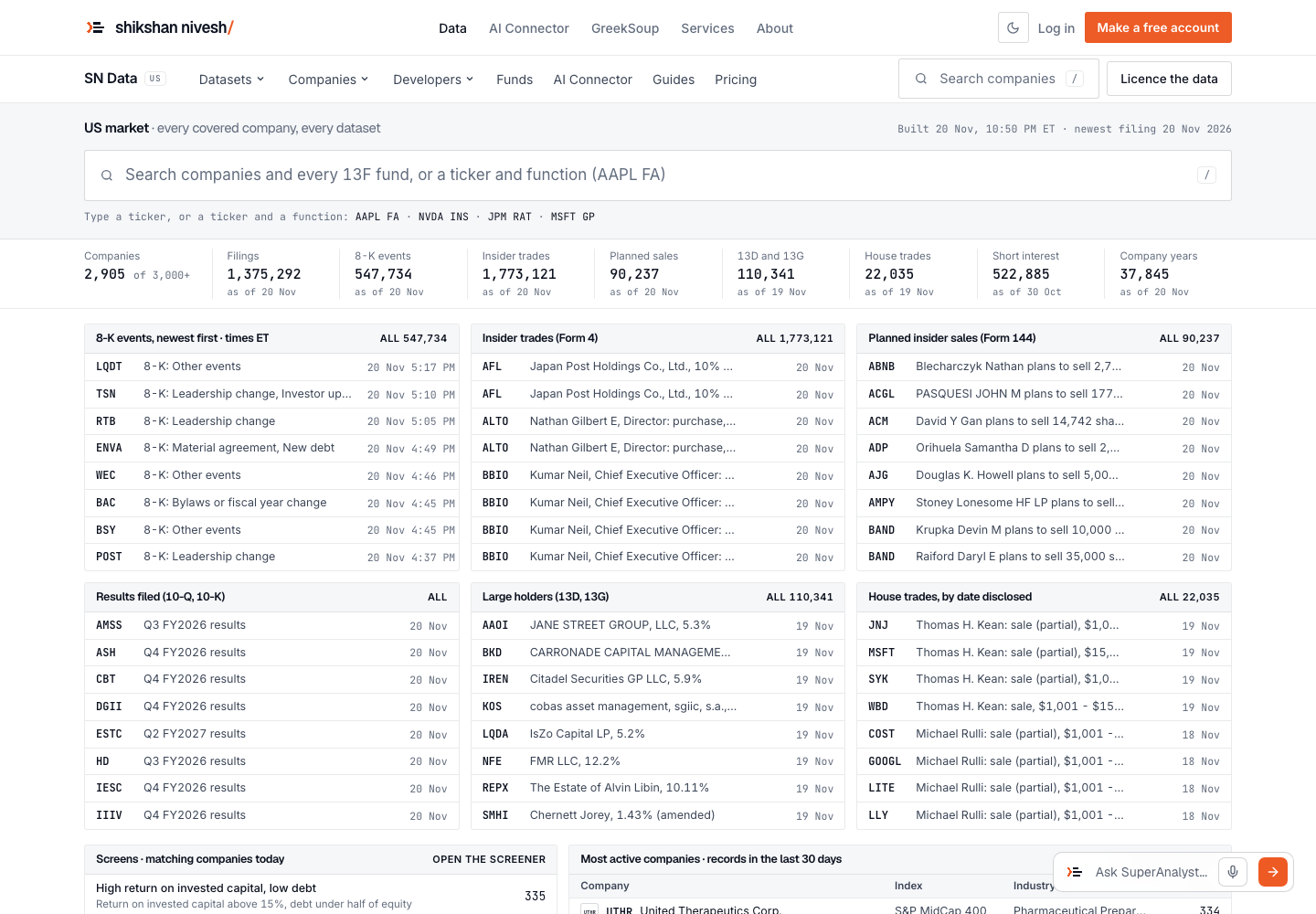
A program that does the repeated work for free is only as good as the numbers it reads, and every time we let an AI fetch a company’s figures on its own, it sometimes came back with a figure from the wrong year or the wrong line. So over the last few months we built the data we wanted for our own workflows, Shikshan Nivesh Data. It holds up to 20 years of income statements, balance sheets and cash flows of US-listed companies, from every annual and quarterly report since 2007, with each figure linked to the filing it came from. Around each company sit every insider trade since 2006, what every large fund has held each quarter since 2013, everyone who has owned more than 5% of it since 1994, the stock trades House members disclose and short interest, and beside all of that the main US economic figures going back to 1940s.
It covers around 3,000 companies: the S&P 500, the MidCap 400 and the SmallCap 600, plus more than a thousand others, which together make up about 98% of the value of all US-based companies listed on American exchanges, along with the larger foreign companies that file with the SEC. You can read it on the website, put it into Excel or Google Sheets, or connect it to Claude and other AI assistants so they answer from the filings instead of from memory, and a free account gets the last five years of every company. Most of the company figures in this letter I pulled from it first and then checked against the filings themselves.
Part 2: The market
Why did the chip shares fall while AI use kept growing?
The market has had a rough few weeks, but most of the damage sits in one corner: at Friday’s close the S&P 500 was 11.5% below its high of the last three months and the average stock in it about 7%, while chip stocks as a group had fallen 37% and Nvidia 47%, which makes this a sell-off in the AI trade far more than a sell-off in everything.
Is Nvidia cheap at under 12 times its profit?
The strange part is that Nvidia’s business has never looked bigger on paper. Revenue for the quarter to 25 October was $115.8 billion, up 103% on a year earlier, and the company expects about $130 billion next quarter (with one extra week in it), yet the shares now sit at about 11.6 times the latest quarter’s profit counted over a full year, with its founder Jensen Huang gone since 11 November and no permanent chief executive named.
That looks cheap, and I do not think it is. The 11.6 comes from dividing the share price, $125.53, by one quarter’s profit of $2.70 a share counted over a full year, which is $10.80, and it only holds if the profit stays at that level. Chip businesses move in cycles: customers order heavily for a few years, then slow down while they use what they bought, and profit falls hard. Say Nvidia’s profit halves in a slowdown like that. At the same share price the shares would then trade at about 23 times profit, which is not cheap at all. A low number on a profit that may be at its top is usually the market saying it expects that profit to fall, and the memory chip makers, priced at three or four times next year’s earnings, are being read the same way. So before I trust the low number, I want to know who is buying the chips and how they are paying for them.
Are the AI labs building their own chips?
The way I see it, Nvidia’s biggest risk may be its own customers, because the AI labs and the cloud companies are now designing their own chips (Google has run its own for years and now sells them to Anthropic and others), and every chip they design for themselves is one they no longer buy from Nvidia. I do not know yet whether that is right, and nobody does, but it is the question I kept coming back to this week, because it is about who will buy the chips at all.
Nvidia’s own filings give me something I can actually check. Customers took 64 days to pay in the October quarter, against 45 days in April, and by July Nvidia held about $94 billion of shares in other companies, up from about $35 billion in January, many of them in AI companies that also buy its chips, so some of this demand is being paid for by Nvidia itself.

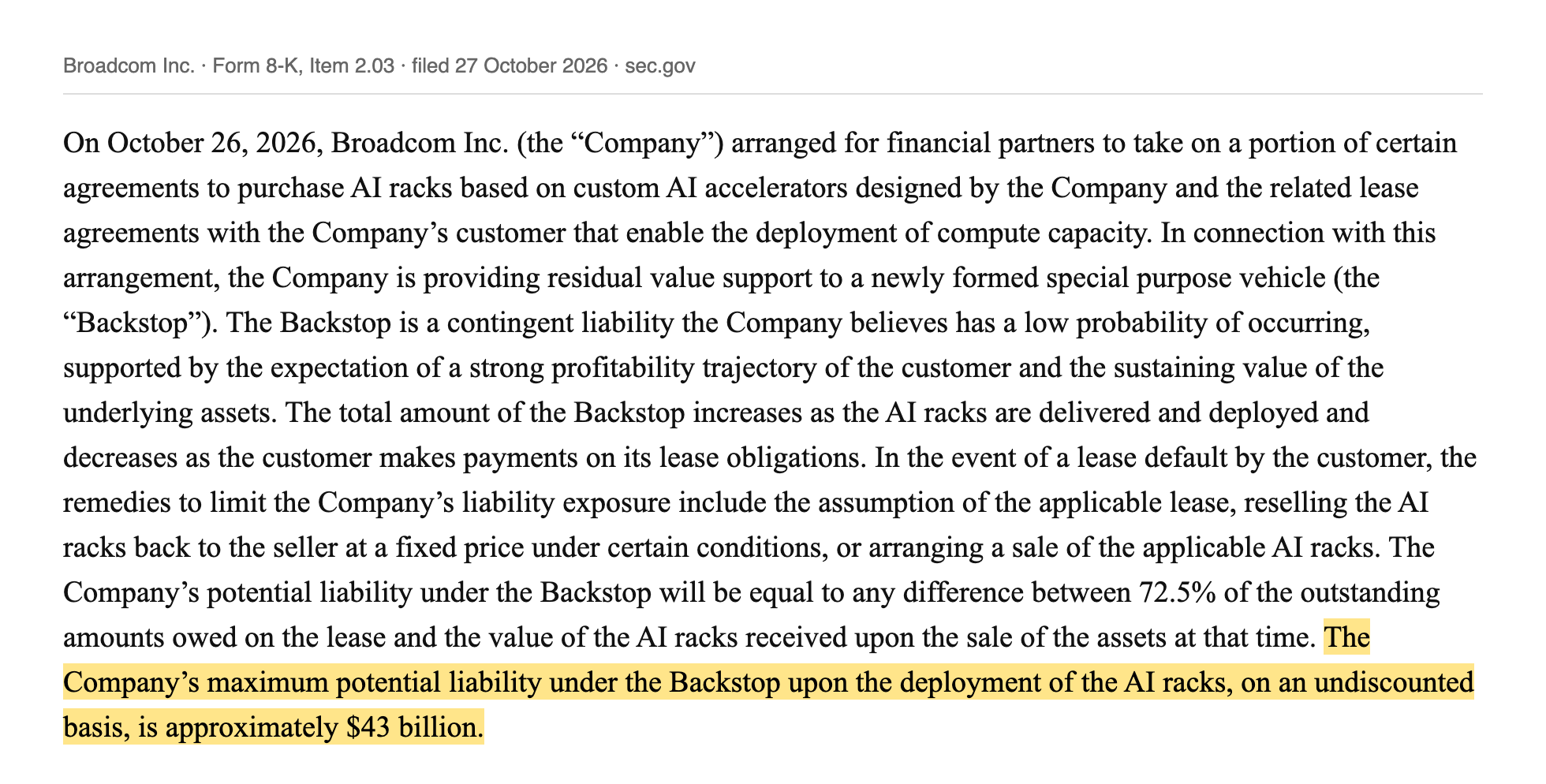
The other side of that argument is not as clean as I expected, though. Broadcom, which is already in the Alpha with AI portfolio, designs custom chips for Google and for what its own filing calls “the leading frontier AI labs”. One of those customers leases the chips instead of paying for them up front, and Broadcom has promised to cover part of the loss if that customer stops paying. It made the first promise by June, worth up to about $29 billion, and a second one on 27 October, worth up to about $43 billion, so about $72 billion in all. So the labs’ own chips are also being bought partly with borrowed money that the chip seller stands behind, and the company that gets paid in cash either way is the one that makes the chips for everyone, which is TSMC.
Why we bought TSMC, ASML, Alphabet and Oracle
Close to 70% of the Alpha with AI portfolio was still in cash, and the only chip company in it was a small position in Broadcom, so when the falls got this brutal I looked at TSMC, ASML and Broadcom, and later Alphabet and Oracle, the same way each time: the price, what the company says in its latest results, how far it has fallen before, its balance sheet, and then the industry around it.
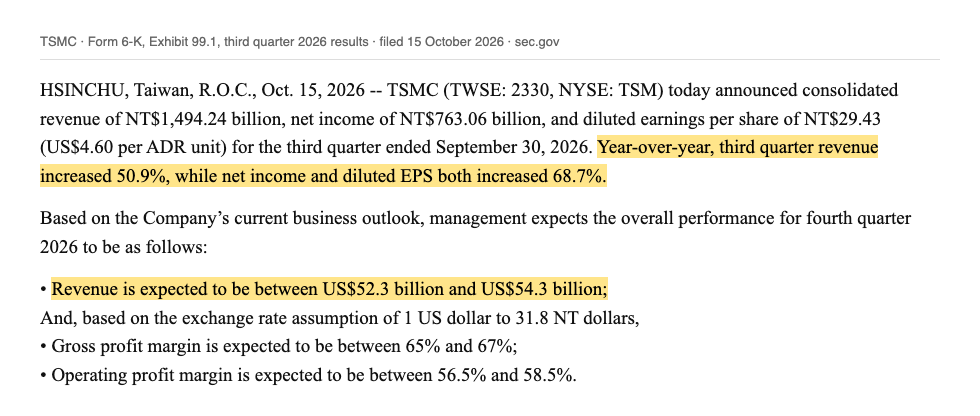
TSMC, 8% of the Alpha with AI portfolio, bought at $323.31. TSMC makes the most advanced chips for Nvidia, Apple and AMD, and the custom chips Broadcom designs, so it gets paid whichever chip wins. Its revenue grew 51% in the third quarter and 60% in October, and it expects about 44% growth for the whole of 2026. The shares trade at about 17 times its third quarter profit counted over a year, it holds about $100 billion more cash than debt, and its customers pay in 28 days, so none of the stretching I described at Nvidia shows up here. The risks are real, though: TSMC fell 55% in 2022, more than I usually accept, and a conflict over Taiwan would hurt it however strong its balance sheet is. I will be wrong if its outlook for 2027 in January is flat or down, or if its customers start taking longer to pay.
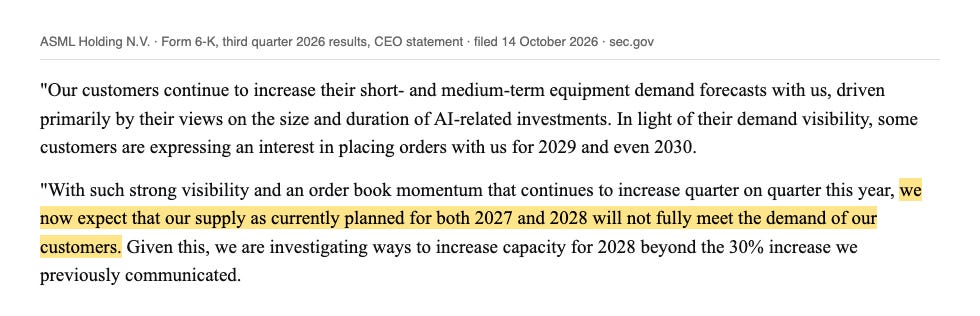
ASML, 5% of the Alpha with AI portfolio, bought at $1,277.56. ASML is the only company that makes the machines used to print the most advanced chips. ASML is strategically important because its EUV technology is exceptionally difficult to replicate: it combines precision optics, lasers, robotics, materials, and sophisticated software. This makes the company a critical supplier for producing the most advanced chips used in AI accelerators, smartphones, data centers, and high-performance computing. In October it said its planned supply for 2027 and 2028 will not fully meet what its customers want, and some customers are already asking to order for 2029 and 2030 and paying ahead to hold their place. But ASML is also the first to suffer when chipmakers cut their spending, because new machines are the first thing they stop buying. It fell 56% in 2021-22 and 44% between July 2024 and March 2025, and China, 23% of its machine sales last quarter, could shrink with one change in export rules. That is why it is the smaller of the two chip buys. If its orders for the fourth quarter, reported in late January, come in lower, then I will be wrong on this one.
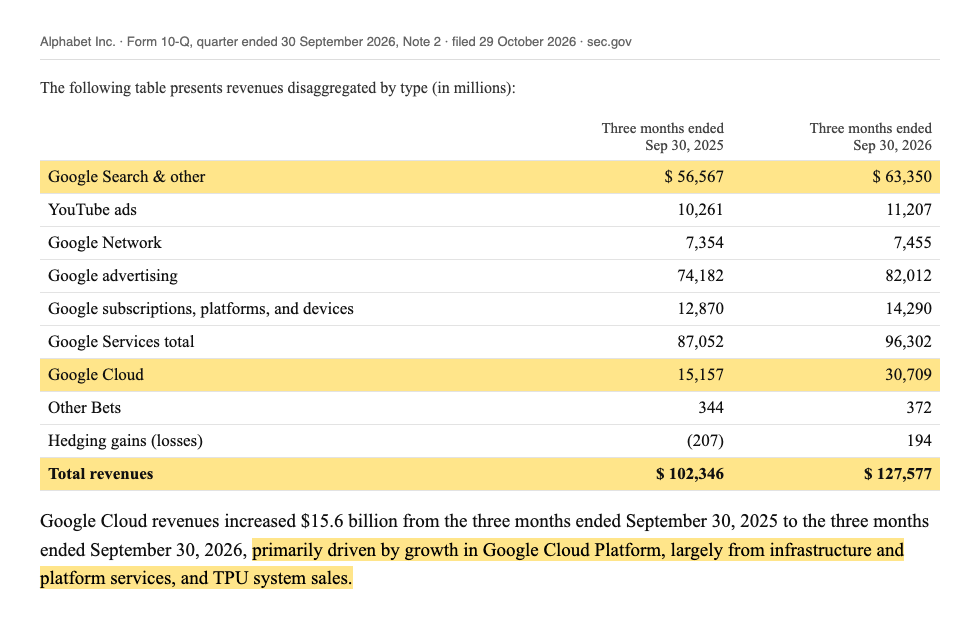
Alphabet, 5% of the Alpha with AI portfolio, bought at $272.86. If the AI labs really are moving to their own chips, Google is already where they are trying to get to. It designs its own chips, the TPUs, builds one of the leading models, Gemini, on them, and rents both out through Google Cloud, so the chip, the model and the place you rent them are all its own, and the way I see it that should let it produce each answer more cheaply than a lab renting Nvidia’s chips from someone else. It now sells those chips to other labs too, Anthropic among them. Its last quarter showed the start of this: Google Cloud’s revenue doubled, with sales of its chips named as one of the reasons, it has $560.8 billion of signed cloud contracts still to be billed, just over half of them due within two years, and search still grew 12% while everyone talks about AI answers replacing it. The cost of getting there is the part I watch. Alphabet has spent more on data centres this year than its business brought in, and it has paid for the gap by taking its long-term debt from about $47 billion to $125 billion, selling $30.5 billion of new shares in June, $10 billion of them to a Berkshire Hathaway company, and selling $19 billion of preferred stock that will turn into shares, and the spending goes up again next year. Some of its chip sales also let the buyer make Google take the chips back at a set price, and the filing does not say how much of that there is. The shares fell 12.6% on 29 October, the day after those results, and are now 32% below their high, even though Alphabet still holds about $140 billion more cash than debt. More spending is already the plan, so that is not what would change my mind. I will be wrong if the spending keeps climbing while Google Cloud’s growth slows sharply, or if search growth drops well below the 12% it just reported.
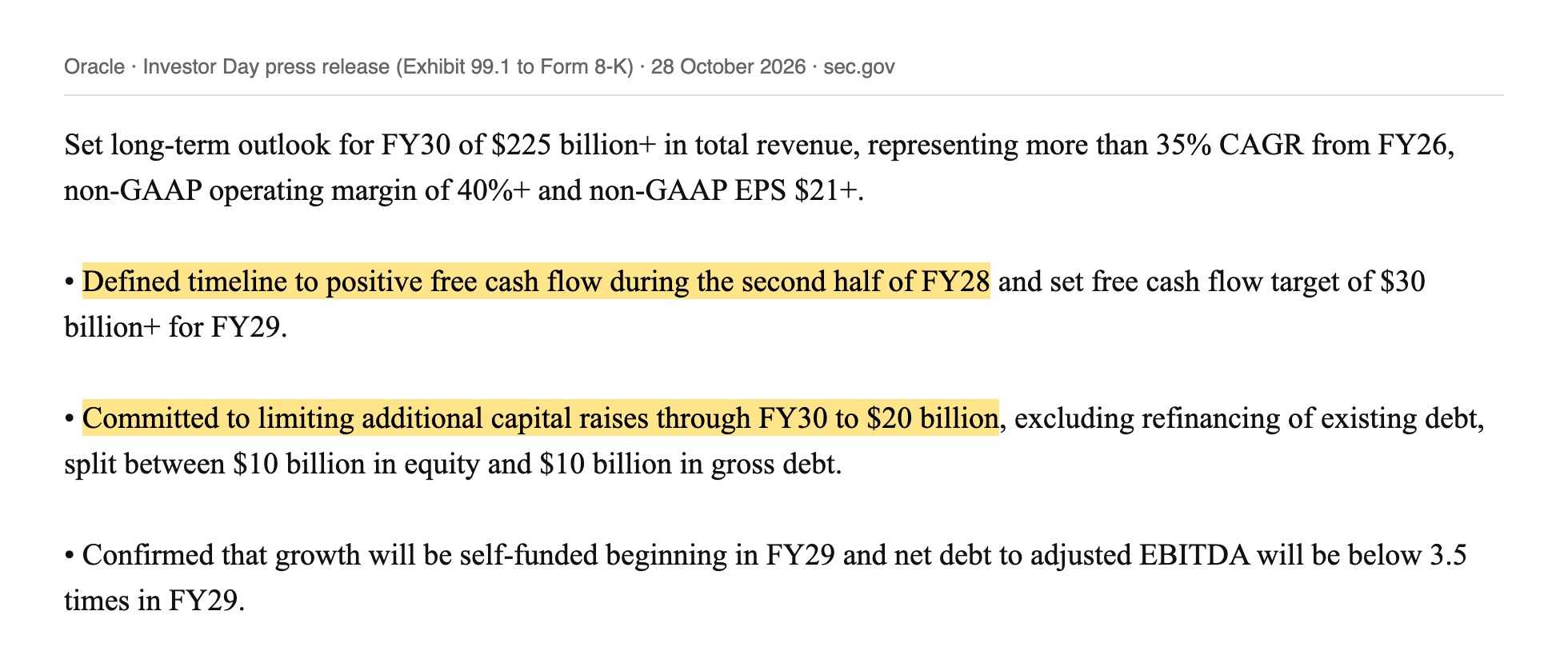
Oracle, 4% of the Alpha with AI portfolio, bought at $101.19, Friday’s closing price. When I first looked at Oracle my answer was no, because it is spending more on data centres than its business brings in and has been selling new shares to cover the gap, about $30 billion of them since June. Then I looked again at how far it has fallen and at what it is priced on, and I read the plan it gave at its investor day in October, which I had skipped the first time. The shares are 66% below their September 2025 peak, the deepest fall in its recent history (in 2022 it fell 40%), and at $101.19 they trade at about 12.5 times the $8.10 a share it expects to earn this fiscal year, with positive free cash flow promised from the second half of 2028, a limit on how much more money it will raise, and Larry Ellison cancelling his plan to sell shares back in September. My second answer is the one I trust more, but the risk behind the first one has not gone away, because most of its new business comes from a few AI customers and if one of them cuts back the plan breaks. That is why it is a small position, and I will be wrong if its results in mid-December cut this year’s guidance or it sells more shares than it promised.
Broadcom stays at 3%. We bought it on 28 October at $346.62 and it closed at $304.41 on Friday. I did not add, because its promises to cover that customer’s lease payments went from about $29 billion to about $72 billion after we bought, and I want to hear how it thinks about them at its results, expected around 10 December, before adding anything.
Nvidia, still no. There is no permanent chief executive, it has fallen 66% once since 2015, and its customers are paying more slowly while Nvidia owns stakes in many of them, so I keep reading about it and I am not buying it.
How has the Alpha with AI portfolio done since July?
Friday was a hard day, with the S&P 500 down 3.6%, and our three new positions, TSMC, ASML and Alphabet, closed below what we paid for them earlier that day. At that close the Alpha with AI portfolio was up 2.9% since it started on 8 July, while the S&P 500 was down 7.5% over the same months, and in November it was about flat, up 0.1%, against the index’s fall of 8.7%. Most of it was in Treasury bills, so the whole-portfolio number moves slowly, and the better test of the picks is the money that actually went into companies: those dollars were up 3.1% on what we paid, while the same dollars put into an S&P 500 fund on the same days would have been down 5.2%. That figure also counts the two positions we sold at a profit in October, PTC at 40.5% and Accenture at 77.4%.
After the four buys 48% of the portfolio is still in cash and the rest is spread across eleven companies.
In our live portfolio we bought TSMC and Alphabet on Friday. ASML stays out of it because of how far it has fallen before and because there is very little cash left in that account right now. Oracle is not in it either. You can follow the live portfolio here:
What comes next?
I was away for a while, and now I am back. From here you will get a series of workflows, some as newsletters and some as videos, and possibly a full video podcast on the AI tools I use and how I think when I work with them.
The number I am watching from here is still how long Nvidia’s customers take to pay, because that tells me how much of this whole boom the chip sellers are paying for themselves, and the first answers on our four buys come between mid-December and February.
If this letter has earned its read, tap the ❤️ at the top of this email or page. One tap from you is how Substack decides whether this piece reaches anyone beyond my own subscribers.
*Disclaimer: Alpha with AI covers US-listed and other global securities for educational and research purposes only. Everything in this letter is my personal view and, where stated, an Alpha with AI portfolio action. The Alpha with AI portfolio is a model (paper) portfolio tracked at dated entry prices with the reasoning published alongside; the live portfolio is a real account we manage, and its trades are reported as they happen. None of it is investment, legal, or tax advice, a recommendation to buy, sell, or hold any security, or tailored to anyone’s situation, and I am not a registered investment adviser or research analyst. The valuations here are my opinions with the method shown, not price targets or calls to act. I may hold or take positions in the securities discussed, my views can change without notice, and when they do, you will read about it here. Every figure traces to a primary public filing, the company’s own calls and releases, or the source named beside it, but filings can be misread and models can be wrong, so verify against the source before acting on anything. AI tools were used in the research and drafting of this letter, with every number checked back against the source documents. Investing carries risk, including the loss of capital. Do your own research and consult a qualified professional in your jurisdiction before making investment decisions.*
Financial Clarity. Insightful Ideas.
Written by Shubham Borkar
The split you draw between AI use and chip shares is the right one, and the two numbers that carry it are the token count and the payment terms. OpenRouter processed about 170 trillion tokens in the latest full week, against a few trillion a year ago, so the work running on the chips has not slowed even as the S&P 500 fell 3.70% on November 20 and Nvidia fell 14% to $125.53. The financing side is where the stress shows: Nvidia's customers took 64 days to pay in the October quarter, against 45 days a year earlier, while TSMC is paid in 28 days — the difference between selling the shovels and financing the diggers. Broadcom's $72 billion of lease guarantees for its customers is the same pattern in another form. If that receivables trend keeps lengthening, the chip sell-off is a cash-conversion story rather than a demand story, and the November 25 PCE and the December 9 Fed decision will matter less to it than the next round of customer payment data.
Nvidia's customers going from 45 to 64 days to pay is the stat I keep coming back to after reading this, it says more than the multiple does. TSMC getting paid whoever wins makes a lot of sense as the first buy