


Earlier this year I wrote, a little proudly, about going through 100 million AI tokens and then 500 million, and on Claude’s Max plan I was hitting the weekly limit in two to four days. Those tokens went into a real system. Our research ran on Claude skills, each one written down from an investing framework we had studied properly, and we wrote a whole edition on how to build them.
The skills worked, and so did our first two IPO editions: a year ago, one long prompt that read a draft prospectus, and in June, Claude Code reading SpaceX’s prospectus against five fixed questions. But a skill is a set of instructions the AI follows each time you run it, so on every run the AI read the whole document again, did the same arithmetic again and spent the same tokens again. A prospectus makes that worse, because the company files an amendment, then another one, and the price usually arrives only in a later version.
What made it click was something I learned long before AI, in mechanical engineering. We studied lean manufacturing and Kaizen, the Japanese idea of continuous improvement, mostly through Toyota, which built its whole way of making cars around finding the waste in each step and taking it out, one small change at a time. In lean, any work that adds no value is waste. Reading the same few hundred pages again for every amendment was exactly that, and so were most of my 500 million tokens, which was nothing to be proud of.
It did not change in one go. We started asking the lean question of our own research: how do we do this job with less AI? Then less again on the next job, and less again after that, over months of trying things, including a free earnings watcher we built in October. Every time, the answer we arrived at was the same: spend the AI’s tokens once, on building a program, and let the program do the repeated work the same way every time, for free, with AI coming back only for a problem we have not met before. Toyota also built its lines so that a mistake could not slip through unnoticed, which it calls poka-yoke, or mistake-proofing, and code can do the same: our program carries tests that fail the moment a figure we checked by hand comes out different.
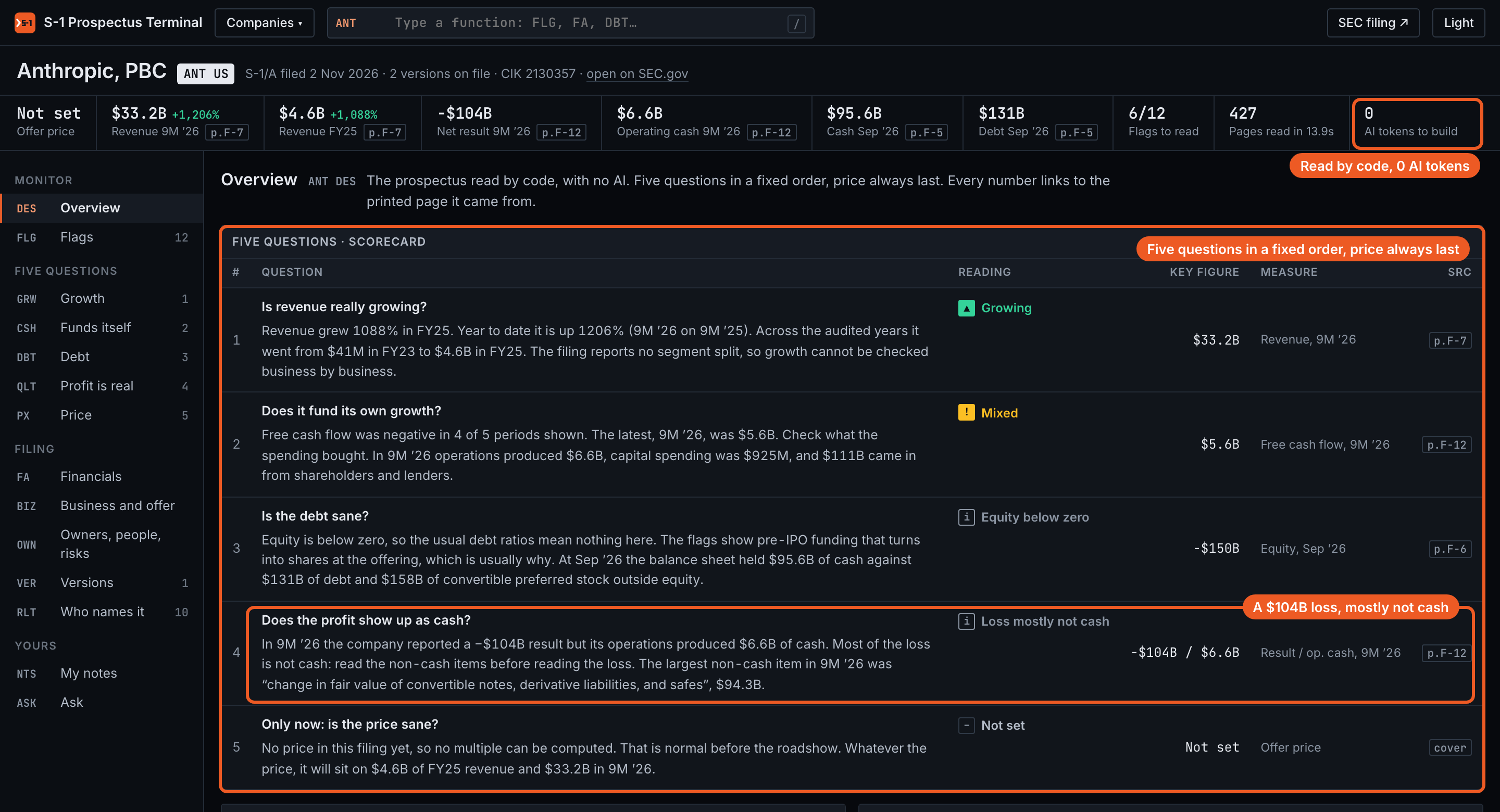
For IPOs, that program is S-1 Prospectus Terminal. Anthropic’s amended prospectus, filed on 2 November, runs to 427 pages and 245,634 words with the price still blank, and on my own laptop the program read all of it and built every screen from it in about a minute and a half, with every number tied to the page it was printed on and no AI involved. It is free and open source for anyone who wants it, and you can type in the name of any other company that has filed for a US IPO and get the same dashboard for it a minute or two later. If you find it useful, a star on its GitHub page helps it reach more investors who could use it. It reads US filings today, anyone in another market can change the code to read their own, and we will add more markets to it over time.
Handing out a free program is the easy part, though, and it only solves the one problem we had. The hard part is building something like it, and that is the part worth far more to you, because once you have built one program like this you can build the next one for the next problem you keep running into, ten problems and ten solutions, in investing and well outside it. So alongside the program we are sharing the way we built it, in the order it happened and with the wrong turns left in, and Anthropic’s prospectus is the worked example all the way through.
Alpha with AI is read by 5,000+ analysts, investors and business leaders. We publish investment research and the AI workflows behind it, Every screen in this edition comes from S-1 Prospectus Terminal, and the research behind our editions runs on greeksoup.ai, our own research platform, where greeksoup.ai Premium is complimentary for Alpha with AI paid subscribers. Paid subscribers get the whole of this edition, with the prompts we gave the AI and the build kit to download, along with every research dive, the AI workflow library, both our portfolio books with every trade I make. For a limited time, paid has a special price.
If pieces like this one are useful to you, consider upgrading to support the work:
Start the build from your own method
Where do you begin when you have never written a program in your life? We began with those two IPO editions, because each of them was a method written down in plain words. The first one read a prospectus in four blocks, the people running the company, the pattern in the numbers, who the business depends on and what the risk section admits, and it carried one rule: when the founders’ behavior and the financial trend move in different directions, look deeper. The June edition on SpaceX added five questions asked in a fixed order with the price always last, a page number beside every figure, and “not disclosed” written in wherever the filing gives no figure.
I then had AI read both editions and turn each of those habits into a check the code can run by itself, such as founders or senior executives leaving shortly before the filing, a profit that never turns into cash coming in from the business, a debt ratio that rose only because the owners’ stake, what the company owns minus what it owes, got smaller, and a customer whose dollar figure is printed in the body of the prospectus but missing from the financial statements the auditors checked. Our two editions made those checks while reading each prospectus from start to finish, and once they were written down as code, the program could run them on every filing it reads without costing anything.
But when I opened the first working version, it answered our five questions well and missed a lot of what an analyst looks for in an S-1, the prospectus a company files with the SEC before it lists in the US: how many shares there will be after the IPO, who holds the shares compared with who holds the votes, what the company would be worth at the offer price, how much of the stock is actually sold to the public, and when insiders are allowed to start selling. It had been built from our two editions and nothing else, and a prospectus holds a great deal more than those two editions ever asked about.
So before building anything more, we wrote out the whole job. We went through an S-1 section by section, from the cover page to the notes at the back, and listed 54 things a professional reads it for, marking each one as read, partly read or missing. We also went through the recent posts on SpaceX and Anthropic by Aswath Damodaran, the New York University finance professor known for valuing companies, and separated what he takes straight from the filing from what he works out himself, since what he takes from the filing is work a program can do. The missing items were built next: the share count after the offering, the company’s value at any price you type in, how much of the company is actually sold to the public, the dates when insiders can sell, and the dilution, which compares the price a new buyer pays for a share with what each share is backed by in the company’s own books. If you build your own, your own method is still the right place to start, since it is the part you already trust, and the full list of what the document contains is what shows you where your method falls short.
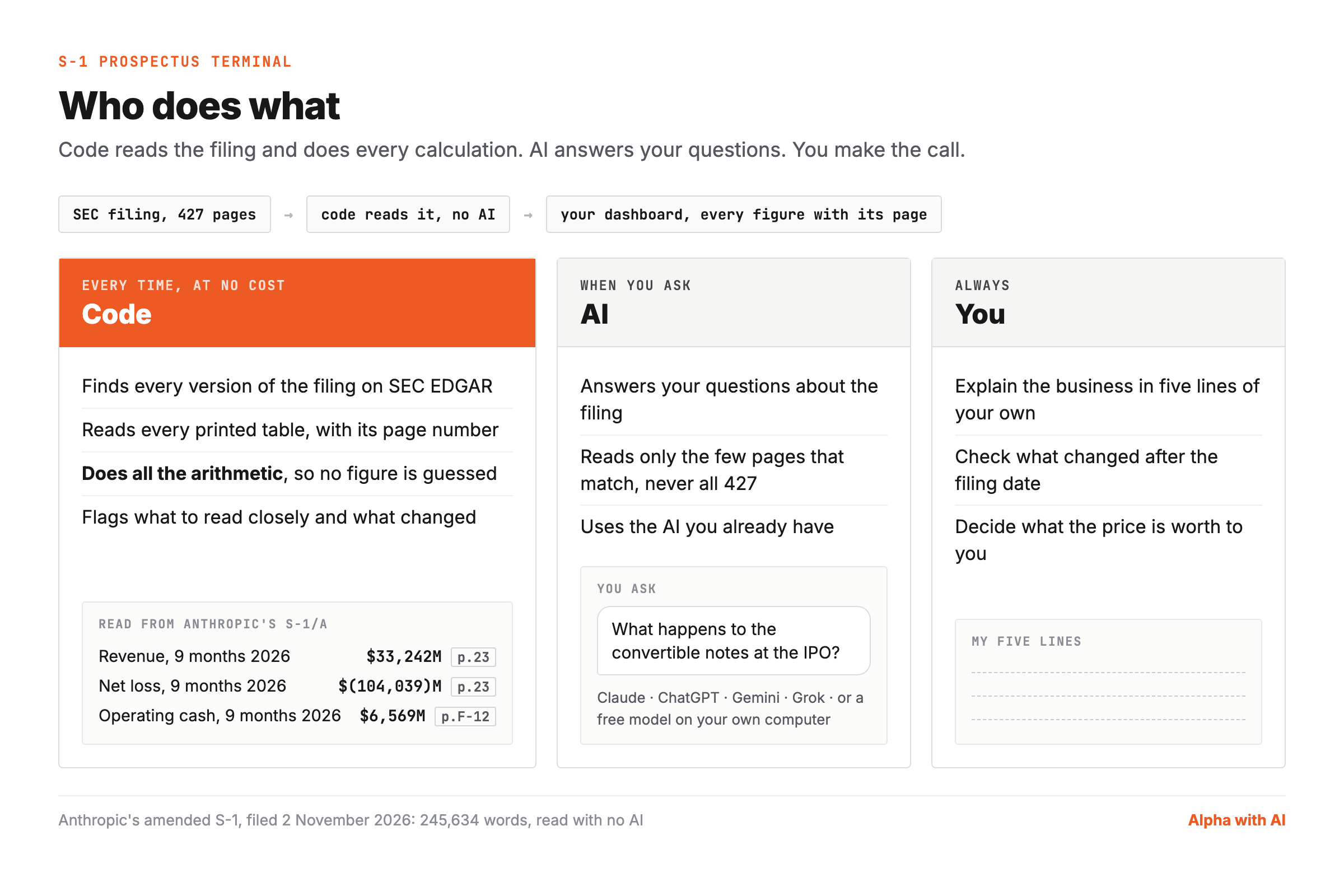
All of that came down to one rule for who does what. The code does everything that repeats, which means finding the filing, reading the tables, raising the flags, comparing one version with the next and drawing the dashboard, and it costs nothing to run again. The code also does every piece of arithmetic, and that was one of the main reasons to build a program at all, because AI is bad at arithmetic and can hand you a number that looks right and is not. One answer it gave us while we were testing the program was a thousand times too small, and code reads the figures printed in the filing the same way every time. AI comes in only when you want to ask something about the filing, through the one you already pay for, ChatGPT, Claude or any other, and even then the code hands it just the few pages that match your question instead of all 245,634 words. What stays with you is the judgment: explaining the business in five lines of your own, checking what has changed since the filing date, and deciding what the price is worth to you.
Test it against answers you already trust
The program was written with AI, so before trusting it with Anthropic we needed to see it get the right answers on a filing we had already checked ourselves. That filing was SpaceX’s. For our June edition we had gone through its prospectus page by page, so we wrote down every answer from that edition and turned them into a test the program has to pass each time we change the code. It now gets all 9 figures we took from SpaceX’s financial tables, all 15 figures behind the five answers and all 7 findings. There is one difference, and the program says so on the screen: it puts SpaceX’s debt at 8.9 times its equity, where we had 9.5 times, because it does not count operating leases, the long rental contracts a company signs, as debt.
It did not get there on the first try. SpaceX’s prospectus has no real tables inside it. Each number is placed on the page by its position, the way it would sit on paper, so the code had to work out which number belongs to which row and which year before it could read a single statement. Later, a rule we added for companies that report in thousands divided all of Anthropic’s figures by 1,000 by mistake, and the dashboard showed its 2025 revenue as $4.6 million instead of $4.6 billion. None of the tests caught it, and we only noticed it on the screen, so we added a second test of 12 Anthropic figures checked by eye against the SEC’s pages. If that mistake ever comes back, the test fails.
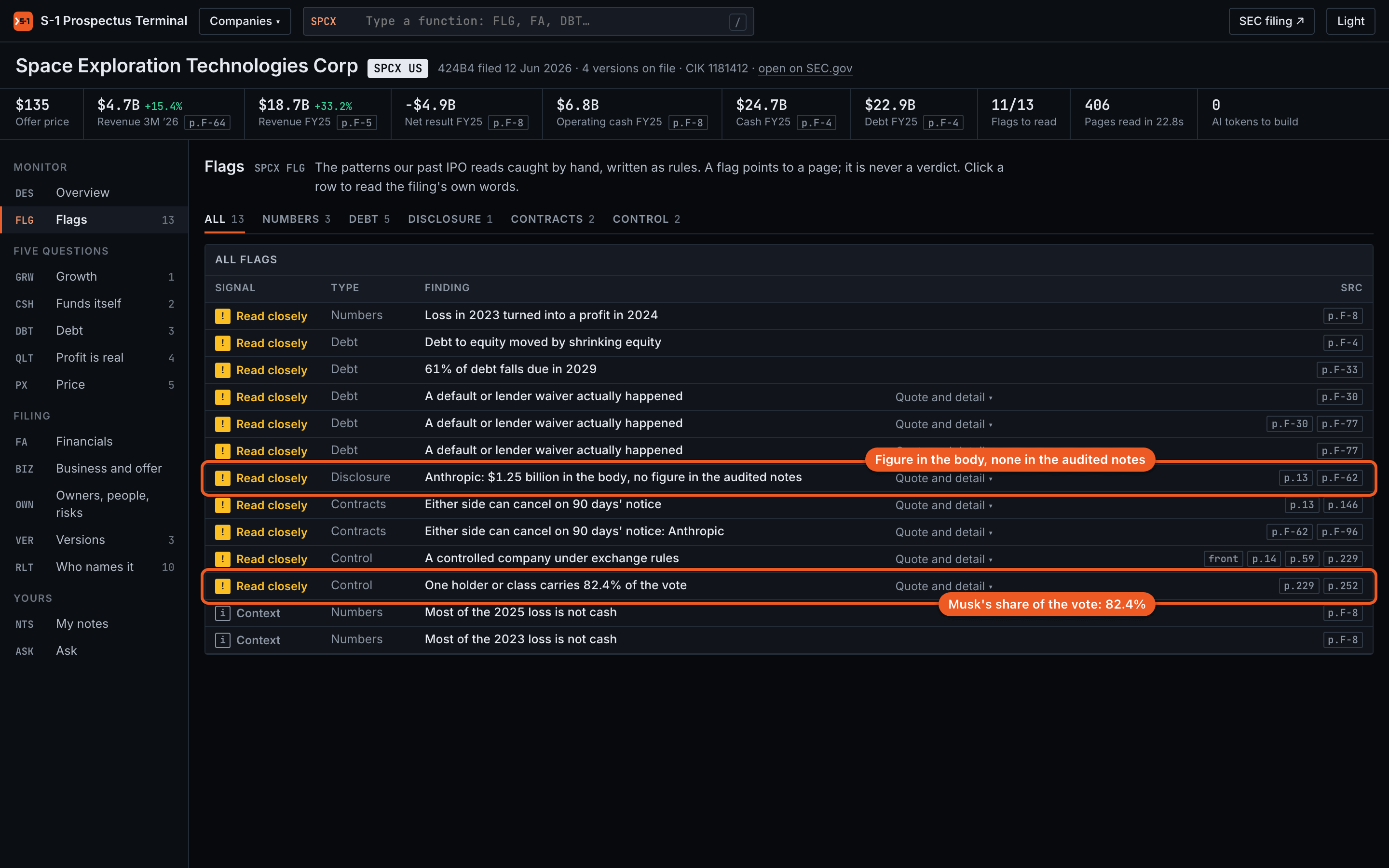
The SpaceX test also showed two mistakes in our June edition. They are small, but they are exactly the kind of thing a program catches easily. We had cited the Anthropic contract, worth $1.25 billion a month to SpaceX, on pages 14, 147 and F-63, and the page numbers printed on those pages are 13, 146 and F-62. We also wrote that Elon Musk would keep over 85 percent of the votes after the IPO. The filing we were reading left that number blank, and the 3 June amendment gave it as approximately 82.4%. In June we read Aswath Damodaran’s post before the filing, and his post, based on the share counts in the first filing, said more than 85%, so that is very likely where our number came from.
We now run that test every time we change the code, and it is the reason we were willing to point the program at Anthropic at all.
Reading Anthropic’s S-1, one screen at a time
Type Anthropic into the program and the strip across the top of the dashboard shows a loss of $104 billion for the first nine months of 2026. That is the figure most people will see first, and the program does not show it on its own. The fourth of our five questions asks whether the result shows up as cash, so the screen for that question puts the reported loss next to the cash the business produced from its operations, which was $6.6 billion coming in.
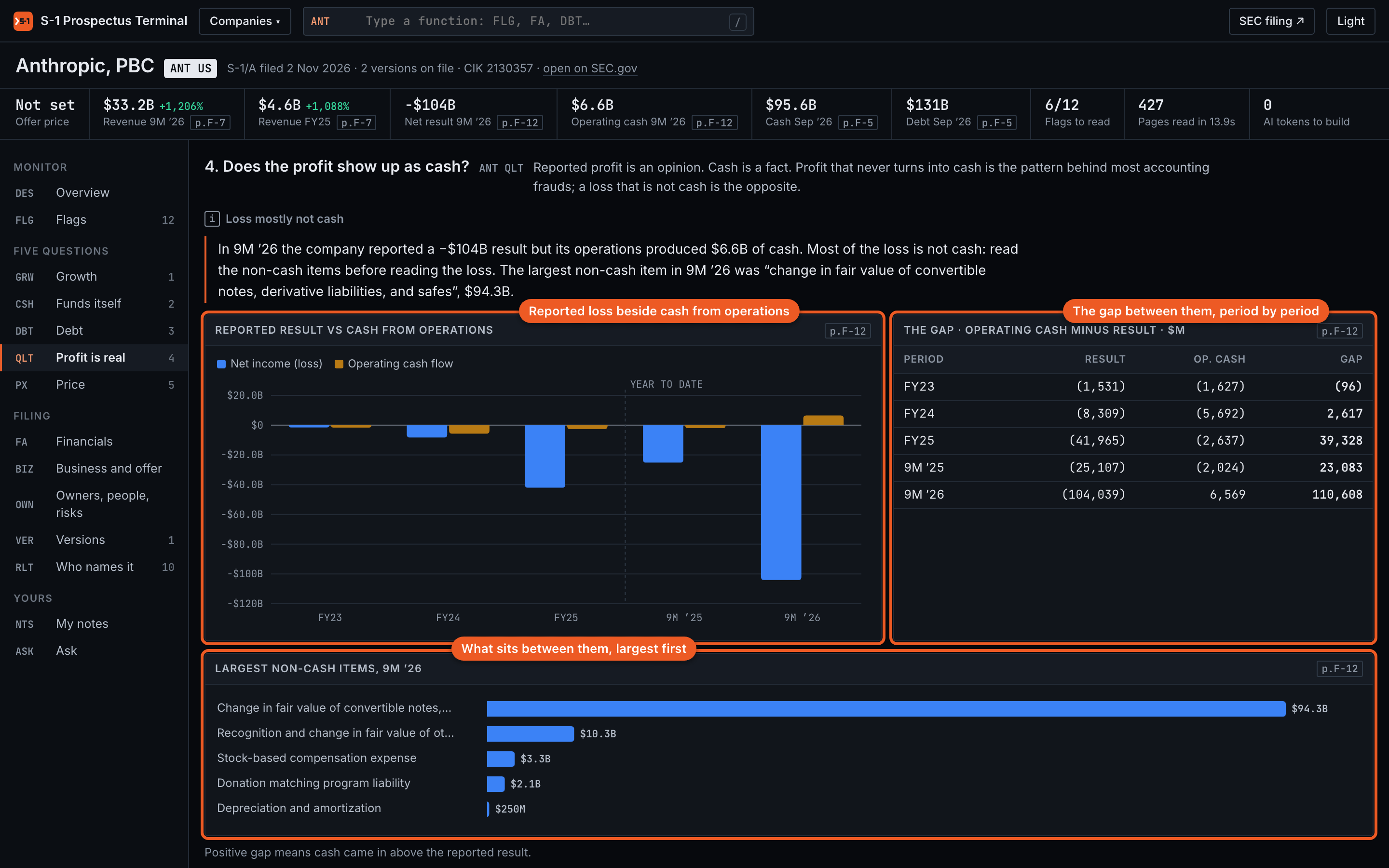
To build this screen, the code reads Anthropic’s cash flow statement on page F-12 line by line. It takes the net loss from the top and the cash from operations from the bottom. In between sit the non-cash items, costs that lower the profit on paper while no money goes out, and the code lists them from largest to smallest. The largest by far is $94.3 billion for the change in value of the company’s convertible notes, which are loans that can turn into shares instead of being paid back in cash. Those notes become worth more when Anthropic’s valuation goes up, and the increase is booked as a loss. In our June edition we used this question to look for profits that never turn into cash. On Anthropic the same question shows that most of the loss is not cash.
You should not have to take the program’s word for any of this, so the full financial statements have their own view, with every line in the filing’s order and with the filing’s own labels, and the change from the year before printed under each line.
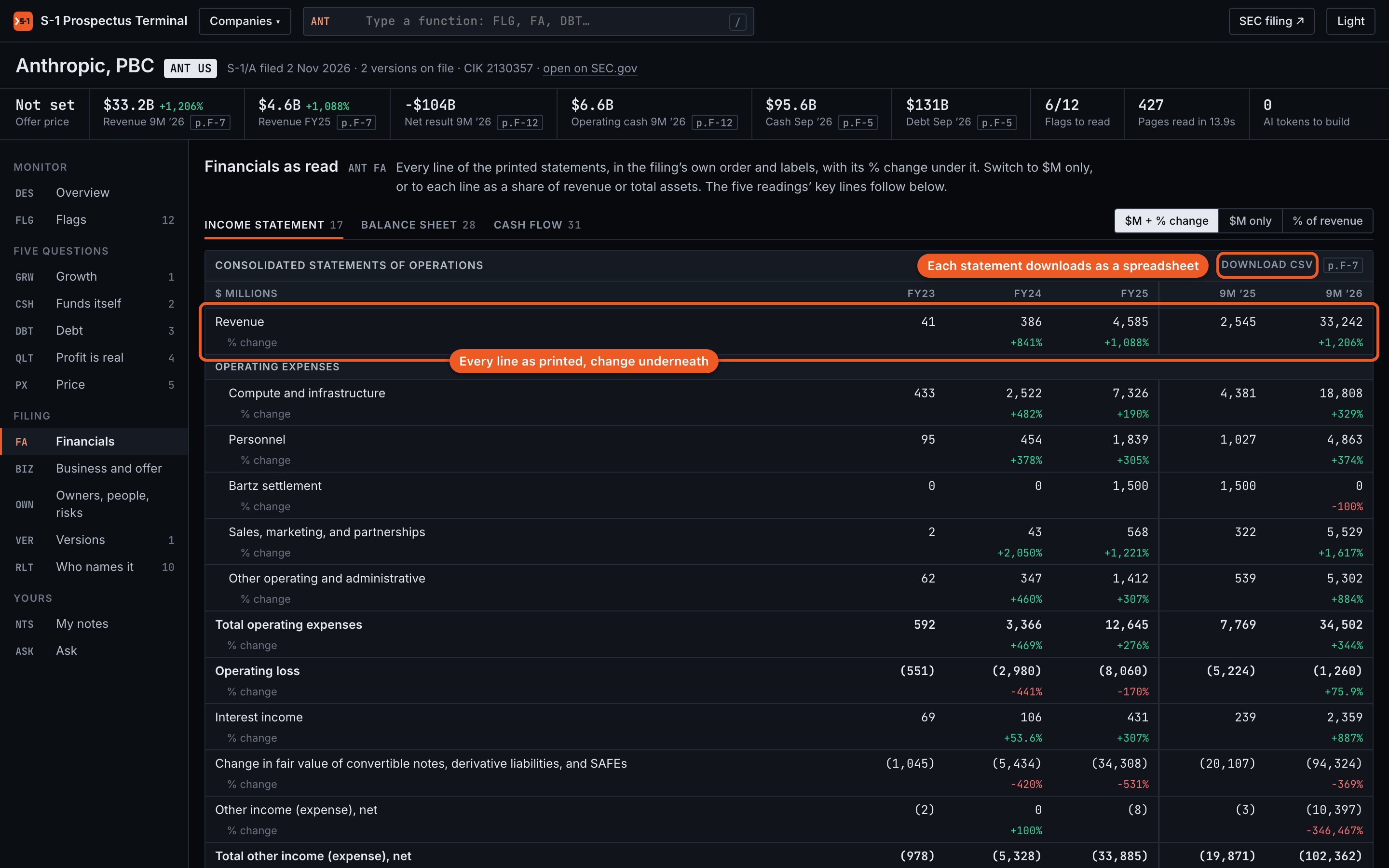
On this screen you can see that revenue for the first nine months rose 1,206% while total operating expenses rose 344%, which took the operating loss down to $1,260 million. That is what the business itself lost before the convertible notes and other financing items are counted, and most of the $104 billion comes from the notes line further down. The code calculates these percentages from the printed figures, not an AI, so they come out the same every time.
Anthropic’s prospectus is Anthropic talking about itself. The companies it does business with also file with the SEC, so the program searches their filings for Anthropic’s name and ranks what it finds by whether a dollar amount appears near words like agreement or contract. The first version got this wrong and put companies that only mention Anthropic as a competitor above SpaceX, and we fixed the ranking after that.
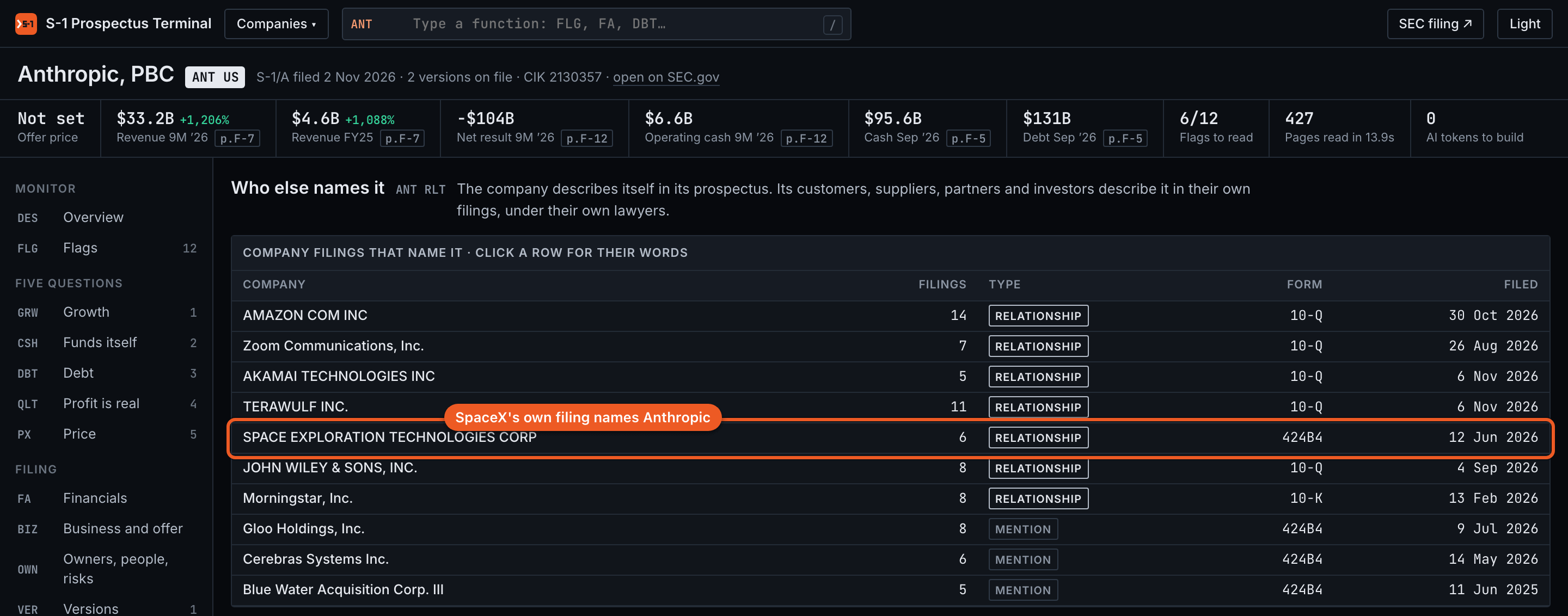
This search turned up SpaceX’s own prospectus, which gives the other side of the deal under which SpaceX rents Anthropic computing power in its data centers. In May, SpaceX said Anthropic had agreed to pay it $1.25 billion a month. Anthropic’s amendment now describes spending of up to $120.5 billion into 2029, about $3.1 billion a month once all the capacity is delivered, and either company can cancel on 90 days’ notice after the first fixed periods end in January and March 2027 (page 175).
A prospectus also changes from one version to the next. On 9 May 2012, eight days before Facebook priced its IPO at $38 a share, its sixth amendment added a few sentences saying that daily users were growing faster than the number of ads Facebook showed them, partly because more of them were using Facebook on their phones, and that the trend had carried on into the second quarter. The fifth amendment, filed on 3 May, had none of it. Massachusetts later fined Morgan Stanley, the bank that led the sale of Facebook’s shares, $5 million over how its analysts’ research reached investors in the days before the IPO. From 9 May, those sentences were in the filing for anyone who read the new version against the old one.
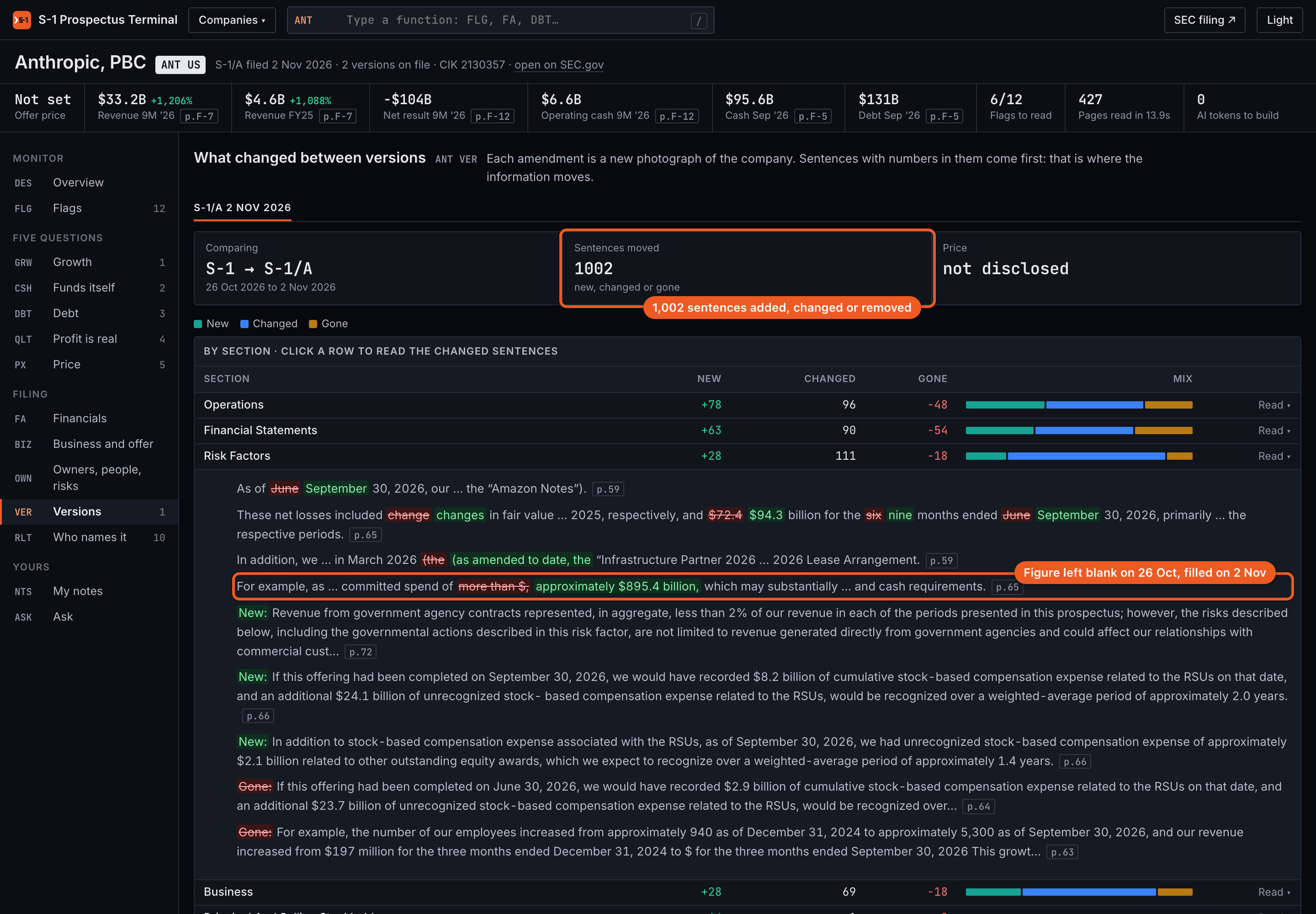
Our program does that comparison by itself, section by section, and puts the sentences with numbers in them first. Between Anthropic’s first filing and its amendment, 1,002 sentences were added, changed or removed. One of them is the committed spending. On 26 October it read “more than $” with the figure left out, and on 2 November it read “approximately $895.4 billion” (page 65, with the same change on five other pages).
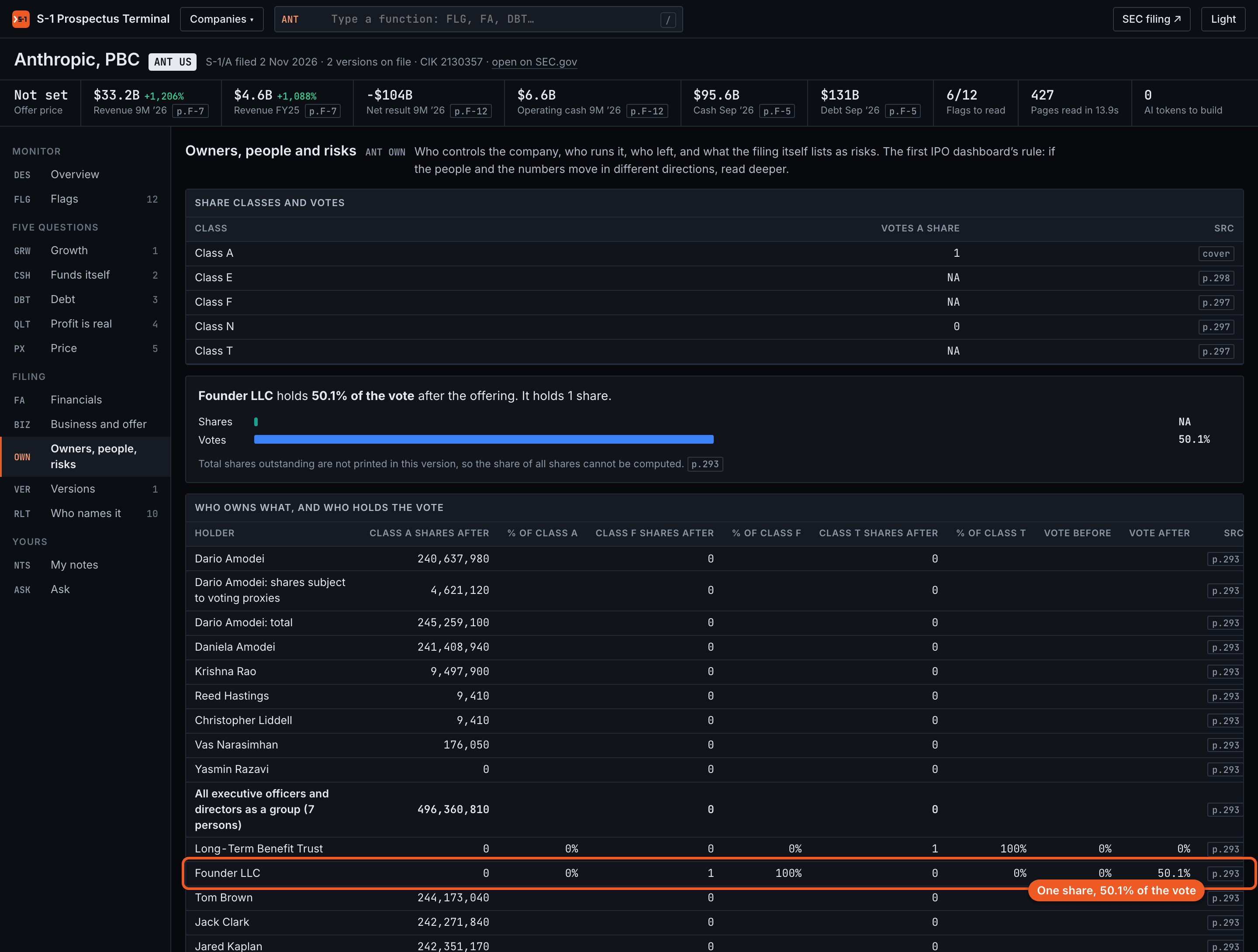
A company can issue several kinds of shares, called classes, and each class can carry a different number of votes. The owners screen reads the filing’s table of share classes and its own sentences about voting. At Anthropic, a single share of Class F, held by a company owned by the seven co-founders, carries 50.1% of the vote until the conditions the filing calls the sunset, on page 110, bring it to an end. The price screen is still empty because this amendment gives no price, so it shows “Not set”, and it will fill in, along with the number of shares sold, who owns what after the offering and how much of Amazon’s convertible notes stays as debt, when Anthropic files its next amendment.
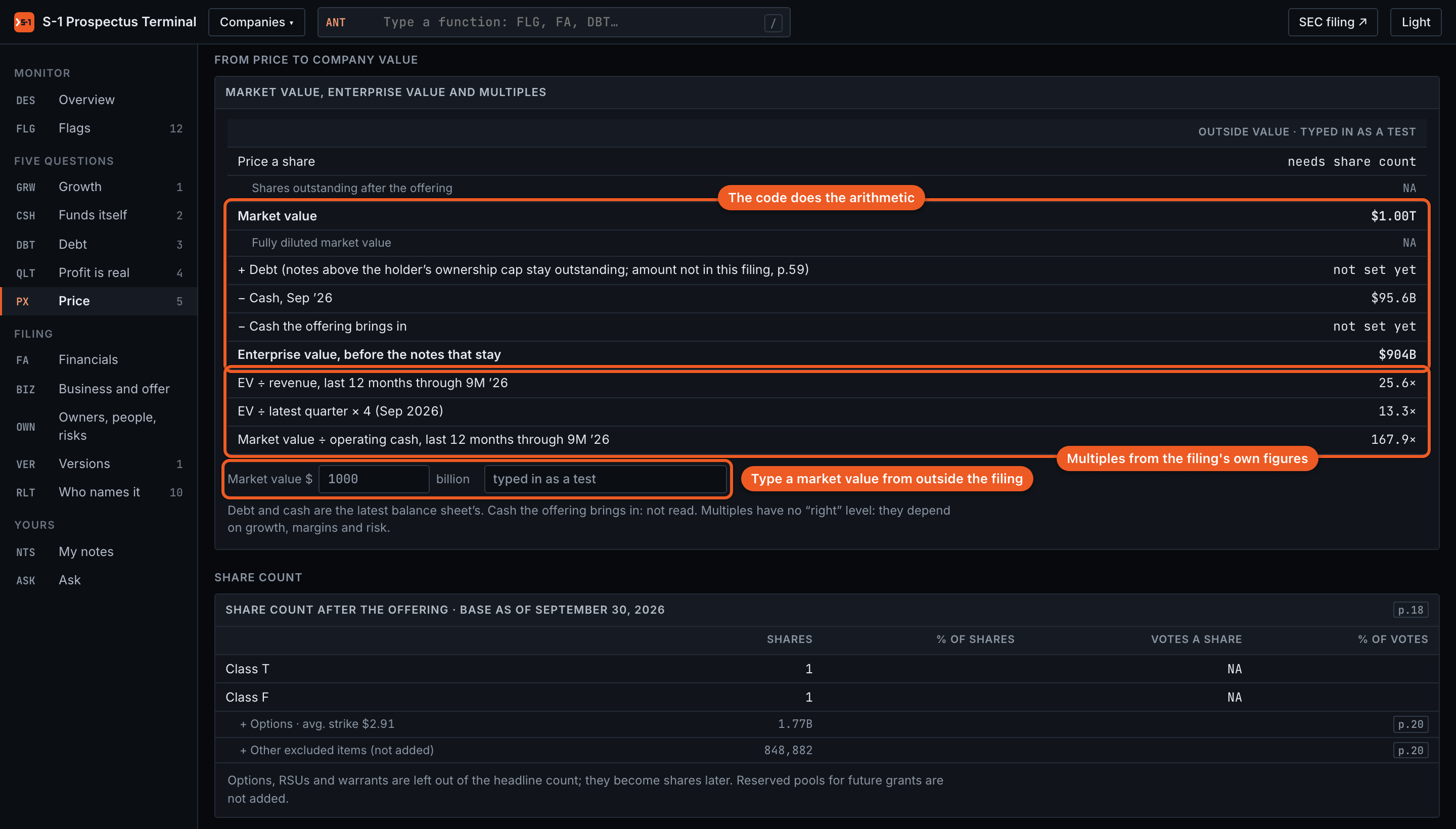
Until then, the price screen has one box you can fill in yourself. Aswath Damodaran has already published his own valuation of Anthropic, and plenty of others will put a number on it before the IPO. Say you read one of them and want to see what it means against the filing. You type it in, add where you read it, and the code works out the enterprise value and the multiples from the cash, revenue and cash flow printed in the filing. Enterprise value is the market value plus the company’s debt and minus its cash, which is roughly what it would cost to buy the whole business. A multiple divides that value by a figure such as revenue, so that companies of different sizes can be compared. The column is marked as an outside value, so it never gets mixed up with what the filing says. The box stays useful after the price is set, because you can put in the value you think the business is worth and see what it means against the same figures.
The rest of this edition is for paid subscribers. It has the instructions we actually gave the AI to build this program, in the order we gave them, the 54-item S-1 checklist we built it against, and how the same steps build the next program for a problem of your own. It also shows how to connect the AI subscription you already pay for, ChatGPT, Claude or another, so you can ask the filing your own questions. Then there is the question we asked ours about Anthropic’s convertible notes, with the condition on Amazon’s notes that both the answer and our program had missed, and the six blanks that fill in when the price amendment lands.