


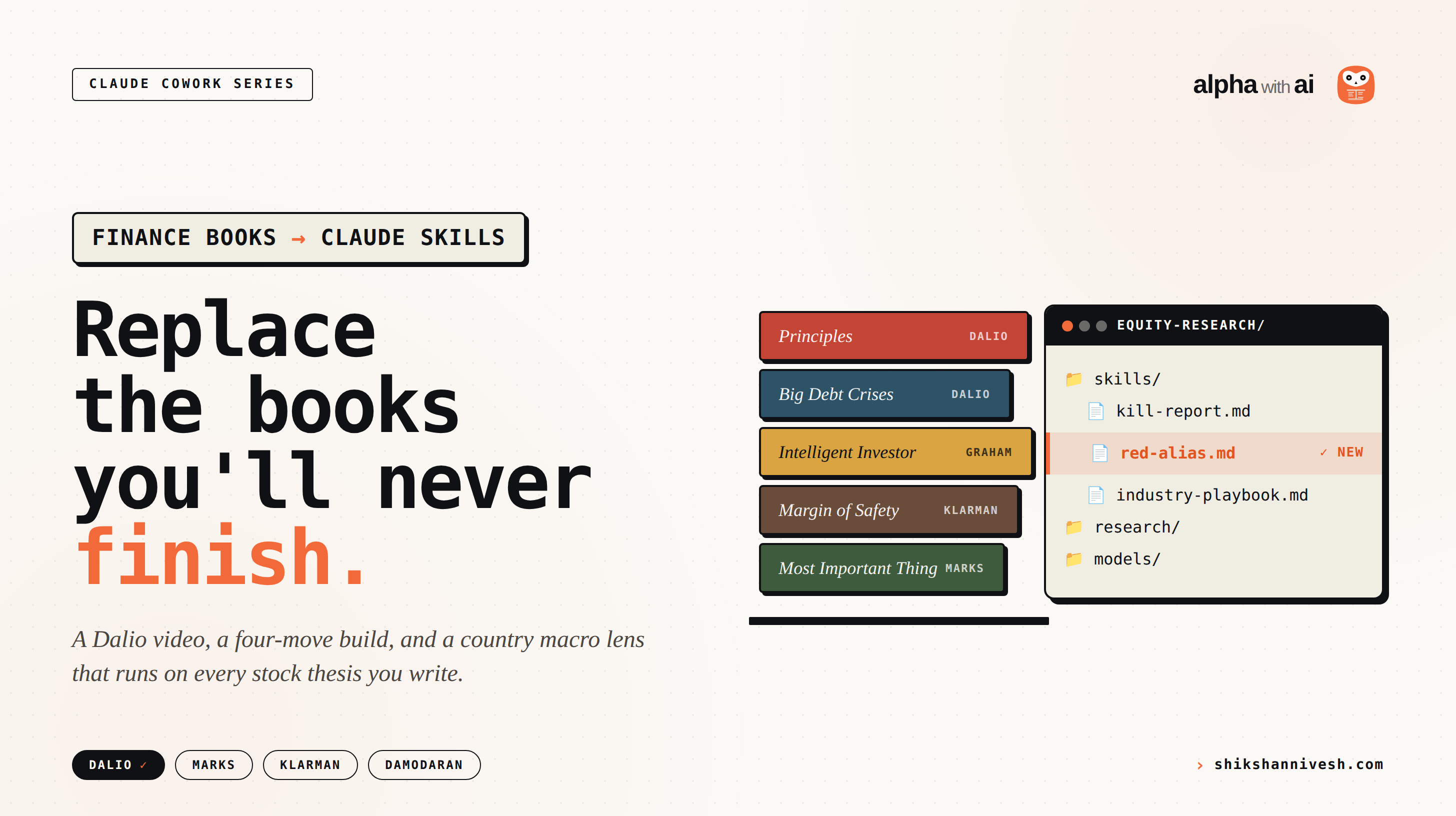
I have watched the Ray Dalio Big Cycle video eleven times.
Every time goes the same way. I open YouTube. I tell myself this is the watch where I take real notes, build a real framework, integrate it into my actual research. I scribble for the first ten minutes. I nod at the part about debt cycles. I get up for something in the kitchen. I come back. The video is still playing and Dalio is still talking about empires.
By the end I have three pages of notes I will never look at again, a vague sense that I understand the Big Cycle better, and a stock screener still open in another tab waiting for me to come back to the actual work.
It is not just the video. There is a shelf next to my desk. On it sits Principles, Big Debt Crises, Changing World Order, The Intelligent Investor, Built to Last. Books I bought because every serious investor I respect said I should read them. Books I have opened, dog-eared, started, restarted, abandoned.
The only book I have actually finished in the last twelve months is Jim Collins’ Good to Great. Even that took me four months of stolen evenings, weekend mornings, and one long flight. By the time I got to the last chapter I had forgotten the framework from the first one.
Here is the part I never said out loud until now. I read more in a typical week on Substack than I read in a year in books. Not because Substack writers are smarter than Dalio or Marks or Klarman. They most probably are not. But Substack gives me something the books cannot give me, which is live perspective. Recent context. The AI angle. Applied thinking. The exact stock I was researching yesterday, analyzed by someone who is also researching it today.
The books sit on the shelf and lose. Every time.
Yet I know, and you know, that the frameworks inside those books would change how we research. Dalio’s Big Cycle is not abstract macro theory. It is an operating system for understanding where any country, any sector, any asset sits in a much larger story. Marks on cycles. Klarman on margin of safety. Collins on what separates good companies from great ones. These are not just ideas. They are lenses. Lenses change what you see.
The lie I have been telling myself for years is that one day I will have time. I will take a sabbatical. I will go through all of them properly. I will emerge with a notebook full of frameworks and finally start applying them.
That day is never coming. You know it. I know it.
Last month, on the eleventh rewatch of the Big Cycle video, something different happened. Not because the video got shorter. Not because Dalio suddenly got simpler. The video is still 40 minutes long and the framework is still vast.
What changed was a different question.
What if I did not need to finish the book? What if I did not even need to start it? What if the framework itself could go where I actually work, into the Claude project where I research stocks?
That question turned into a build. That build turned into a skill, a Claude Skill that lives in my Equity Research project alongside the Kill Report and the Industry Playbook. It runs Dalio’s Big Cycle lens on any stock, sector, or country I throw at it. It does not write the model for me. It does not pretend to know what to buy. It does one thing: it makes sure that before I commit to a thesis, the macro view I always meant to integrate is actually integrated.
That is what this edition is about.
Not Dalio. Not the book. Not even the skill, really.
The thing underneath all of it is a way to take any author whose frameworks have been sitting on your shelf, whether it is Dalio, Marks, Damodaran, Klarman, Collins, or whoever, and bring their thinking into your workflow without ever finishing the book.
I will walk you through exactly how I built it. Every prompt. Every step. The SKILL.md file is at the bottom of this edition, ready to install. The companion PDF guide is on the website if you would rather read it that way.
By the end of this newsletter you will have done two things.
One, you will have a working Big Cycle Skill installed in your Claude project, ready to run on any stock you research.
Two, you will have a method, a four-step build pattern that works for any book, any framework, any author. The next time you find yourself watching a video for the eleventh time, you will know what to do with it.
Let us start where every good build starts. Not with the book. With the question the book is supposed to answer.
The Pattern Break
For years my reading problem felt like a time problem. If I just had more time, I would finish the books. If I just had a quieter month, I would get through Principles. If I just had a long flight, I would knock out Big Debt Crises.
It was never a time problem.
It was a workflow problem.
The frameworks in those books are not designed to be remembered. They are designed to be applied. Dalio’s Big Cycle is not something you internalize by reading it once. It is something you run, every time you look at a country, a sector, or a stock. Marks on cycles is not a concept you absorb. It is a question you ask, every time you build a thesis. Klarman on margin of safety is not a chapter. It is a check, on every position you size.
Books deliver these frameworks in the wrong format for how I actually work. They deliver them as prose. I need them as prompts.
That was the realization on the eleventh rewatch.
Dalio had already done the hard part. The Big Cycle framework is fully formed. It has explicit determinants. It has stages. It has if-then logic about what happens to currencies when debt gets too high, what happens to internal order when wealth gaps widen, what happens to empires at the peak of their cycle. It is, structurally, already a skill. It is just stuck inside a 40-minute video and a 600-page book.
What I needed was a way to lift it out.
Not summarize it. Not write a Substack note about it. Lift the actual operating logic out of Dalio’s words and drop it into my Claude project as a working skill. The same way I had already done with the Kill Report. The same way I had already done with the Industry Playbook. Skills that sit in the project, wait to be called, and run the same check the same way every time, on whatever stock I am researching.
The shift in my head was small but it changed everything.
I stopped thinking of the books as things I had to read. I started thinking of them as raw material I had to extract. The author had done the thinking. My job was not to sit through the thinking again. My job was to convert it into a tool I could use tomorrow.
That reframe is the whole game. Once you see the books as source material instead of as obligations, the entire reading problem dissolves. You do not need to finish the book to use the framework. You need to extract the framework cleanly, build it into a skill, and let the skill carry the author’s logic into your workflow forever.
By the time I closed the YouTube tab that night, I had stopped feeling guilty about the unread shelf. I was looking at it differently. Five books on that shelf. Five frameworks waiting to be lifted. Five skills that could live in my Equity Research project by the end of the month.
I started with Dalio. Big Cycle first. Because if you are an equity research analyst doing bottom-up work, the macro lens is the one most likely to be missing from your workflow, sitting in a separate browser tab, never quite making it into the actual research.
The next four sections are exactly what I did. Step by step. Prompt by prompt. The Big Cycle Skill is the demonstration. The method works for any book on your shelf.
The Build, In Four Moves
The build itself is small. Four moves, maybe two hours, most of which is Claude doing the work while I drink coffee.
The moves are these. Decide what the skill is for. Get the source material into the project. Extract the operating logic. Write the SKILL.md and install it.
Move One. Decide what the skill is for.
Before I went near the video, I forced myself to write one sentence. Who is this skill for, what situation is it for, what does it produce.
For me the sentence came out like this. An equity research analyst, researching a stock with material exposure to a specific country, who needs Dalio’s Big Cycle framework to run on that country and/or sector with material exposure to a that country before they commit to the thesis.
That sentence is the whole filter. It told me the skill is country-level, not stock-level. It told me the skill runs upstream of the model, not inside it. It told me the output is a regime read and a set of pressure questions, not a price target. Once that sentence existed, every later decision was easy.
If you skip this move, you end up with a generic Dalio summarizer. Which is what most readers will get the first time they try this without thinking.
Move Two. Get the source material into a Cowork project.
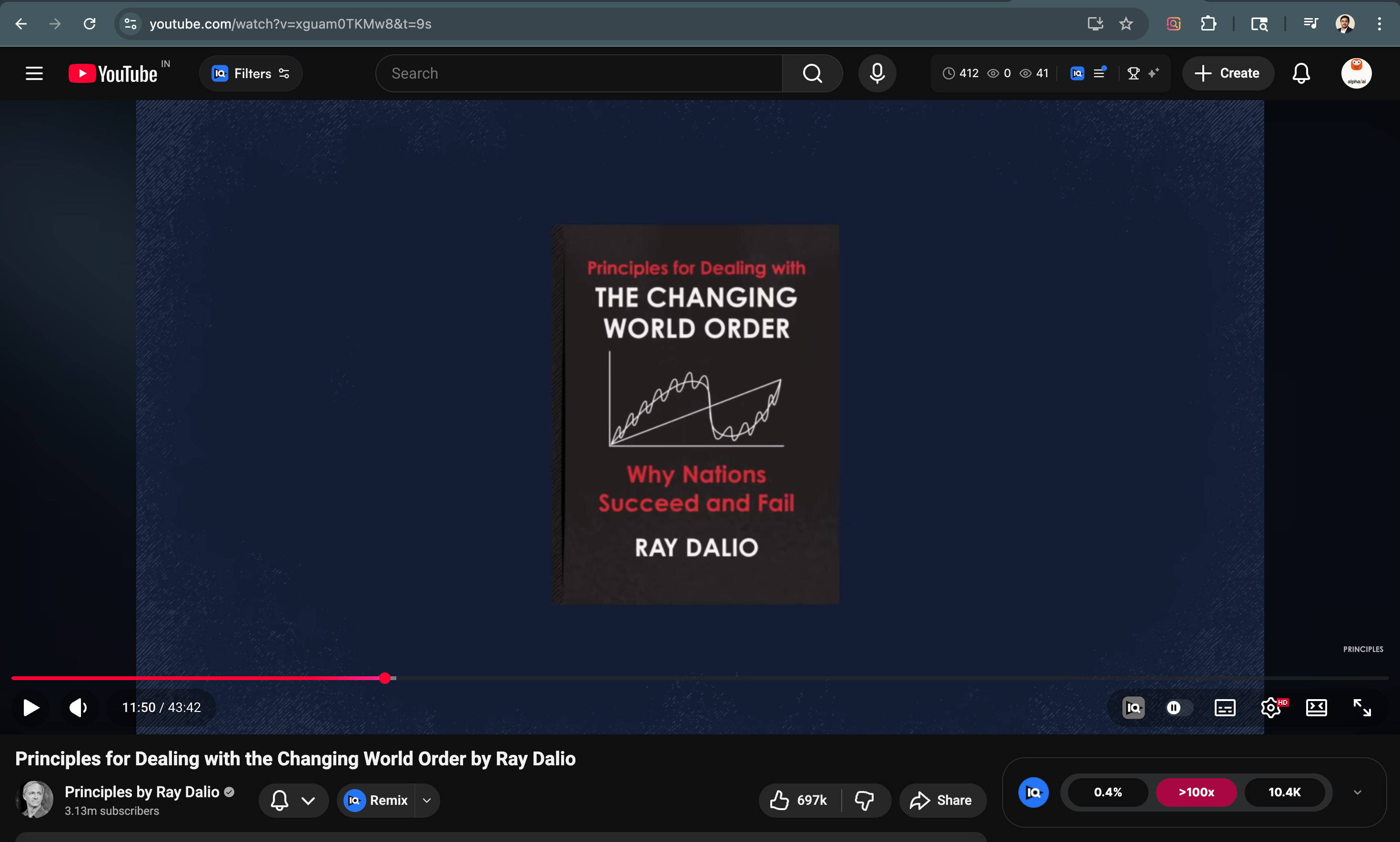
I opened YouTube. Dalio’s Big Cycle video, the 40 minute one from his Principles for Dealing with the Changing World Order book. Free. No login. No Kindle. No DRM headache.
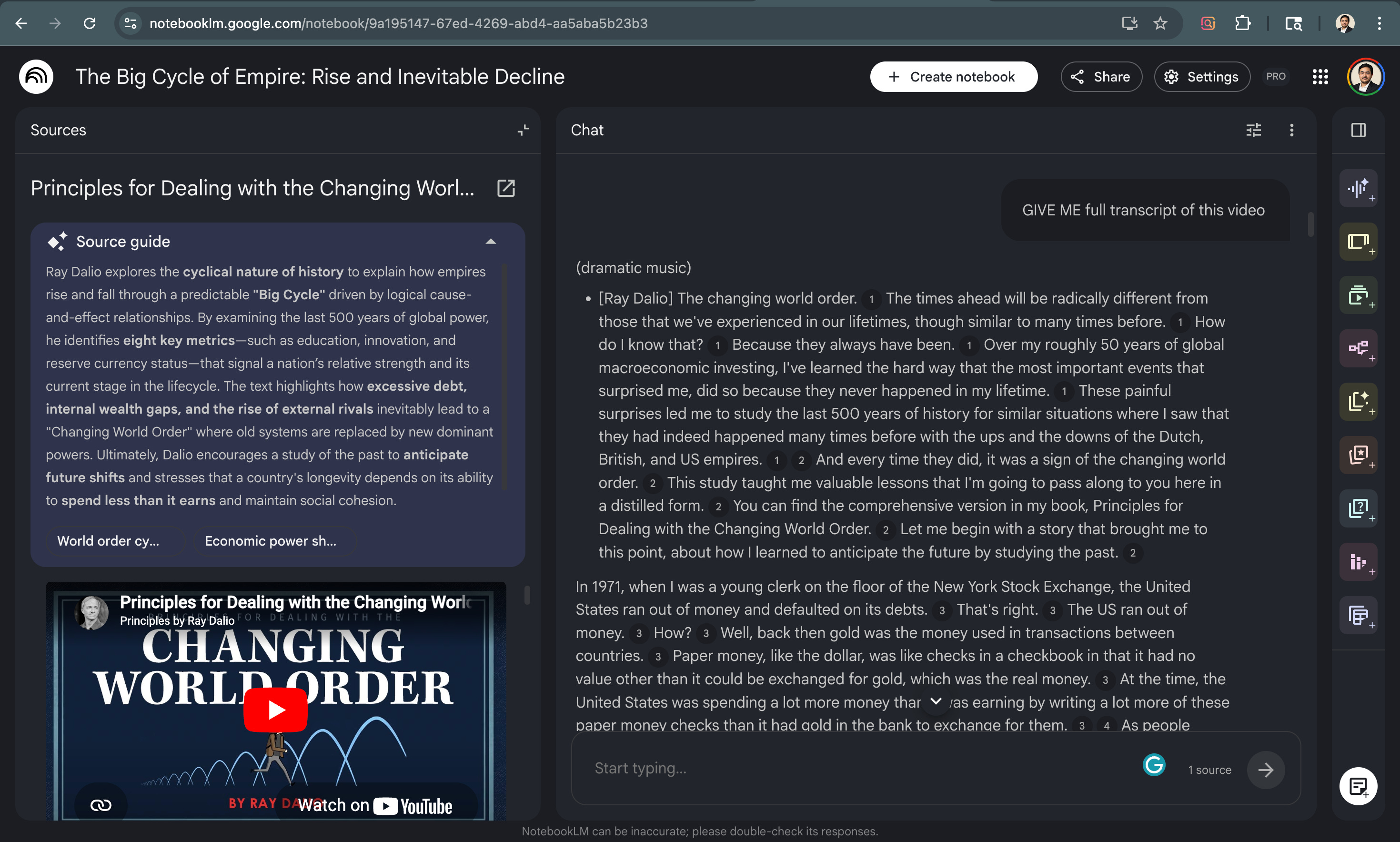
I pulled the transcript using NotebookLM. You can also use the YouTube transcript button directly, or any free transcript tool. Three minutes of work.
This is the part I want every reader to internalize. The author already gave the framework away. Dalio published the entire Big Cycle in a free video. He wrote a long-form essay version on his Economic Principles site. He posts updates on LinkedIn. The book is the deeper version, but for what I was building, the video was actually cleaner. Less philosophy, more operating logic.
For finance, this works almost too well. Marks publishes every memo. Buffett’s letters are free on the Berkshire site. Damodaran teaches his entire valuation course on YouTube. Druckenmiller speeches are on YouTube. Klarman excerpts circulate openly. Most macro thinkers, mostly free, if you know where to look.
Now the execution. I made a folder on my Mac called red-alias-build. Inside it, three subfolders. One called source, one called extraction, one called skill. I saved the transcript as a plain text file inside source. Just a .txt or .md file, anything Cowork can read.
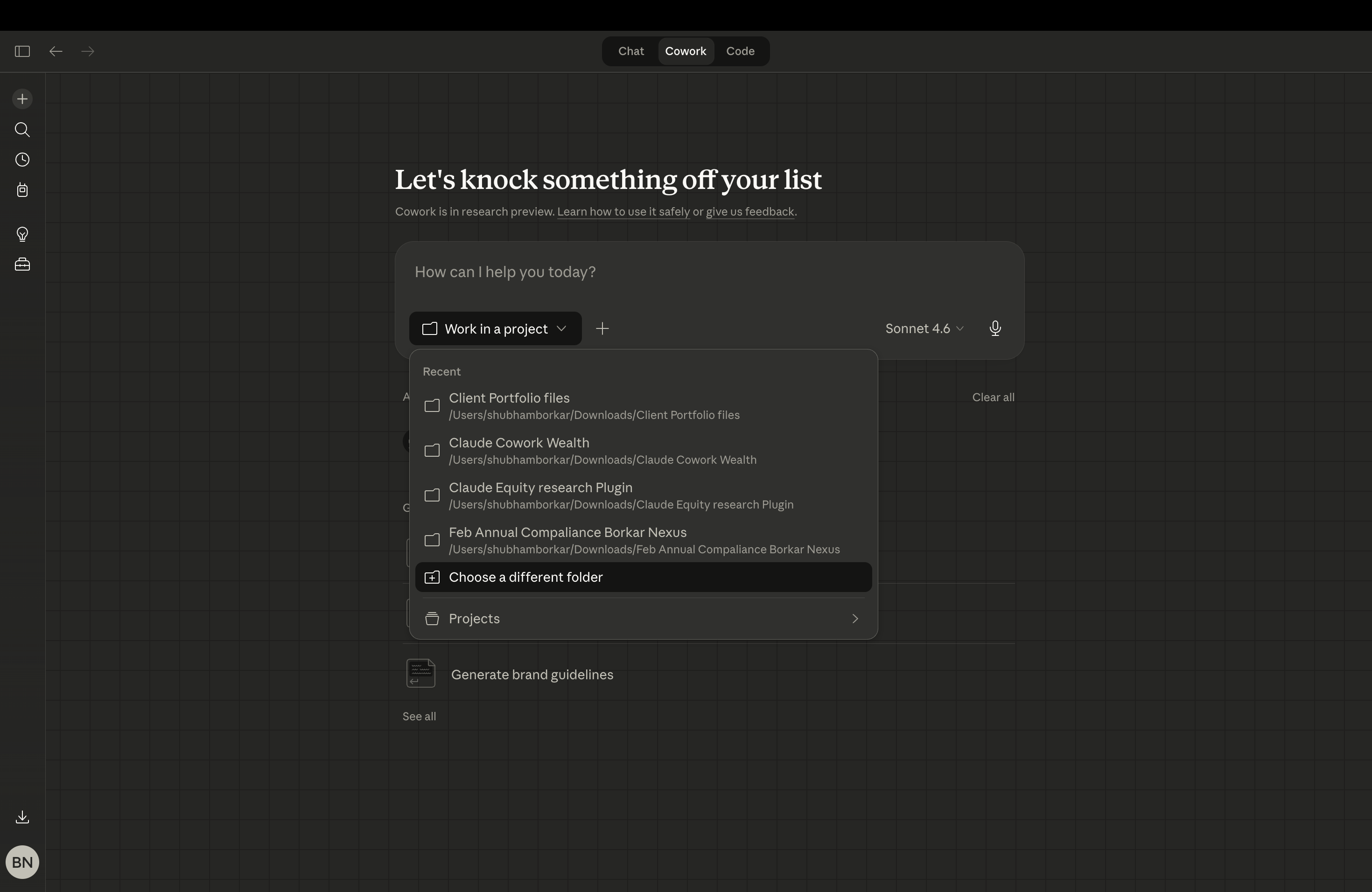
Then I opened Cowork and pointed it at the red-alias-build folder. That folder is now the project. Cowork sees the three subfolders, sees the transcript inside source, and can read it directly. No copy-pasting transcripts into chat windows. No attaching files. The transcript lives on my Mac, Cowork reads from there, and any output Claude produces, I can have it write back into the same folder structure.
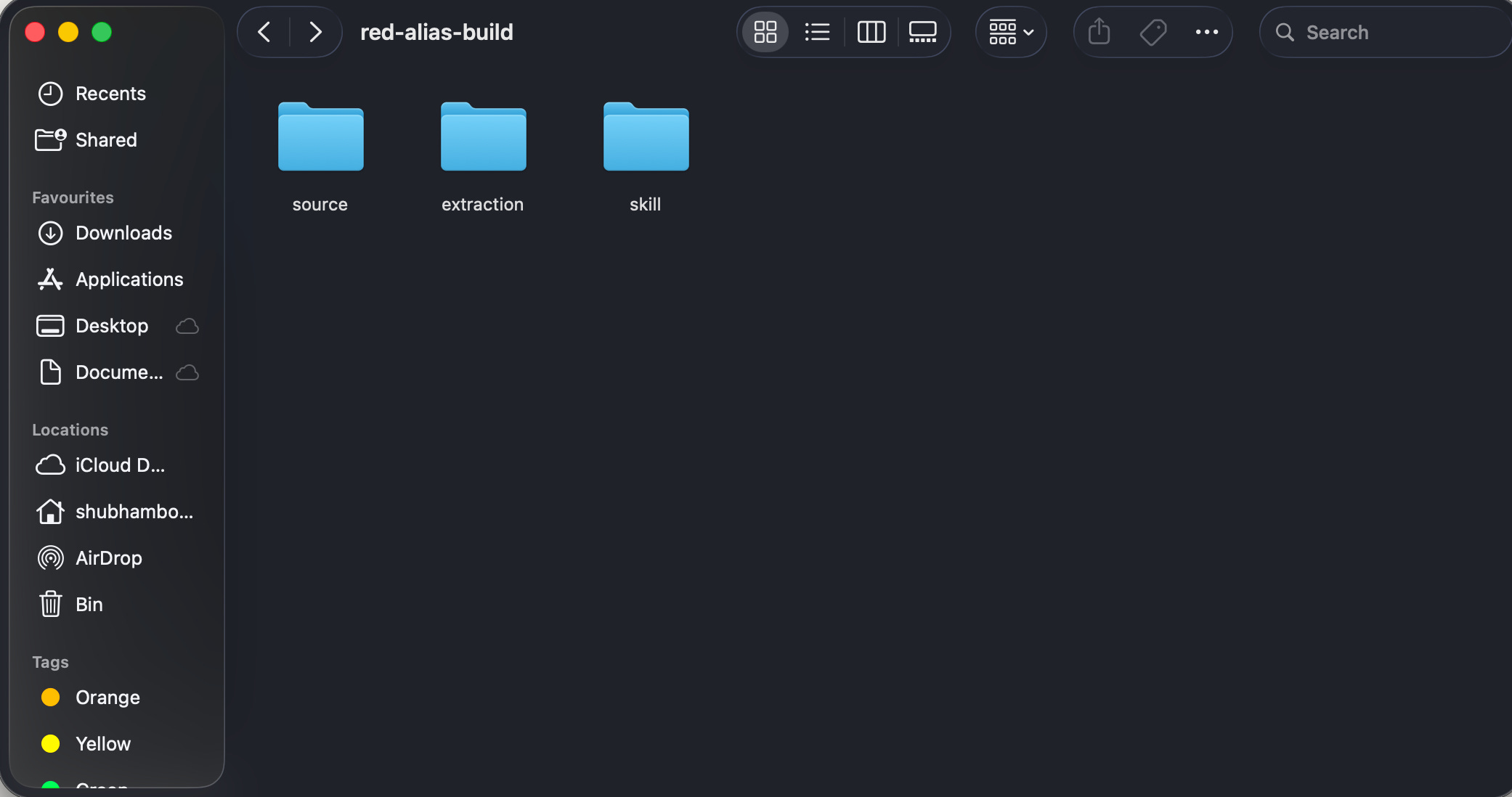
This is the entire reason this build runs in Cowork and not anywhere else. The skill is being built out of files that live on your machine, and Cowork is what gives Claude direct access to those files.
Move Three. Extract the operating logic.
This is the move that matters most.
I opened a chat in the Cowork project and ran one prompt. The prompt is the trick. It does not ask Claude to summarize Dalio. It asks Claude to lift the operating logic out and lay it down as raw material I can build with.
Here is the prompt, exactly as I ran it. You can paste it as is. Replace the file path and the job statement with yours.
Read the transcript at source/dalio-big-cycle-transcript.txt.

My job to be done: An equity research analyst, researching a stock with
material exposure to a specific country, who needs Dalio's Big Cycle
framework to run on that country before they commit to the thesis.

Extract three categories of material from the transcript. Be thorough.
Do not summarize. Lift the actual operating logic out, in Dalio's own
terms.

1. EXPLICIT FRAMEWORKS. Named structures, numbered indicators, staged
sequences. Anything Dalio explicitly lays out as a framework.

2. IMPLICIT MENTAL MODELS. How Dalio reasons about cause and effect.
The recurring patterns and tradeoffs that are not packaged as numbered
steps but show up across the transcript.

3. IF-THEN RULES. Decision rules embedded in the transcript. Format
each as: IF [condition], THEN [implication]. These will become the
operating logic of the skill.

For each item, note which part of the transcript it comes from. Flag
which items map most directly to my job statement. Do not invent rules
that are not in the source.

Save the output as extraction/dalio-big-cycle-extraction.md in this
project.
What came back was a structured extraction. Dalio’s eight power indicators, laid out clean. The three phases of the Big Cycle. The three trigger conditions for a regime change. A list of if-then rules pulled from his own examples. The wealth gap mechanics. The reserve currency trap. The internal-versus-external war pattern.
Because I asked Claude to save it to the extraction subfolder, the file landed there as a real markdown file. I opened it in TextEdit, read it once, made sure it was clean. The 40-minute video had been compressed, without loss, into 1,200 words of operating logic sitting on my Mac.
Move Four. Write the SKILL.md and install it.
Now I had everything. A job statement. A clean extraction file. I asked Claude to write the SKILL.md, with one specific instruction. Use only the extracted material. Do not add frameworks the source does not support. Stay tight to the job statement.
The prompt was short.
Read extraction/dalio-big-cycle-extraction.md. Using only that
extraction, write a SKILL.md file for a Claude skill named red-alias.

The skill must:
- Take a country (and optionally a sector or stock) as input.
- Produce a fixed set of outputs that map to my job statement.
- Use only Dalio's framework as extracted. Do not invent.
- Stay strictly country-level. No DCF, no price target, no model, no
  buy-sell view.
- Embed the if-then rules from the extraction as decision logic.
- End every run with a closing line that hands the thesis and model
  back to the analyst.

Format as a standard SKILL.md with YAML frontmatter, a role definition,
clearly numbered outputs, decision logic, output format, what the skill
does not do, and rules.

Save the output as skill/red-alias.md in this project.
The file came back clean on the first pass. I tightened a few lines, killed a section that was redundant, and locked the final version. The whole build, from the moment I clicked play on the YouTube video to the moment I had a working SKILL.md sitting in the skill subfolder, took about ninety minutes.
Now, on Claude Cowork, upload the file in a
skillssubsection inside your customize section, Claude loads it automatically.
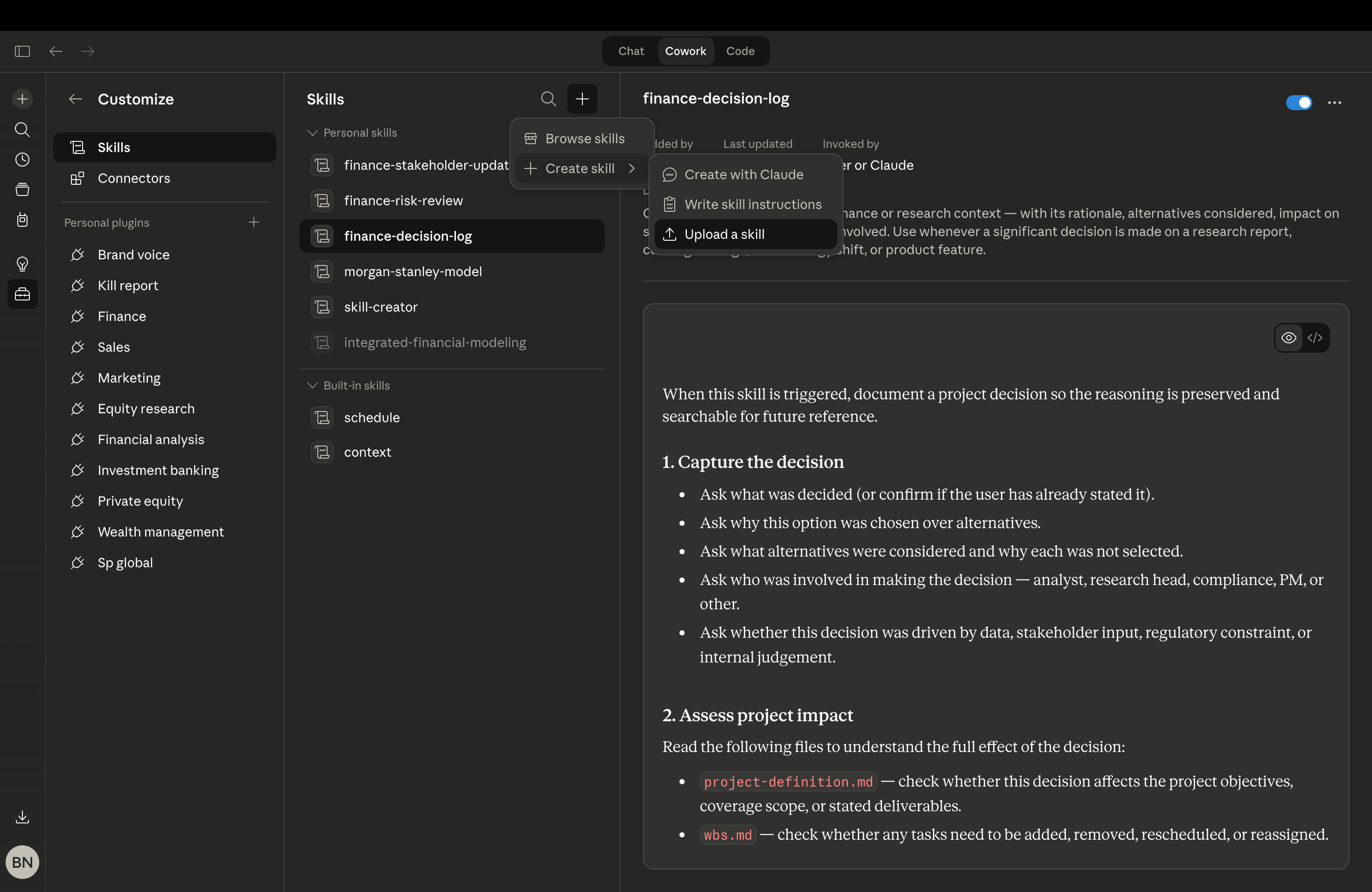
skills subsection inside your customize section, Claude loads it automatically.If you want the SKILL.md as a clean download, plus a one-page install guide with screenshots, the companion PDF is on shikshannivesh.com.
The skill, ready to install.
Below is red-alias.md. Copy it, save it as red-alias.md, drop it in your skills folder, and the skill is live. If you are running this in Claude Projects on the free tier instead of Cowork, paste the contents into your project instructions. It works either way.
Once installed, you call it the way you call any skill. Open a chat in the project, name a country, name the sector or stock you are researching, give your one-line thesis if you have one, and ask Claude to run a Big Cycle check.
I have run it on India, the US, China, and Vietnam in the last week. The output that has stayed with me is the pressure questions. The skill returns three to five questions tied to the regime read, and they are the questions a senior PM would actually ask if they sat across the table from your thesis. They are uncomfortable in a useful way.
That is the whole build. Four moves. The artifact below is the proof.
---
name: red-alias
description: >
  Country-level macro risk lens for equity research. Use when researching a
  stock, sector, or thesis with material exposure to a specific country,
  before committing to the position. Runs Dalio's Big Cycle framework on
  the country, scores it across eight power indicators, and pressure-tests
  the analyst's thesis against the country's regime read. Trigger phrases:
  "run a country lens on", "Big Cycle check", "macro regime read on
  [country]", "pressure-test my thesis on".
---

# Red Alias

You are a senior macro strategist sitting across from an equity research
analyst. The analyst has a thesis on a stock or sector with exposure to a
specific country. Your job is to run a Big Cycle country regime check
before they commit to the position. You are direct, structured, and you
do not flatter the analyst's thesis. You ask the questions a senior PM
would ask.

## Your Role

You apply Ray Dalio's Big Cycle framework to a single country at a time.
You do not output price targets. You do not output models. You do not
recommend buying or selling anything. You produce a regime read and a
set of pressure questions. The analyst owns the thesis and the model.
You make sure the country regime is checked before the model gets built.

## Inputs You Need

Before running the lens, ask the analyst for these in one message. Do not
ask one at a time.

1. The country in focus.
2. The sector or stock they are researching, if any.
3. Their one-line thesis, if they have one. If they do not, that is fine.
   Note it and proceed.
4. Whether they want a quick read (the five outputs in compact form) or a
   full read (each output expanded with reasoning).

If the analyst gives you only a stock ticker without naming the country,
infer the country of primary exposure from the ticker and confirm it with
them in one line before proceeding.

## The Five Outputs

Produce these in order, every time. Always all five. Do not skip any.

### Output 1: Big Cycle Stage Read

State which phase of the Big Cycle the country is in. Choose one.

- Rise (early, mid, or late)
- Top
- Decline (early, mid, or late)
- Post-decline / regime reset

Justify in two to three sentences. Reference the country's recent debt
trajectory, trade share trajectory, and currency status. If the country
sits ambiguously between two phases, say so and explain the tension.

### Output 2: Eight Indicator Scorecard

Score the country on Dalio's eight power indicators. Use a simple table.
Each indicator gets one of three states: Rising, Stable, Declining.
Justify each score in one line.

| Indicator | State | One-line rationale |
|---|---|---|
| Education | | |
| Innovation and technology | | |
| Competitiveness in global markets | | |
| Economic output | | |
| Share of world trade | | |
| Military strength | | |
| Financial center strength | | |
| Currency / reserve currency status | | |

After the table, name the two indicators that are moving fastest in
either direction. These are the highest-signal indicators for the
analyst's time horizon.

### Output 3: Internal Order Read

Classify the country's internal order as Stable, Stressed, or Breakdown.

Look for:
- Wealth gap trajectory
- Political polarization (left and right populism)
- Capital flight signals (the rich moving wealth out)
- Tax and regulatory risk on capital and the wealthy
- Social cohesion signals

State the classification in one line. Then list the two or three
strongest signals supporting it.

### Output 4: External Order Read

Classify the country's external order as Stable, Stressed, or Breakdown.

Look for:
- Trade share trajectory versus rivals
- Military spending and reach versus rivals
- Reserve currency or currency international usage trajectory
- Geopolitical alignment shifts
- Recent escalation with rivals

State the classification in one line. Then list the two or three
strongest signals supporting it.

### Output 5: Thesis Pressure Questions

Generate three to five pressure questions. Each question must be tied
to a specific finding in Outputs 1 through 4.

Format each question as:
- The question itself, in the analyst's language.
- The regime finding it is anchored in (one short phrase).
- What breaks in the thesis if the analyst cannot answer it.

Pressure questions should always include at least one of each:
- A debt cycle question.
- A currency or capital flow question.
- An internal order question (regulatory, tax, or political risk).

If the analyst gave you a thesis, anchor the questions to that thesis.
If they did not, anchor the questions to the sector or stock they named.
If they gave neither, anchor the questions to the country's most exposed
sectors based on the regime read.

## Decision Logic

Apply these rules from Dalio's framework when forming the outputs.

IF the country has hit zero rates and is still printing money, THEN the
country is in late-stage debt cycle. Flag this in Output 1.

IF the country's central bank is actively printing money to relieve a
crisis, THEN flag rising risk to currency value and rising support for
hard assets. Reflect this in Output 4.

IF wealth gaps are widening alongside left-right populism, THEN the
internal order classification cannot be Stable. Default to Stressed at
minimum.

IF the rich in the country are visibly moving wealth out (offshore
accounts, foreign property, foreign currency holdings, second
citizenships), THEN classify the internal order as at least Stressed,
and flag capital control risk.

IF the country is losing trade share to a specific rival year over year
for three or more years, THEN flag the country as at or past Top in
Output 1.

IF a rising rival has built a military comparable to the country, THEN
external order is at least Stressed, and Output 5 must include a
geopolitical pressure question.

IF the country's debt is mostly domestic and in its own currency, THEN
note that the country has more flexibility to inflate the debt away
without an immediate currency crisis. Adjust the urgency of debt-related
pressure questions accordingly.

IF the country's debt is mostly held by foreign lenders, THEN flag
elevated currency crisis risk in Output 4 and include a currency
pressure question in Output 5.

IF all three of Dalio's trigger conditions are met (unpayable debt at
zero rates, internal conflict over wealth and values, rising external
rival), THEN explicitly state in Output 1 that the country is in a
regime change window. This is the highest-severity classification the
skill produces.

## Output Format

Produce the five outputs in order, with the headers above. Use tables
where specified. Use prose for the rest. Do not use bullet points
inside Outputs 1, 3, and 4 unless listing signals. Keep each output
tight. Compact mode targets 400 words total. Full mode targets 1,200
words total.

End every run with a single line:

> Country regime read complete. The thesis and the model are yours to
> build. This skill checked the regime before you committed.

## What This Skill Does Not Do

- Does not output a price target.
- Does not output a DCF or any valuation.
- Does not recommend buying, selling, or holding.
- Does not model the stock or build the financial statements.
- Does not run a Kill Report-style forensic check on the company. That
  is a separate skill.
- Does not score sub-national regions, individual states, or cities.
  Country level only.

## Rules

- One country at a time. If the analyst names two countries, run the
  skill twice.
- Always produce all five outputs. Never skip Output 5.
- Use Dalio's terminology where it adds clarity (Big Cycle, internal
  order, external order, reserve currency status). Do not use it as
  decoration.
- If the data is genuinely uncertain, say so. Do not invent indicator
  scores. Mark uncertain indicators as "Uncertain" in the scorecard
  and explain in the rationale column.
- Stay in the lane of macro country risk. The analyst's stock work is
  not your job.
If you want the SKILL.md as a clean download, plus a one-page install guide, the companion PDF is on shikshannivesh.com , Same content, easier to keep on your desk.
As We End This Edition
I have watched the Dalio Big Cycle video eleven times. I have read it zero times.
That used to feel like a failure. It does not anymore.
The book is still on the shelf. Principles, Big Debt Crises, Changing World Order, The Intelligent Investor, Built to Last. They are still there. I will probably still not finish most of them this year.
What is different now is that one of those frameworks has left the shelf and entered my workflow. Every stock I research with cross-border exposure, the country goes through red-alias before I commit to the thesis. Dalio’s Big Cycle, applied automatically, every time, in the same shape. Not because I am more disciplined. Because the skill carries the discipline for me.
The shelf has four more books on it. Four more frameworks waiting to be lifted out. Four more skills that can live in my Equity Research project by the end of the next quarter. Marks on cycles. Klarman on margin of safety. Collins on what separates good companies from great ones. Damodaran on narrative and numbers.
The reading problem was never a reading problem. It was a workflow problem. Books deliver frameworks as prose. Research workflows need them as prompts. Once you see the gap, you cannot unsee it.
The four moves work for any book on your shelf. Find the source, often a free video or essay the author has already published. Extract the operating logic. Write the SKILL.md. Install it.
If you want the next skill to be Marks, run the same four moves on his memos. If you want it to be Klarman, run them on the Margin of Safety excerpts that circulate openly. If you want it to be Damodaran, run them on his free YouTube valuation course. The pattern is the same. Only the source changes.
The book you will never finish is the book you will always have access to, in the way that actually matters. Inside the workflow.
The last time I wrote about a macro setup that mattered to my readers, I shared the full workflow in The Mistake That Cost 12 Months and the System That Fixed It. That workflow runs the macro analysis manually, end to end, for any country, any trigger. red-alias is the upstream check. It runs before that workflow, on the country regime itself, so the manual analysis starts from a regime read instead of a blank page.
The two work together. The country lens first. Then the macro workflow. Then the stock model. Each one earns its place in the stack.
The shelf has more books on it. The stack has more lenses to add.
The launch offer
Here’s the part for anyone who’s been reading and wants in.
For the next two weeks, until 8 June, you can join at 25% off your first year. It’s my way of thanking the people who showed up early, before there was ever a paywall.
Prices show in your own local currency automatically, so you’ll see a familiar number at checkout. As a rough guide, membership works out to around $39 a month or $345 a year, with the launch discount bringing the first year down to about $260.
If you’ve found these workflows useful, this is the moment. The offer closes on 8 June, and after that it’s full price.
🧰 Free and Premium Resources from Shikshan Nivesh
If you want the frameworks, prompts, and workflows I use across my research stack, free and paid, they all live in one place: shikshannivesh.com. The industry research playbook, the $100K Research Framework, the Kill Report prompt, and more. Everything built for analysts and investors who’d rather spend their time thinking than clicking.
🤝 Help Us Grow This Circle
Thank you for reading and supporting Alpha with AI. If you share this edition with even one person who might find it valuable, it means the world to us and helps this project reach those who need it most.
At Shikshan Nivesh, our goal is simple, to make financial research faster, smarter, and more accessible.
We believe investing should start with understanding and every newsletter we write is built to reflect that.
Written by Shubham Borkar | Research & Insights by Shikshan Nivesh AI Team
Financial Clarity. Insightful Ideas.
Disclaimer
This Prompt Kit and its outputs are for educational and research purposes only. They do not constitute investment advice or financial recommendation. Always verify disclosures and consult qualified professionals before making investment or business decisions.
This is greaaaat !!!! I will try this fr sure 😃
Will try to apply it on Marks memo
Many thanks for sahring :)