


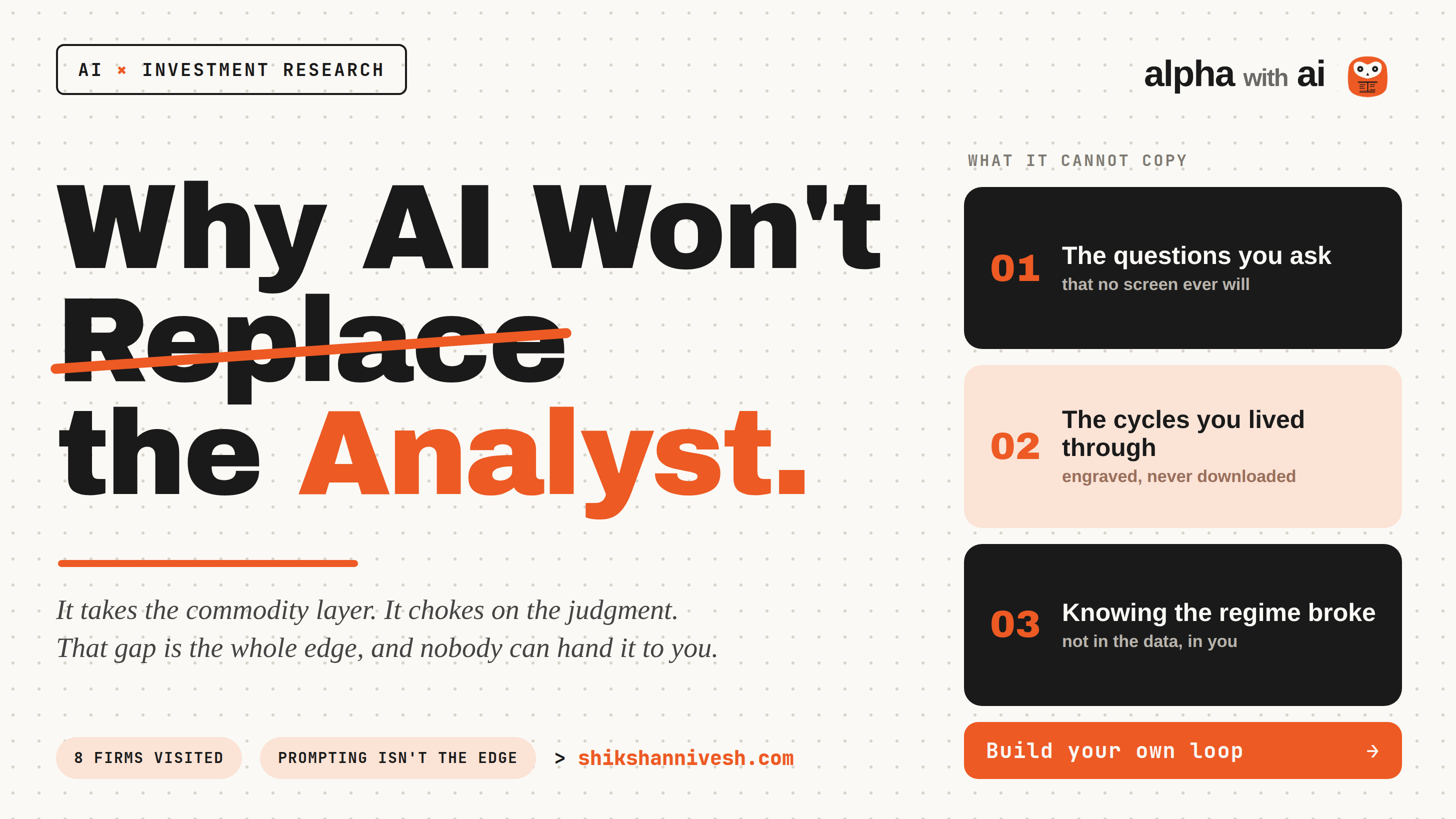
I have never written an opinion piece here. Not once. Every edition is a workflow you can copy and a repo you can tear apart line by line.
So when I break that rule, it is worth asking why.
I broke it because of the last twelve days, and because of a word the whole timeline has suddenly fallen in love with. Loop engineering. Prompting is dead, they say, the real skill now is the loop. I will come back to that word, because the people repeating it loudest are missing what it is actually for. Hold it in your head for now.
I spent the last twelve days inside eight investment firms and family offices. They invited me in, one after another, to see what a finance person actually does with AI. Real desks. People moving real money. I went into each room expecting to walk out with something to learn.
In all eight, I saw the same thing instead.
And it had almost nothing to do with prompts, or loops, or whatever the timeline is selling this week. It had everything to do with why almost all of that noise, prompting is dead, the labs are coming for your tools, hurry up and clone the right framework, is pointing you at the wrong target.
Let me take you into the rooms.
Quick context before we go in. I am a finance person who builds AI research workflows for investors, the practitioner kind, tested on real filings and real decisions, not the theory kind. I publish them here so you can copy them.
The Prototypes Were Already Gathering Dust
The first thing I noticed was how similar the eight rooms were.
Not the offices. The offices were nothing alike. Some were glass towers, some were quiet family setups with a few people and a great deal of money sitting behind them. What was identical was the AI.
Everywhere, it was doing the same two jobs. Summaries and slides. Feed it a long report, get back a shorter one. Feed it last quarter’s numbers, get back a cleaner pitch deck. A few people had a handful of prompts they were proud of, pulled out like party tricks. That was the ceiling. Useful, real, and about two inches deep.
Then there were the prototypes.
Almost every firm had one. Not built by them. Nobody on these desks writes software. At some point someone had gotten excited, found the budget, and brought in an outside engineer or an AI person to build the thing. A screening tool. A research dashboard. An internal assistant that was going to change how the whole team worked.
And in every case the thing was sitting there, open in a tab nobody clicked, gathering dust. The software worked. It ran. It did exactly what it had been told to do. It just did not do what these people actually do all day, and so nobody touched it.
I would ask about them, and the answer kept arriving in the same shape. *It is close. It is just not how we actually do it.*
That was the tell. The prototype was not bad. In most cases it was genuinely good. They had tried to pour their own framework into it, the way they actually screen, weigh, and decide, and somewhere between what they said and what the builder understood, it got lost in translation. What came back worked. It ran. It impressed everyone for a week. But it never became the thing they reached for when a real decision was on the table, and a tool that does not touch the actual decision is a fancy monument. It sits on the shelf and gathers dust.
Underneath all of it was a posture I started to recognize halfway through the second visit. Everyone was watching everyone else. Nobody wanted to go first. They had all heard the tools change every three months, so they were waiting, scouting, holding position, hoping someone down the street would prove it worked before they risked their own desk on it. The enthusiasm was real. The movement was zero.
And the people who wanted it most, the ones who pulled me aside with their eyes lit up, asking how to actually do this, were somehow the most stuck of all.
That part bothered me more than the dust. Because the dust already had an explanation, and it was sitting in the gap between the people who knew the work and the person who built the tool.
It Was Never an Engineering Problem
Sit with that gap for a second, because it is the whole thing.
On one side stood someone who could build software but had never sat in the chair. They had never carried a position overnight, never had to defend a number to a person who could lose money on it, never felt the difference between a screen that looks right and a screen you would actually act on. On the other side stood the investor who knew all of that in their bones and could not get it out in a form that survived the handoff.
And here is the part almost nobody sees. The investor was not being lazy or vague. The knowledge that runs a real desk is the hardest kind to put into words. A good analyst does not fully know their own process. Half of it is judgment they have never once had to explain, because they have never needed to. They just do it. Ask them to write it all down for a stranger to rebuild, and most of it does not come out. So the builder built from the half that could be spoken, and the half that actually mattered stayed in the investor’s head. That is the translation gap. Not a bad engineer. Not a bad investor. A thing that does not move cleanly from one person to the other.
Now watch what every firm reaches for next. A better engineer. A more senior AI person. More budget on the technical side. It feels right and it never works, because you cannot out-engineer a translation problem. The missing piece was never engineering. Pour ten times the technical skill into the same gap and all you get is a more impressive monument gathering the same dust.
The only thing that closes it is both understandings living inside one head. Someone who knows the work and can build the loop themselves, so there is no handoff for the judgment to die in.
That person barely exists yet. Not the engineer who picked up a little finance along the way. The investor who learned to build. It is going to be one of the most valuable seats in this business over the next few years, and I will come back to why, and what it means for you, before this letter is done.
One honest caveat before I go further. Eight firms is what I saw, not a survey. I am not claiming this is every desk in the country. But it was eight out of eight, and the pattern was identical enough that I stopped expecting the ninth to be different.
You Have Been Asking Me for Something You Already Own
Which brings me back to the word I told you to hold.
Loop engineering. Strip away the breathless part and here is all it means. The machine does a step. It checks its own work. It throws out what fails the check. It comes back to you only when something is actually worth your time. Discover, verify, filter, repeat, with a gate at every handoff and a point where it stops. That is the whole idea. It is old. The label is new. Treating it like it arrived last week is how you end up paying a premium for something you could have built quietly months ago.
Now go back to those eight rooms with this in your hand. The reason none of those prototypes were loops is the same reason they gathered dust. A tool just runs. A loop decides. And a loop can only decide well when the person who knows what counts as a real signal, and what is noise to be thrown away, is the one wiring the checks. An outside builder cannot wire judgment they do not carry. So the firms got tools that run. Not loops that decide. The deciding part never made it across the gap.
Here is the uncomfortable part, and this one is aimed at the people in my own inbox.
You have watched me work this way for months. Whatever tool happened to be in front of me, the shape was always the same. [The screen that reads the filings, throws out the noise, and hands me the names actually worth reading]. [The vault that holds everything I have ever read, so nothing leaks and the research compounds instead of scattering]. None of it was a one-off trick. It was the same loop, over and over, long before anyone bothered to give it a name. I never called it loop engineering because it did not need one.
So when readers message me asking me to build them a loop engineering research workflow, I am not quite sure how to answer. It is already in the archive. You are asking me for something you already own.
Which leaves the only question that actually matters. If the loop is not the hard part, and the tool is not the edge, and the prompt everyone is now declaring dead was never the thing carrying the weight, then what is. That is the rest of this letter.
If the argument so far made something click, tap the ♡ like. It is a small thing, but it genuinely tells Substack to put this in front of more investors who think this way, and that is the whole reason I can keep writing these.
A Perfect Buffett Prompt Still Fails in Your Hands
Let me make the other side’s case first, because it is stronger than most people admit.
AI is going to eat the commodity layer of this work, all of it. The summaries. The screens. The extraction. Reading a three-hundred-page filing in a minute. Pulling a debt schedule, computing a fifty-year ratio, lining up ten comparables before you have finished your coffee. That is real, it is already here, and it is most of what those eight firms were using it for. Anyone who tells you AI will not flatten that layer is selling you something.
And the labs are not stopping at the inputs. They are now shipping the judgment layer too, or trying to. Pre-built financial-services agent templates aimed at banks, insurers and asset managers. Managed deployments inside the big consulting firms. The pitch is that you will not even need to build the loop, because a polished one will arrive in a box with your logo on it. So the honest version of the bear case is not just that the easy part gets commoditized. It is that the hard part is next.
Here is why I still think it is wrong.
Mohnish Pabrai built his entire public reputation on cloning. Copy the best investors, feel no shame about it, the idea does not have to be yours. He says it openly. And then, in the same breath, he draws a line most people skip right past. Once you see the idea, he says, you do all your own work, your own research, you make sure it is something you understand, you make sure it sits inside your circle of competence. Read that again. The most quotable champion of copying on earth is telling you the idea clones, and the work does not. You can lift the what. You cannot lift the who.
That is the whole thing. A perfect Buffett prompt is a cloned idea. Hand it to me and it does not become Buffett’s judgment, it becomes a very confident set of instructions pointed at a circle of competence I do not have. I wrote this once and I still believe it. Borrowing someone else’s investment skill is like wearing someone else’s prescription glasses. For two minutes you feel sophisticated. Then you realise you cannot see properly.
I have said this another way before, and I will say it again here because it is the hinge of the whole argument. Two successful investors can agree on eighty percent of the principles and still work completely differently, because the way they extract information, the way they connect dots, the questions they keep asking and the things they choose to ignore are never the same. You cannot inherit that from a zip file.
So when the labs ship you a research agent in a box, you are buying a cloned idea with a logo on it. It will be good. It will be fast. It will do the commodity layer beautifully. And it will work for everyone who buys it identically, which is exactly why it cannot be anyone’s edge. The moment a framework is packaged and handed out, its edge expires.
A quant I read said it cleanly: borrowed approaches expire when everyone else adopts them. The generative thing, the part that keeps producing new angles, is the part that was never in the box.
There is a second way frameworks fail, and it is quieter, because it is not about people at all. It is about time.
You have heard someone say the gold-to-silver ratio is high, so silver is cheap, sell when it reverts. They will hand you fifty years of data to prove it. But fifty years ago silver was mostly a monetary metal. What industrial demand it had ran through photographic film, and then digital cameras quietly erased most of that overnight. Today the demand has come back in a completely different form, wired into solar panels and electronics and EVs at a scale that did not exist when the ratio was first worshipped. The number still computes. It is just quietly measuring a thing that no longer exists in the same form. And I want to be careful here, because the failure is not using history. History gives you base rates and cycles, and the best investors lean on them hard. I lean on them so hard that when I built [my framework for researching any industry from scratch], the very first pillar, before growth, before unit economics, before a single number, was simply this:
how did we get here. The origin. You cannot read an industry until you understand the forces that shaped it. So history is not the enemy.
The failure is making it the final step. A fifty-year backtest is a cloned past, and the world it was cloned from changed underneath it while no one was looking.
Notice that AI is brilliant at exactly this layer. It will pull the fifty years and compute the ratio in seconds. Which is the entire point. If the machine can clone the past instantly, then the past was never the edge either. The edge is knowing when the regime broke. That is not in the data, and it is not in the prompt. It is in you.
So both clones fail the same way. The Buffett prompt is a framework that does not transfer across people. The gold-silver ratio is a framework that does not transfer across time. AI makes both clones free, and free is the tell. The thing it cannot copy, the judgment about which idea is real, which number still means what it used to, what to throw away, is the only thing left that was ever worth anything.
Which raises the obvious question. If you cannot buy the edge, and you cannot download it, and you cannot inherit it from a zip file, then where does it actually come from, and what are you supposed to do about it.
That is the part I have been building toward this whole time.
Build the Loop Around Yourself
So where does it come from.
It comes from the one place nobody can ship you. The work you have already done, the cycles you have already sat through, the questions you cannot stop asking, the things you instinctively ignore. Everything that got engraved into you slowly, over years, while you were not trying to turn it into a product. That is the circle of competence Pabrai was pointing at. It is not downloadable because it was never written down. It only exists as you.
The mistake almost everyone makes from here is to go looking for a better framework to copy. A sharper prompt. A more complete skill. Someone else’s system that finally works. I have watched smart people lose a year to this, hunting for the perfect borrowed process, and it never arrives, because the thing they are missing was never going to come from outside.
I have said this before, and I will keep saying it. A skill will not make you a better investor. Building your own, badly, watching it fail on a real thesis, and fixing it run by run, just might. Not because the file is valuable. Because by the third version, the clearest thing in the room is not the skill. It is your own process, finally written down where you can see it.
That is the real reason to build your own loop. Not because the loop is magic. Because building it is the only thing that forces the engraved, unspoken half of your judgment out of your head and into something you can run. The loop is just the excuse. You are the output.
And this is where the eight rooms come all the way back. The reason those prototypes gathered dust was that someone tried to write down a process they did not own. You will never have that problem with your own. You are not translating across a gap. There is no gap. The person who knows the work and the person building the loop are the same person, sitting in the same chair. Nothing gets lost, because nothing has to move.
That is the seat I told you we would come back to. It barely exists today. The investor who learned to build, who can take the judgment that lives only in their head and wire it into a loop that runs while they sleep. Not the engineer who studied some finance. The other direction. And I think over the next few years it becomes one of the most valuable profiles in this entire business, because it is the one profile that cannot be handed to anyone else.
Let me kill the obvious objection, because someone at one of those eight firms will raise it. The labs are coming for this too, they will say. They are already shipping research agents in a box, managed deployments, templates with your logo on them. Will they not just commoditize the build-your-own act as well.
No. They will commoditize the loop. They cannot commoditize what you point it at. A boxed agent is the most cloned idea of all, the same one sold to every firm on the street, which is exactly why none of them can build an edge on it. The lab can hand you a better engine every quarter. It cannot hand you the circle of competence to steer it. That part still has to be yours, and the better their engines get, the more the only scarce thing left is the judgment driving them.
There is one more reason this is worth starting now, and it is the part most people get backwards. The tools are not going to settle. They will get better every month, for years. Most people hear that and freeze, waiting for the dust to settle before they commit. But if the edge is the judgment you wrap around the loop, then a moving toolset is not a threat. It is leverage that compounds. Every upgrade makes your engraved judgment worth more, not less, because there is more horsepower behind the same irreplaceable hand on the wheel. The people waiting for it to stabilize are waiting for the one thing that gives them an advantage to disappear.
So stop hunting for someone else’s framework. Build your own loop, badly, around the one thing you already have that nobody can clone. Then let the tools race. You are the part that does not expire.
Know someone who keeps hunting for the perfect borrowed framework instead of building their own? This was written for them. Send it over.
Enough Opinion. Here Is the Proof.
I have argued this long enough.
And argument is not what you come here for. You come here to watch the thing get built, then tear it apart yourself. So I am going to stop talking about loops and judgment and go do the only thing that has ever made this case for me. Build them in front of you.
This is the start of a series. Not a content calendar, a proof. Each edition is me taking some piece of judgment that lives only in my head and wiring it into a loop you can watch run, end to end, mistakes left in. You do not have to believe a word of the argument above. Watch me build, and decide for yourself whether the engraved part actually survives the trip into the machine.
Three are coming.
First, the insider signal your data feed deletes before you ever see it. Not the open-market buys everyone tracks. The quiet election, buried in a single Form 4 footnote, where a director quietly swaps guaranteed cash for stock. No vendor surfaces it. I will show you the loop that finds it, throws out the fakes that fool a naive screen, and hands back only the few worth a second look. Then I will tell you what those names did.
Second, Obsidian as the brain that any model can plug into. Not Claude only. Whatever runs best next month. The library sits still while the model behind it changes, and I will show you why the brain, not the model, is the part that compounds.
Third, the full loop engineering setup for investment research, start to finish. The thing readers keep asking me to build for them. The whole loop, in one place, so you can stop asking and start building your own.
I cannot hand you my loop. You already know that is the whole point. But I can build mine in the open, one edition at a time, and show you exactly where the judgment goes in. The rest is yours to engrave.
A note for anyone getting real value from these. Each edition is days of building, testing, and writing down a process that mostly lived in my head. Some of it I will always publish in the open. The full builds, the deeper work, and the deep dives that are coming live behind the paid tier. Going paid is how you back the work and get the part that goes further.
If you want to see where this all leads, three past editions are the spine of everything above:
The setup that started it: How I Set Up Claude Code as My Investment Research Analyst.
The memory layer that makes it compound: the Obsidian edition.
The first real workflow using claude code: Insider Trades Decoded.
Before I Close
A quick, honest word about where the ideas in this letter came from, because the whole argument is that nobody does this alone.
The view that your edge is the slowly engraved version of you, not the tool in your hand, I have been circling for months in this newsletter. But the sharpest writers I read keep saying it better than I do, and the quants thinking out loud about loops put words to a thing I was already doing without a name. I steal from people smarter than me. That is not a confession. It is the method. The only original part is what survives my own pass.
Which is exactly what is coming, beyond the three editions above.
I am also starting something I have wanted to do for a long time. Real deep dives, on real companies, mostly the small and micro caps nobody else is bothering to cover. The kind of approach you already know, because it is the one I keep teaching. I find an idea from an investor sharper than me, on X, in a newsletter, in the rooms where good investors talk. Then I do the part most people skip. I run it through my own forensic process, AI doing the heavy lifting in the middle, and I find out whether the idea actually survives.
Because here is the belief under all of it. AI is not going anywhere. The only question left is how you use it. Almost everyone is using it to replace their judgment, let the model pick the stock, let the model tell them what to think. That is the fast way to be wrong with confidence. I use it the other way. To amplify what I can already do, not to do it for me. The view at the end is mine. The machine just got me there faster.
Idea to verdict, the whole thing in the open, a couple of times a month. Including the ones that fail my check, because a killed idea is often the more useful read.
None of this replaces the workflows. The frameworks are not going anywhere. This is on top.
So that is the plan. Less of me arguing, more of me building, and now some of me actually putting it to work on live names. If you have been reading this far, you are exactly who I write for.
Would you read it? Tell me. And if a sharp investor or a desk you respect should see this, send it their way. That is the only way this circle grows.
Disclaimer: Alpha with AI covers US-listed and other global securities for educational and research purposes only. Nothing here is investment, legal, or tax advice. AI-assisted analysis can be wrong, and every figure worth acting on should be checked against the primary filing yourself. Always do your own work and consult a qualified professional before making any investment decision.
Written by Shubham Borkar | Research & Insights by Shikshan Nivesh AI Team
Financial Clarity. Insightful Ideas.